






Posted:
I know. From the bottom
And you are going to lose from the top😎
BHAI & FAMILY 10.12
CHACHI vs CUTEY 11.12

6 year leap promo : Tulsi-Mihir separation

BoI aka Harminder ka tune change start hogaya!!!!

🏏South Africa tour of India 2025: India vs SA - 2nd T20I🏏
Hrithik ‘praises’ Dhurandhar but he also disagrees with its politics
Alia Bhatt & Salman at the Red sea Festival
Film Critics Guild issues statement
Is Yrkkh in trouble?
Kritika Kamra Gaurav Kapur Confirm Relationship
Who is the most hated character
I hope pari sudhar nahi gayi ho!
Aditya Dhar and Yami paid to troll
Shah Rukh Khan new video launching Danube property

Happy Birthday champion: Gaurav Khanna

Should India Ban Social Media for Children Under 16 Like Australia?

December Reading Challenge & Christmas Reads- BT Page Log Thread
Paresh Rawal deletes his distasteful tweet on Anupama Chopra

Kasam Se Banta Rishta ~ Ssharad Malhotra x Shivani Tomar SS
Industry support for Dhurandhar (a compilation)
I know. From the bottom
And you are going to lose from the top😎
Disney queercoding their villains ...
https://www.instagram.com/p/Ce7S5BKqUSE/?igshid=YmMyMTA2M2Y=


WHY ARE YOU SO OBSESSED WITH US?
Article by Chris Murphy
Graphics from Mario Oscar Gabriele
Okay Disney… As a true Gay Icon once said, ‘why are you so obsessed with me?’ What is Disney’s obsession with the LGBTQ+ community. How come every villain is rooted in queer culture or inspired by real-life queer icons? As with all roots of homophobia it begins with rules made to discriminate against us, and we’re the villains?
QUEER CODING
What is ‘Queer-Coding.‘ No it is not queer folk who code, but rather queer coding is when writer’s, either consciously or subconsciously include negative stereotypes of queer people as characteristics of a particular character, particularly a villain. Well, what does this even mean sis?
Stereotypes used in male queer coding:
Stereotypes used in female queer coding:
HAYS CODE
Not to be confused with the ‘haaaaaaaaaaaaay code’, which is a fictional code that requires all queer folk to acknowledge each other in public with a raising of the eyebrow or several snaps, the Hays Code is less fabulous and much more sinister. The Hays Code, is a code from 1940s Hollywood that prevented the positive portrayal of LGBTQ+ characters on screen. The Hays Code is attributed to the popular use of negative queer stereotypes in media at the time which inspired further use of queer coding. To be clear, it is not about a character actually being ‘gay’ but it’s about using negative stereotypes around gay and queer people in villain roles.
TLDR; Hays Code made it so that all portrayals of LGBTQ+ people could not be positive, therefore: LGBTQ+ = Villains (the only math this gay can do!)
As Tannu rightly pointed : I was researching as part of the game, and found this: https://www.pride.com/movies/2022/3/10/not-just-queer-coded-these-disney-villains-were-designed-gay-man
And this is his blog: https://andreasdeja.blogspot.com/
I had no clue it was created by someone who identifies as part of the LGBTQ+ community.
🏳️🌈🌈🏳️🌈
I will survive by Gloria Gaynor
Kindly read all the posts on this page. ❤️
Proud by Heather Small
I'm coming out by Diane Ross
🏳️🌈🌈🏳️🌈
Gender-neutral pronouns are words that don't specify whether the subject of the sentence is female or male. 'They', for instance, is a third-person pronoun that is gender neutral. Other gender-neutral pronouns include 'them', 'this person', 'everyone', 'Ze', or 'Hir'. If you're not sure which pronoun to use, you can also use that person's name.
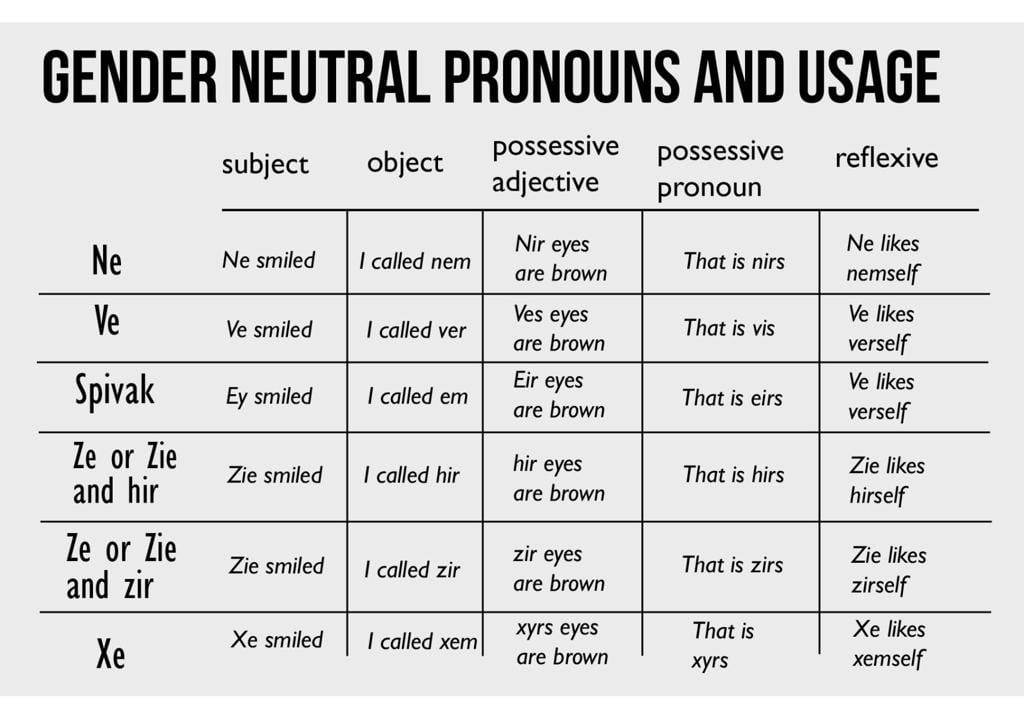
They/Them is used in both singular and plural form, be respectful of the pronouns people use. It's the bare minimum.
🏳️🌈🌈🏳️🌈
Kindly read all the posts on this page
https://twitter.com/lindzamer/status/1534557941248020481?s=20&t=3Df2HAt-G2-BbbEw6h3t8Q
Maurice Sendak, Arnold Lobel, James Marshall, Remy Charlip, and Tomie dePaola differ in just about every outward way, from the look and content of their books to the course of their lives and careers. But open the covers of those books and you’ll find tenderness, wit, and imagination as a common bond — qualities that they have in common with the unfettered young.
The AIDS epidemic, in the early 1980s, was painful for Sendak, as it was for other gay men, and like many of them, he became more open about his sexuality. Those agonizing times, emotional and political, had creative issue in We Are All in the Dumps with Jack and Guy (1993), a virtual mural of social protest, panel by panel. An echo of Dickens in the backwash of Ronald Reagan.
No age range is indicated on the jacket, nor should there be. Sendak was no longer making the “kiddie books” that, he often grumbled, got no respect. But early childhood was still home ground. In a late press photo, the grizzled Sendak is seen snuggling up to a Wild Thing, his protector now.
Frog and Toad Are Friends (1970): is there a more satisfying, more puzzling title in children’s lit? Friends pal around, have misunderstandings, make up; but a frog and a toad — strange. Lobel had watched frogs and toads and noticed their differences. He’d also learned that toads will overwinter in the city without ill effects; but you can’t coop up a frog. So we have energetic, adventurous Frog and his best friend and opposite number Toad, something of a sluggard and a bumbler. All told, an odd, appealing couple.
At a later, savvier time, a gay couple. Through a wide lens, the designation fits: Frog and Toad jousting, in what are essentially two-character skits, could be two old loving, teasing, mutually indulgent mates. Or they could simply be humanized animals in the tradition of Beatrix Potter et al., mimicking human behavior. Lobel may have thought of them as gay, or they may have developed as they did because he was gay.
James Marshall was an accidental illustrator. Texas born and bred, he was on track to be a professional violist, then injured his hand, took up teaching…and, as the origin story goes, lucked into picture books. Lying in a hammock one summer day, sketchpad in hand, he overheard the battling George and Martha, in Who’s Afraid of Virginia Woolf? on his sister’s TV, and — voilà! — conjured up the fondly parrying hippo couple of that name.
 The seven George and Martha books owe their acclaim to many factors. The spare illustration is flat-out brilliant, as the delicate line delineating the hippos’ bulk, a funny thing in itself, morphs into one sharp-witted, space-teasing composition after another. Take “Split Pea Soup,” the very first story. Martha keeps serving it to George, George keeps eating it reluctantly…until he doesn’t, and pours the remains of his bowl into his loafers under the dining table. The scene is tricky to picture, and a hoot as done: wit distilled to a pea-green pour.
https://www.hbook.com/story/five-gay-picture-book-prodigies-and-the-difference-theyve-made
Kindly read all the posts on this page
A Non-fiction book by queer Indian author
Me Hijra, Me Laxmi by Laxmi Narayan Tripathi
Loving Women: Being Lesbian in Unprivileged India edited by Maya Sharma
Same-Sex Love In India: A Literary History edited by Ruth Vanita and Saleem Kidwai
The Truth About Me: A Hijra Life Story by A. Revathi
No One Else : A Personal History of Outlawed Love and Sex by Siddharth Dube
Kindly read all the posts on this page
Here are some of the underrated sapphic artists worth checking out for when you want more feel-good, women loving women songs to jam to.
Raveena Aurora is a bisexual Indian-American artist that grew up in a traditional Sikh family. Her first album “Lucid” was released last year to much acclaim. Much of her songs deal with the trauma that she has experienced as a teenager or her experiences as a woman of color. Her dreamy musical style inspired by indie rock puts self-care at the forefront of her troubles. She released her EP “Moonstone” earlier this year as well as a music video for the single “Headaches” that depicts her falling cautiously in love with her real-life close friend Hitomi Mochikuzi.
When she was aged seven and dreamed of becoming rock star, L Devine created a punk band called Safety Pins. Today, she is one of pop’s relatable rising stars whose songs cover the difficult but ultimately fun adventure from adolescence to adulthood. “Party On Our Own” is my introvert anthem that is also unironically the theme song for my virtual hangouts. One of her songs that most resonated with me is “Daughter.” It’s a fairly cheery tune but the lyrics just gut my heart as it’s about a girl telling her girlfriend’s mother about their love and relationship.
Pixie Labrador is an up and coming singer-songwriter whose songs are mostly based on her real-life experiences. Expect raw emotions and a bunch of feels for many of her songs. “What It’s Like,” a song about saying goodbye to a lover, often comes up when introducing Labrador to a first-time listener. However, if you want a sweet love song, give “For You” a try. This song is all about the little ways you show love to someone as well as the hopes you have for your future together.
Even though she was a classically trained pianist and cellist, Wang’s current music style is indie-pop. Her songs often center around authenticity despite societal pressures but in an interview with AZ magazine, she hopes that even though the subject matter is serious, hopefully, people can have fun with her music. She says, “Sometimes everyone is too serious. Just chill!”
“Minimize” is Valenzuela’s demonstration of her mastery of electro-pop and heartfelt lyricism. It shows Valenzuela’s technical skill in electronic music production while still giving us a bop that can make anyone kiling to the bones.
Japanese-British singer Rina Sawayama released her debut studio album “Sawayama” just over a month ago. The album touches on many different genres while creating Sawayama’s personal story of love and family. The album’s lead single, “STFU,” showcases the racism she has experienced into an uncomfortable conversation where she is likened to both Lucy Liu, who is Chinese and Sandra Oh, who is Korean. The song that introduced me to her was “Comme Des Garçons,” a colorful music video where the former model showcased her chic anime-inspired fashion and makeup looks. The song is also a great jab at the misplaced confidence that toxic masculinity enables.
https://preen.ph/111099/underrated-sapphic-artists
Kindly read all the posts on this page.



Tadbeer se bigdi hui taqdeer banale Apne pe bharosa hai toh yeh daav lagale Don't worry I won't make you gamble. But it's time to test your luck...
Welcome, welcome, welcome. On popular demand it is time for Deal or No Deal Season 1! We are going to play 4 total rounds and you will have a...










 Music Corner
 Anupamaa


464