"Anybody can sympathise with the sufferings of a friend, but it requires a very fine nature to sympathise with a friend's success." Oscar Wilde


Mannat Har Khushi Paane Ki: Episode Discussion Thread - 35
CHACHI vs CUTEY 11.12
CONFUSED SOULS 12.12
🏏South Africa tour of India 2025: India vs SA - 2nd T20I🏏
Is Yrkkh in trouble?
Happy Birthday champion: Gaurav Khanna
Film Critics Guild issues statement
Akshaye Khanna is the highest grossing actor of 2025!!!
Critic Roshan is back with another review of Dharundhar!!
Dhurandhar emerges a BLOCKBUSTER
Saahil & Pooja Set To Return!!
Industry support for Dhurandhar (a compilation)
Paresh Rawal deletes his distasteful tweet on Anupama Chopra
Next season’s contestants - speculations
When Anupama called Yami Just A Dead Girlfriend Trope
How convenient

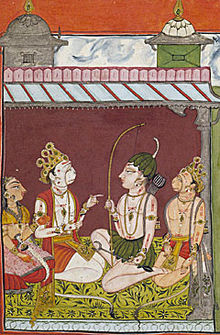
In exile, Sugriva made the acquaintance ofRama, the Avatar of Vishnu, who was on a quest to rescue his wife Sita from the demonRavana, king of the Rakshasas. Rama promised Sugriva that he would kill Vali and would reinstate Sugriva as the king of the monkeys. Sugriva, in turn, promised to help Rama with his quest.[2]
Together, Sugriva and Rama went to seek out Vali. While Rama stood back, Sugriva shouted a challenge, and dared him to battle. The brothers rushed at each other, fighting with trees and stones, with fists, nails and teeth. They were evenly matched and indistinguishable to the observer, until Sugriva's counsellor Hanuman stepped forward and placed a garland of flowers around Sugriva's neck. It was then that Rama emerged with his bow and drove an arrow through Vali's heart. When Vali had expired, Sugriva reclaimed the monkey kingdom, took back his wife, Rum, and took over Vali's main wife, Tara, who became empress, and her son by Vali, Angada, who became crown prince.[3]
When Rama decided to move against Lanka, he was angered because Sugriva spent his time carousing and seemed to forget his pledge to help Rama. Rama's brother, Lakshmana, was about to destroy the monkey kingdom and kill Sugriva. It was only after the diplomatic intervention of Tara that Lakshmana was pacified. Then through Tara's efforts Sugriva and Rama were reconciled. Sugriva sent his trusted advisorHanuman to determine Sita's whereabouts. Hanuman's finding was that Ravana was holding Sita captive in his island fortress ofLanka. Then Sugriva placed his army of monkeys at Rama's disposal. The army crossed into Lanka by means of a specially erected bridge and laid siege to Ravana's citadel. After some hard fighting, the monkeys prevailed over the demons, Rama slew Ravana, and Sita was liberated.[4]
During the battle, Sugriva almost came to a violent death when he decided to take on the Rakshasa Kumbhakarna, a brother of Ravana. Seeing the demon in the middle of the fray, Sugriva attacked him with the trunk of a sala tree. The tree, however, merely broke over the demon's head. Kumbhakarna then seized Sugriva and dragged him off, and no doubt would have killed him but for the timely intervention of Rama's brother Lakshmana.
Scroll down for more
Vibhishana had a sattvic (pure) mind and a sattvic heart. From his early childhood, he spent all his time meditating on the name of the Lord. Eventually, Brahma appeared and offered him any boon he wanted. Vibhishana, said that the only thing he wanted was to have his mind fixed at the feet of the Lord as pure as lotus leaves (charan kamal). He prayed that he should be given the strength by which he would always be at the feet of the Lord, and that he would receive thedarshan (holy sight) of Lord Vishnu. This prayer was fulfilled, and he was able to give up all his wealth and family, and join Rama, who was Avatar (God incarnate).
Vibhishana was the youngest son of Kaikashi and Sage Vishrava, who was the son of Sage Pulatsya, one of the Heavenly Guardians. He (Vibhishana) was the younger brother of the Lord of Lanka, Ravana and King of Sleep,Kumbakarna. Even though he was born in thedemon race, he was alert and pious and considered himself a Brahmin, since his father was intuitively such.
Due to Vibhishana's differences with Ravana because he was against the act of kidnapping Sita and most of all because Ravana wanted the throne for himself, he fled Lanka. His mother, Kaikesi, advised him to go and serve Shri Rama, who was at that time assembling an army to conquer Ravana and to recover Sita. He divulged the secrets of Ravana's army and made sure Rama ended up being victorious in the great battle. Lord Rama accepted Vibhishana's service and anointed him the Lord of Lanka after Ravana's death.
In the Lanka War, Vibhishana's knowledge about the secrets of Lanka proved invaluable to Shri Rama. Vibhishana freely divulged many secrets that became key to the success of Rama's attack, including revealing the secret path to the temple of Mata Nikumbala, the family deity of the Pulatsya Clan. Because of this, however, Vibhishana is also known as a traitor.
While modern readers tend to view the Indian epics with eyes used to seeing clearly defined good and bad characters, the Ramayana's characterisation is trying to represent the practical implications of the concept of Dharma. The epic stresses that neither Vibhishana or Kumbhakarna strayed from the path of Dharma and that there is no single way out of a moral dilemma. The Ramayana teaches that Kumbhakarna adhered to the Dharma of loyalty to his kin when his advice fails, while Vibhishana chose to oppose his kin when his advice failed.
Symbolically, Vibhishana represents devotion to Shri Rama, and as a demon devotee, he shows that the Lord does not distinguish between his followers based on birth or circumstances in life. The same aught can be read in the story of Prahlada and Narasimha.
When Vibhishana attained the position of the King of Lanka, he turned his subjects from the path of evil to the path ofDharma(righteousness). His wife, QueenSarama also aided him in this effort. He had a daughter named Trijata.
When Rama was about to leave Ayodhya at the end of his reign, Lord Rama in his original form of Shri Vishnu ordered Vibhishana to stay on earth and serve the people and guide them to the path of truth and Dharma. Hence, Vibhishana is considered one of the seven immortals, or Chiranjeevins. Lord Vishnu also ordered Vibhishana to pray the family deity of Rama's natal Sun Dynasty, Lord Ranganatha.
Hanuman meets Rama during the latter's 14-year exile.[21] With his brother Lakshmana, Rama is searching for his wife Sita who had been abducted by Ravana. Their search brings them to the vicinity of the mountain Rishyamukha, where Sugriva, along with his followers and friends, are in hiding from his older brother Vali.
Having seen Rama and Lakshmana, Sugriva sends Hanuman to ascertain their identities. Hanuman approaches the two brothers in the guise of a brahmin. His first words to them are such that Rama says to Lakshmana that none could speak the way the brahmin did unless he or she had mastered the Vedas. He notes that there is no defect in the brahmin's countenance, eyes, forehead, brows, or any limb. He points out to Lakshmana that his accent is captivating, adding that even an enemy with sword drawn would be moved. He praises the disguised Hanuman further, saying that sure success awaited the king whose emissaries were as accomplished as he was.[21]
When Rama introduces himself, the brahman identifies himself as Hanuman and falls prostrate before Rama, who embraces him warmly. Thereafter, Hanuman's life becomes interwoven with that of Rama. Hanuman then brings about friendship and alliance between Rama and Sugriva; Rama helps Sugriva regain his honour and makes him king of Kishkindha. Sugriva and his vanaras, most notably Hanuman, help Rama defeat Raavana and reunite with Sita.
In their search for Sita, a group of Vanaras reaches the southern seashore. Upon encountering the vast ocean, every vanara begins to lament his inability to jump across the water. Hanuman too is saddened at the possible failure of his mission, until the other vanaras and the wise bear Jambavanthabegin to extol his virtues. Hanuman then recollects his own powers, enlarges his body, and flies across the ocean. On his way, he encounters Mount Mainak that rises from the sea and offers him to rest on his mountain which had abundant fruits and berries. Mainak explains that Lord Vayu had once saved him from Indra's Vajra. Not wanting to waste any time, Hanuman thanks the mountain, touches it briefly, and presses on. He then encounters a goddess disguised as a sea-monster, Surasa, who challenges him to enter her mouth. When Hanuman outwits her, she admits that her challenge was merely a test of his courage. After killing Simhika, arakshasi, he reaches Lanka.
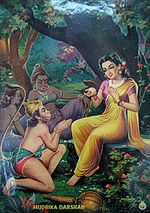
Hanuman reaches Lanka through Air jump and marvels at its beauty. After he finds Sita in captivity in a garden, Hanuman reveals his identity to her, reassures her that Rama has been looking for her, and uplifts her spirits. He offers to carry her back to Rama, but she refuses his offer, saying it would be an insult to Rama as his honour is at stake. In order to give Sita faith, Hanuman gives her a ring that Rama wanted Hanuman to give her. After meeting Sita, Hanuman begins to wreak havoc, gradually destroying the palaces and properties of Lanka. He kills many rakshasas, including Jambumali and Aksha Kumar. To subdue him, Ravana's son Indrajit uses theBrahmastra. Though immune to the effects of this weapon Hanuman, out of respect toBrahma, allows himself be bound. Deciding to use the opportunity to meet Ravana, and to assess the strength of Ravana's hordes, Hanuman allows the rakshasa warriors to parade him through the streets. He conveys Rama's message of warning and demands the safe return of Sita. He also informs Ravana that Rama would be willing to forgive him if he returns Sita honourably.
Enraged, Ravana orders Hanuman's execution, whereupon Ravana's brotherVibhishana intervenes, pointing out that it is against the rules of engagement to kill a messenger. Ravana then orders Hanuman's tail be lit afire. As Ravana's forces attempted to wrap cloth around his tail, Hanuman begins to lengthen it. After frustrating them for a while, he allows it to burn, then escapes from his captors, and with his tail on fire he burns down large parts of Lanka. After extinguishing his flaming tail in the sea, he returns to Rama.
In the Ramayana Hanuman changes shape several times. A time when he changed shape was while he searches for the kidnapped Sita in Ravana's palaces on Lanka, he contracts himself to the size of a cat, so that he will not be detected by the enemy. Later on, he takes on the size of a mountain, blazing with radiance, to show his true power to Sita.[22]
Also he enlarges & immediately afterwards contracts his body to out-wit Surasa, the she-demon, who blocked his path while crossing the sea to reach Lanka. Again, he turns his body microscopically small to enter Lanka before killing Lankini, the she-demon guarding the gates of Lanka.
He achieved this shape-shifting by the powers of two siddhis; Anima and Garimabestowed upon him in his childhood by Sun-God, Surya.
When Lakshmana is badly wounded during the battle against Indrajit, Hanuman is sent to fetch the Sanjivani, a powerful life-restoring herb, from Dronagiri mountain in theHimalayas, to revive him. Ravana realises that if Lakshmana dies, a distraught Rama would probably give up, and so he dispatches the sorcerer Kalanemi to intercept Hanuman. Kalanemi, in the guise of a sage, deceives Hanuman, but Hanuman uncovers his plot with the help of an apsara, whom he rescues from her accursed state as a crocodile.[2]:147
Ravana, upon learning that Kalanemi has been slain by Hanuman, summons Surya to rise before its appointed time because thephysician Sushena had said that Lakshmana would perish if untreated by daybreak. Hanuman realizes the danger, however, and, becoming many times his normal size, detains the Sun God to prevent the break of day. He then resumes his search for the precious herb, but, when he finds himself unable to identify which herb it is, he lifts the entire mountain and delivers it to the battlefield in Lanka. Sushena then identifies and administers the herb, and Lakshmana is saved. Rama embraces Hanuman, declaring him as dear to him as his own brother. Hanuman releases Surya from his grip, and asks forgiveness, as the Sun was also hisGuru.
Hanuman was also called "langra veer";langra in Hindi means limping and veer means "brave". The story behind Hanuman being called langra is as follows. He was injured when he was crossing the Ayodhya with the mountain in his hands. As he was crossing over Ayodhya, Bharat, Rama's young brother, saw him and assumed that some Rakshasawas taking this mountain to attack Ayodhya. Bharat then shot Hanuman with an arrow, which was engraved with Rama's name. Hanuman did not stop this arrow as it hadRama's name written on it, and it injured his leg. Hanuman landed and explained to Bharat that he was moving the mountain to save his own brother, Lakshmana. Bharat, feeling regret, offered to fire an arrow to Lanka, which Hanuman could ride in order to reach his destination more easily. But Hanuman declined the offer, preferring to fly on his own, and he continued his journey with his injured leg.[citation needed]
Shortly after he is crowned Emperor upon his return to Ayodhya, Rama decides to ceremoniously reward all his well-wishers. At a grand ceremony in his court, all his friends and allies take turns being honoured at the throne. Hanuman approaches without desiring a reward. Seeing Hanuman come up to him, an emotionally overwhelmed Rama embraces him warmly, declaring that he could never adequately honour or repay Hanuman for the help and services he received from the noble Vanara. Sita, however, insists that Hanuman deserved honour more than anyone else, and Sita gives him a necklace of precious stones adorning her neck.
When he receives it, Hanuman immediately takes it apart, and peers into each stone. Taken aback, many of those present demand to know why he is destroying the precious gift. Hanuman answers that he was looking into the stones to make sure that Rama and Sita are in them, because if they are not, the necklace is of no value to him. At this, a few mock Hanuman, saying his reverence and love for Rama and Sita could not possibly be as deep as he implies. In response, Hanuman tears his chest open, and everyone is stunned to see Rama and Sita literally in his heart.