





| |||||||||||
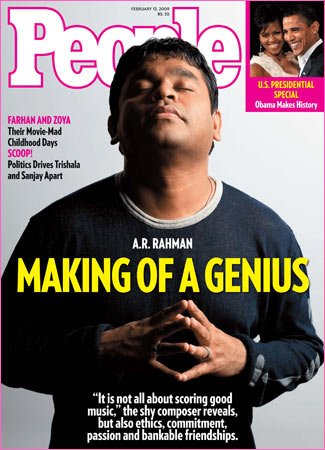
A R Rahman: The making of a genius PEOPLE magazine's latest issue explores the musician's amazing journey with the help of his mother Kareema Begum -- who offers a glimpse of the genius at work -- his friends, and of course, from the man himself. We present the story here. On January 11, as Kareema Begum watched her son, the prolific Allah Rakha Rahman, walk up to the stage inside The Beverly Hilton Hotel, California, and accept his first-ever Golden Globe for Best Original Score for a motion picture, tears streamed down her face. The rest of Rahman's family including sister, A R Rehana, who caught the live telecast at his Chennai residence, tried pacifying her but the moment was too emotional for her to stop. "My son looked so tall, holding his award among all those foreigners," says Kareema, clearly moved by Rahman's achievement. If a Golden Globe win had this effect, imagine the impact of an Oscar victory for her son. It now seems a real possibility after he snagged three Academy Award nominations for Slumdog Millionaire on January 22. Besides receiving a nomination for the Best Original Score, he has been nominated in the Best Original Song category for 'O... Saya' and 'Jai Ho'. Even as the accolades started pouring in, the man at the centre of the jubilation was typically self-effacing. "It was really unexpected and we all are very surprised," Rahman said in an interview to CNN-IBN. "I have received so many SMSes from all over the country. Thank you so much for your love and prayers." Before the international recognition, Rahman has long enjoyed a reputation as a quiet musical genius among contemporaries and critics in India. Since he burst onto the mainstream with the soundtrack to Mani Ratnam's Tamil film Roja in 1993, Rahman has composed for nearly 110 films including southern hits like Bombay, Thiruda Thiruda, Gentleman, Rakshasudu, Kannathil Muthumittal, Minsara Kanavu, Kandukondain Kandukondain, Sivaji and Hindi blockbusters like Rangeela, Taal, Dil Se, Lagaan, Jodhaa Akbar and Jaane Tu Ya Jaane Na. In 2002, Rahman collaborated with British producer Andrew Lloyd Webber for the West End musical Bombay Dreams, announcing his presence on the international scene. Combining diverse genres and arrangements, Rahman is the consummate artist constantly experimenting with new sounds and challenging the boundaries of music with his creations. As filmmaker Subhash Ghai, who worked with Rahman on Taal, Kisna and Yuvvraaj, describes him: "Rahman has been restlessly in search of excellence since the time he started making music."
'Ilayaraaja taught me great discipline' It was his father, Malayali music composer, late R K Shekhar, who showed him the way. Rahman remembers how he was a man who always valued musicians as "human beings first." "My father was a hard worker and never judged musicians by their compositions. He had great respect for them as people and I learnt the same. He was always ready to help those who are in need." In the 1980s, Rahman work as a keyboard player with legendary south Indian composer Ilayaraaja, which turned out to be his other learning ground. "Ilayaraaja taught me great discipline," says Rahman. "With other musicians, I always saw that there were people, who would drink and smoke. With Ilayaraaja, things were always systematic and disciplined. He was dedicated towards work and, once again, respected every musician." Those who know Rahman well observe that the musician strives to live by the same tenets. Suhasini Mani Ratnam, wife of director Mani Ratnam, Rahman's good friend sees in him, a child-like innocence at heart. "I have seen A R Rahman showering lot of sympathy on children and people in need," says the actress. "His family has a very positive influence on him and I guess that makes his music more sensitive." 'I don't have a social life' Rahman was nine years old when his father R K Shekhar passed away. "Other boys his age were interested in outings, films and fun but Rahman worked hard to make both ends meet. I have never seen my son having a good time as a youngster and work has always been worship for him," says Kareema. Rahman, however, does not feel like he is missing much. "I don't have a social life," he says. Spending time around his three children Khatija, 13, Rahima, 10, and son Ameen, 5, is his greatest joy. At his Kodambakkam residence, they playfully cycle around the house while Rahman attends to visitors. All three of them love their father's music and are big fans of Miley Cyrus's Hannah Montana and High School Musical like many kids their age. Rahman definitely wants his children to learn music someday. "But they are too playful right now," he says. Being A R Rahman's children has its advantages at school. All three of them are often besieged with autograph requests from friends, which they are happy to oblige with. After the Oscar nominations were announced, Rahman declared to a news channel that it is his wife Saira's dream that he win an Oscar. Saira was the first person he SMSed after his Golden Globe win. "She was the right person to call. She can inform everyone else in the family," he says. It is hard to miss the predominantly female presence in the Rahman household. Apart from his mother, wife and two daughters, the musician also has three sisters. Rahman laughingly quips that "there are too many women" in his house. "Maybe that's why I was never interested in women after marriage." He is incredibly protective of his family and guards them from the public eye even if that means compromising on his own privacy. "I can't go jogging on Chennai roads nor can I enjoy a great time with family or friends in a restaurant," he says. "At least my family can do it. I wanted to ensure that happiness for my entire family." As Rahman immerses himself in different projects and becomes busier, his mother frets about his food habits. A non-fussy eater, he usually doesn't have any special preferences at the dinner table. "He feels happy with clean, homemade food even if it is piping hot rasam," says Kareema. But the work often eats into his diet. "I have to send my grandchildren to the studio to remind him to have his food. These days, he has lunch as late as 5 pm and dinner at 1 am." This year, Rahman is hoping to make amends to his routine. In 2008, he worked on around nine big film projects, something he is not too happy about. He wants to be choosy about his local assignments in the future. "It is too exhausting to have many films on hand. We all need a personal life. I need to spend quality time with my family," he says. |
















 Bollywood
 Cricket
 Kyunki Saas Bhi Kabhi Bahu Thi 2
 Mangal Lakshmi

