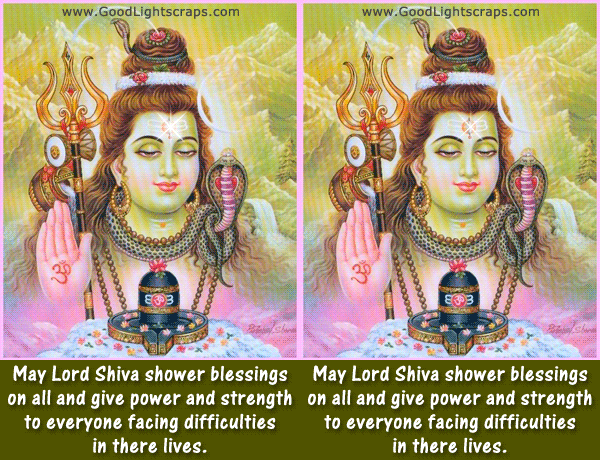
~ Happy Mahashivratri To All ~

Angel_Luv thumbnail
13th Anniversary Thumbnail Stunner Thumbnail + 4
Posted: 11 years ago
#1

!!!Om Namah Shivaya!!!
!!! Bham bham Bhole !!!
!!! Har Har Mahadev !!!


Om Namastestu Bhagavan
Vishvesharaya Mahadevaya
Trayambakaya Tripurantakaya
Trikagni - Kalaya
Kalagni - Rudraya Neel - Kanthaya Mrityunjaya
Sarveshvaraya Sadadhivaya
Sriman Mahadevaya Namah.

Meaning:
Om. I bow down to Lord Shiva, who is the creator and protector of the universe, who is the greatest among Gods, who has three eyes, who is the annihilator of all the three worlds, one whose throat is blue, who is the conqueror of death, who is the Lord of all, who is propitious who is possessed of all marks of greatness and who is the greatest among Gods. To him my prostration

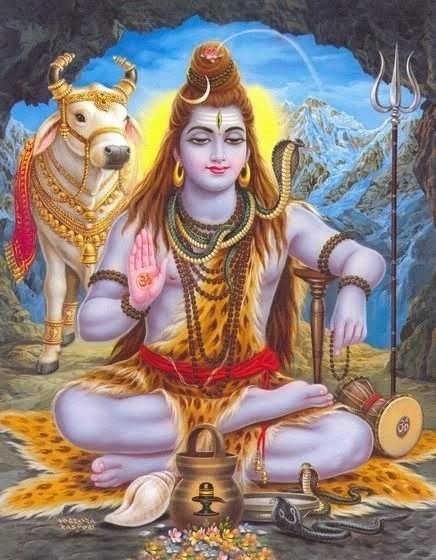
Maha Shivratri, the night of the worship of Lord Shiva, occurs on the 14th night of the new moon during the dark half of the month of Phalguna. It falls on a moonless February night, when Hindus offer special prayer to the lord of destruction. Shivratri (Sanskrit 'ratri' = night) is the night when he is said to have performed theTandava Nritya or the dance of primordial creation, preservation and destruction. The festival is observed for one day and one night only.

Origin of Shivratri:

According to the Puranas, during the great mythical churning of the ocean called Samudra Manthan, a pot of poison emerged from the ocean. The gods and the demons were terrified as it could destroy the entire world. When they ran to Shiva for help, he in order to protect the world, drank the deadly poison but held it in his throat instead of swallowing it. This turned his throat blue, and since then he came to be known as 'Nilkantha', the blue-throated one. Shivratri celebrates this event by which Shiva saved the world.

A Festival Significant for Women :

Shivratri is considered especially auspicious for women. Married women pray for the well being of their husbands and sons, while unmarried women pray for an ideal husband like Shiva, who is the spouse of Kali, Parvati and Durga. But generally it is believed that anyone who utters the name of Shiva during Shivratri with pure devotion is freed from all sins. He or she reaches the abode of Shiva and is liberated from the cycle of birth and death.

Shiva Rituals:

On the day of Shivratri, a three-tiered platform is built around a fire. The topmost plank represents 'swargaloka' (heaven), the middle one 'antarikshaloka' (space) and the bottom one 'bhuloka' (earth). Eleven 'kalash' or urns, are kept on the 'swargaloka' plank symbolizing the 11 manifestations of the 'Rudra' or destructive Shiva. These are decorated with the leaves of 'bilva' or 'bael' (Aegle marmelos) and mango atop a coconut representing the head of Shiva. The uncut shank of the coconut symbolizes his tangled hair and the three spots on the fruit Shiva's three eyes.

Bathing the Phallus:

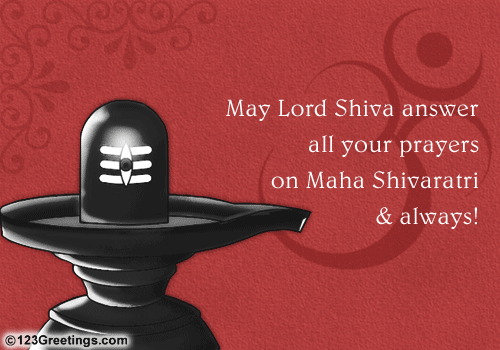
The phallus symbol representing Shiva is called the lingam. It is usually made of granite, soapstone, quartz, marble or metal, and has a 'yoni' or vagina as its base representing the union of organs. Devotees circumambulate the lingam and worship it throughout the night. It is bathed every three hours with the 5 sacred offerings of a cow, called the 'panchagavya' - milk, sour milk, urine, butter and dung. Then the 5 foods of immortality - milk, clarified butter, curd, honey and sugar are placed before the lingam. Datura fruit and flower, though poisonous, are believed to be sacred to Shiva and thus offered to him.

"Om Namah Shivaya!":

All through the day the devotees keep severe fast, chant the sacred Panchakshara mantra "Om Namah Shivaya", make offerings of flowers and incense to the Lord amidst ringing of temple bells. They maintain long vigils during the night, keeping awake to listen to stories, hymns and songs. The fast is broken only the next morning, after the nightlong worship. In Kashmir, the festival is held for 15 days. The 13th day is observed as a day of fast followed by a family feast.


Here're three reasons to celebrate Shivratri:


1. The absolute formless God, Sadashiv appeared in the form of "Lingodbhav Moorti" exactly at midnight on Maha Shivratri. That is why all Shiva devotees keep vigil during the night of Shivratri and do "Shivlingam abhishekham" (coronation of the pallic idol) at midnight.

Did You Know?

God in his manifestation as Vishnu made his appearance as Krishna at Gokul at midnight, 180 days after Shivratri, commonly known as Janmashtami Thus, the circle of one year is divided into two by these two auspicious days of the Hindi calander.

2. Lord Shiva was married to Devi Parvati on Shivratri. Remember Shiva minus Parvati is pure 'Nirgun Brahman'. With his illusive power, (Maya, Parvati) He becomes the "Sagun Brahman" for the purpose of the pious devotion of his devotees.

3. It is also believed that on Shivratri, Lord Shiva became 'Neelkantham' or the blue-throated by swallowing the deadly poison that came up during the churning of "Kshir Sagar" or the milky ocean. The poison was so deadly that even a drop in His stomach, which represents the universe, would have annihilated the entire world. Hence, He held it in His neck, which turned blue due to the effect of poison. Shivratri is therefore also a day of thanksgiving to the Lord for protecting us from annihilation.

The 14th shloka of Shivmahimna Stotra says: "O three eyed Lord, when the poison came up through the churning of the ocean by the gods and demons, they were all aghast with fear as if the untimely end of all creation was imminent. In your kindness, you drank all the poison that still makes your throat blue. O Lord, even this blue mark does but increase your glory. What is apparently a blemish becomes an ornament in one intent on ridding the world of fear."


This Year Maha-Shivaratri is on Tuesday 17th Feb.2015...
Wishing you All Good Luck,Prosperity and Happiness..😊

May the Blessings Of Lord Shiv-Shankar,

be with you all On... Maha-Shivratri ...and always.

Edited by Angel_Luv - 11 years ago

Created

Last reply

Replies

18

Views

5.6k

Users

9

Likes

46

Frequent Posters

Angel_Luv thumbnail
13th Anniversary Thumbnail Stunner Thumbnail + 4
Posted: 11 years ago
#2


Manifestation of Lord Shiva as a Jyotirlinga on this day:

On this day manifested the great & also the first ever effulgent (Jyotirmaya) form (Anala-skanda or a pillar of fire) of Lord Shiva in front of Lord Vishnu & Brahmaji.

The story goes that once both Vishnuji & Brahmaji, got infected by ego. The result was an clash between both these gods. In order to show their respective superiority they decided to fight it out. Lord Shiva decided to intervene so as to make them realise that there is something more to life than the powers of an embodied beings. He manifested in the form of a huge pillar of fire (Anala-skanda) whose beginning and end could not be seen. Vishnuji & Brahmaji decided to check what this strange thing was. While Vishnuji, in the form of varaha (boar) went down towards patal-loka to see the end of this pillar, Brahmaji sitting on his swan went up. Even after years of travel they could not see the beginning or the end of this manifestation. Brahmaji saw a leaf falling off, and thought it fell down from the top of pillar of fire, and returned satisfied that he had seen the starting point. They came back, while Lord Vishnu accepted that he could not see the end, Brahmaji said that he had seen, which was a lie. Lord Shiva cursed Brahmaji that no will ever worship him. Then he too surrendered. This manifestation of Lord Shiva in the form of the first effulgent linga was on this special day of Mahashivratri, and thus all devotees pray to the effulgent linga (jyotirlinga) of Lord Shiva.


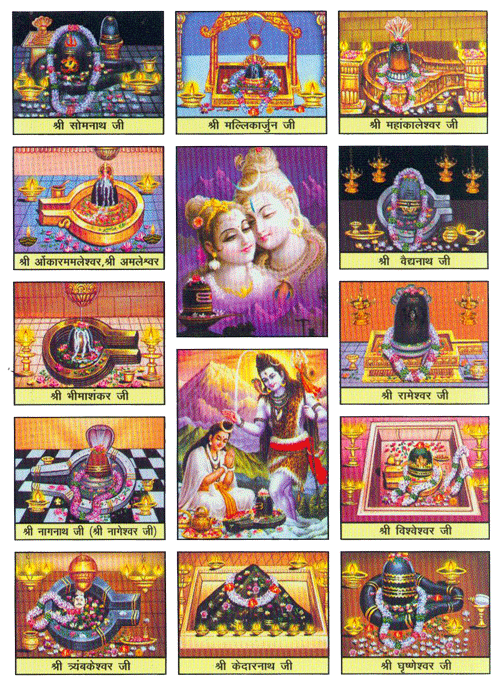
There are twelve Jyotirlingas: 1) Somnath in Saurashtra, 2) Mallikarjuna in SriShail, 3) Mahakal in Ujjain, 4) Amareshwar in Omkar, 5) Kedar in the Himalaya, 6) Bheemashankar at the bank of Bheema river. 7) Vishwanath in Varanasi. 8) Trayambakeshwar ar the bank of Gautami river, 9) Baidyanath at Chitabhumi, 10) Nagesh which is situated between Darukvan dwarika and Bhet dwarika 11) Rameshwar at Betubandh and 12) Dhushmesh in Shivalaya.
Jyotir Linga Kshetras


All the above mentioned twelve Jyotirlingas are very sacred and give total accomplishment to the devotees.

Other types of Shivlingas are generally seen as 1) Chala, 2) Achala.
Chala linga is made for the puja, is immersed later. They are used at home too for worship, made of Black, stone, Crystal, Mercury etc.
Achala linga is immovable. It is very deep under the Earth. Such lingas are next to Jyotirlingas. They are created by Shivji's wish & a devotees gets to know about it, is worshipped after that it's discovery knowingly & unknowingly before that.
The reason for creation of Swayambhu Shivlinga:
1)For removing unseen obstacles in creation of this Srushti should be removed first & should be smooth running later on.
2)The place needs Shiv-bhakti.
3)To make unfavourabe period favourable for the devotees.
Some Shivlingas which are on the surface of the Earth, have less power compared to Swayambhu Shivlinga, they are made & worshipped by King, rishis or devotees.
They have comparitively less power, so the devotee can sit next to it & worship.
A Shivlinga has 3 parts. The lowest is Brhma's, is square in shape, Middle octagonal part is Vishnu's, both placed are under the Earth. The top Round part is of Rudra, is worshipped.
On the auspious occasion of MahaShivratri of Lord Shiva, everyone is invited to contribute in this thread .😊


[YOUTUBE]http://www.youtube.com/watch?v=LEYG_IqcU64[/YOUTUBE]


Edited by Angel_Luv - 11 years ago
wayward thumbnail
Posted: 11 years ago
#3
A Happy Mahashivratri To All My Friends On IF !
uluvmg thumbnail
14th Anniversary Thumbnail Rocker Thumbnail + 2
Posted: 11 years ago
#4

Happy MahaShivratri to All...🤗

Have A Blessed Mahashivaratri Scraps

awesome thread poodi...👏
Edited by uluvmg - 11 years ago
annirogc thumbnail
12th Anniversary Thumbnail Dazzler Thumbnail Commentator Level 1 Thumbnail
Posted: 11 years ago
#5
happy mahasivarathri to u all
Angel_Luv thumbnail
13th Anniversary Thumbnail Stunner Thumbnail + 4
Posted: 11 years ago
#6

Originally posted by: uluvmg

Happy MahaShivratri to All...🤗

Have A Blessed Mahashivaratri Scraps

awesome thread poodi...👏

thnx sweety..May God Shiva shower his blessings on you..,🤗
nirmalac99 thumbnail
13th Anniversary Thumbnail Dazzler Thumbnail Commentator Level 2 Thumbnail
Posted: 11 years ago
#7
Happy Mahashivratri...
poonam the thread s capitivating with Shiva's pic nd information....Great going
Angel_Luv thumbnail
13th Anniversary Thumbnail Stunner Thumbnail + 4
Posted: 11 years ago
#8

Originally posted by: nirmalac99

Happy Mahashivratri...
poonam the thread s capitivating with Shiva's pic nd information....Great going

thnx sweety🤗🤗
Chitra_11 thumbnail
13th Anniversary Thumbnail Rocker Thumbnail Commentator Level 3 Thumbnail
Posted: 11 years ago
#9

Significance of Bilva or Bel Leaves in Lord Shiva & Vishnu's Worship

Vande shambhum umapatim sura gurum

vande jagat kaaranam

vande pannaga bhooshanam sashi dharam

vande mukundapriyam

vande surya shashaanka vahni nayanam

vande pashoonaam patim

vande bahkta jana asrayam cha varadam

vande shivam shankaram

Lord Shiva is worshipped by chanting sacred nama "Eka Bilvam Shivarpanam". Bilva leaves are generally trifoliate (three leaves attached together)

According to vedic scriptures the three leaves of a Bilva Dalam denotes:

  • Three eyes of Lord Shiva
  • Trimurthi Swaroopam - Brahma, Vishnu & Maheswara
  • Three syllables of Aumkara(Omkara) - Akara, Ukara & Makara
  • Pooja, Stotra and Gyana (It is believed that by offering a single bilva dalam, one can get rid of darkness caused due to agyanam/ignorance)
  • Bilva dalam represents Srusthi (Creation), Sthithi (Sustaining) and Laya (dissolution)
  • Bel leaves are considered the most sacred offerings in Shiva pooja. A worshipper should offer Trifoliate meaning Three leaves together called Bilva dalam.
  • One should not offer Bilva dalam with two or a single leaf. It is a sin to offer incomplete Bel -Patra.
  • In an Ekabilvam (A single trifoliate bel-patra), Left leaf is Brahma, Right leaf is Vishnu and the middle leaf is Shiva.

Our Vedic Scriptures also says...

Bilva/Bel leaves offered once in Shiva Pooja can be re-used or re-offered to God the next day by sprinkling few drops of water on them. A devotee can offer the same Bilva dalam for 15 continous days. Even though bel-leaves become dry, one can still use the dried one's in Shiva pooja, such is the grateness of Bel-Leaf. Make sure before offering, it has all the three leaves attached to the stem (Trifoliate).


The front portion of a Bel-leaf denotes Amrutham" (Nectar of Immortality). So, while offering bel-leaf, the front portion of the leaf should face Lord Shiva.

A Garden of Bilva trees (Bilva Vanam) is equivalent to Kashi Kshetram. It is very auspicious to have a Bilva tree at home.

According to Vastu-Sastra (Science of Architecture or Construction), a house with Bilva Tree in:

North East - Bestows all kinds of wealth & remove unforeseen dangers.

East - Blesses with happiness, peace and good health.

West - Blesses with healthy progeny

South - Protects from troubles caused due to Yama.


shantaakaaram bhujaga shayanam

padmanaabham suresham

viswaadhaaram gagana sadrisam

megha varnam shubhaangam

lakshmi kantam kamala nayanam

yogi hridhyana gamyam

vande vishnum bahva bhaya haram

sarva lokaika natham


Significance of Bel-leaf in Lord Venkateshwara & Alamelumanga's worship:

It is our vedic tradition to worship Shiva with Tulasi dalam and Lord Venkateswara (Vishnu's form) with Bilva dalam during Kartheeka masa. One should never differentiate between Hari(Vishnu) and Hara(Shiva), hence the exchange of these Holy leaves/dalams.

To overcome financial problems, devotees chant a powerful stotram called "Shree Venkateswara Mahishi Mahalakshmi Stotram" while offering Bel-leaves.

It is also believed that offering prayers to Shree Mahalakshmi with Bel-leaves (particularly on Friday's and also during Shravana Masa), showers the worshipper with abundant wealth and prosperity.

Bilvashtakam

Tridalam trigunakaram trinetram cha triyayudham

Trijanmapapasamharam ekabilvam shivarpanam .. 1

rishakhaih bilvapatraishcha hyachchidraih komalaih shubhaih

Tavavapujam karishhyami ekabilvam shivarpanam .. 2

Koti kanya maha danam tila parvata kotayah

Kanchanam sheela danena ekabilvam shivarpanam ..3

Kashikshetranivasam cha kalabhairavadarshanam

Prayagamadhavam druishtva ekabilvam shivarpanamh .. 4

Induvare vratam sthitwa niraharo maheshwara

Naktam haoushyami devecha eka bilvam shivarpanam ..5

Ramalinga pratistha cha vaivahika krutam tatha

tatakadi cha santanam eka bilvam shivarpanam ..6

Akhanda bilva patram cha ayutam shiva poojanam

Krutam nama sahasrena eka bilvam shivarpanam ..7

Umaya sahadevesha nandi vahana meva cha

Bhasma lepana sarvangam eka bilvam shivarpanam ..8

Salagrameshu vipranam tatakam dasha koopayo

Yagyakoti saharacha eka bilvam shivarpanam ..9

Dantikoti sahasreshu ashwamedha shatakratau

Kotikanya mahadanam ekabilvam shivarpanam ..10

Bilvanam darshanam punyam sparshanam papa nashanam

Aghora papa samharam eka bilvam shivarpanam ..11

Sahasra veda patheshu brahma sthapana muchyate

Aneka vrata kotinam eka bilvam shivarpanam ..12

Annadana sahasreshu sahasropanayanam tatha

Aneka janma papani eka bilvam shivarpanam ..13

Phalastuthi (Merits of recital)

Bilvashhtakamidam punyam yah patheth shivasannidhau.

Shivalokamavapnoti eka bilvam shivarpanam ..14

Ashta Bilvas - 8 varieties of Bilva


Lord Shiva

According to Bilvashtakam, a powerful stotra describing the merits of offering Bilva Patram (Bel-leaf) to Lord Shiva mentions Seven(7) other sacred leaves, which are

equivalent to Bilva dalam. They are together called "Ashta Bilvas". Ashta meaning Eight(8).

Shloka on Ashta Bilvas:

Transliteration to English:

"Tulasi Bilva Nirgundee Apaamaarga Kapihthakov!

Shamee Cha Aamalakam Dhoorva Ashta Bilvaah Prakeerthathah" Ithyashtabilvaani

Ashta Bilvams...

1.Tulasi (Holy Basil) - Ocimum Sanctum

2. Bilva (Bel-Patra) - Cynodon Dactylon

3.Nirgundi - Vitex Negundo

4. Apaamaarga - Achyrantes aspera

5. Kabitha - Limonia acidissima

6. Shamee - Proscopis Spicigers

7. Aamalakam - Phyllanthus Emblica

8. Doorva - Cynodon Dactylon

"Ashta Bilvas" are said to have medicinal properties. Tulasi is mostly consumed in raw form to cure common cold and flu. The remaining Bilvas (bilva leaves in powder form) are used to treat various medical conditions. "Ashta Bilvas" are indeed God's gift to Humans.




Happy MahaShivratri to ALL..😃 AND what a beautiful thread Po...thanks.


Edited by chitsri65 - 11 years ago
Angel_Luv thumbnail
13th Anniversary Thumbnail Stunner Thumbnail + 4
Posted: 11 years ago
#10
@ Chitra
Thankyou very much sweety for posting

Significance of Bilva or Bel Leaves in Lord Shiva & Vishnu's Worship😃

May God Shiva shower his blessings on you..,
May happiness and peace surround you with his eternal love..,
Happy Shivratri to you...
Related Topics

Top

Stay Connected with IndiaForums!

Be the first to know about the latest news, updates, and exclusive content.

Add to Home Screen!

Install this web app on your iPhone for the best experience. It's easy, just tap and then "Add to Home Screen".