





Autism and Genetics: Facts (Link in Article archive) - Page 4

Created

Last reply

Replies

33

Views

5.9k

Users

26

Likes

29

Frequent Posters

2009Rule thumbnail
17th Anniversary Thumbnail Navigator Thumbnail
Posted: 16 years ago
#31
Communication

About a third to a half of individuals with autism do not develop enough natural speech to meet their daily communication needs. Differences in communication may be present from the first year of life, and may include delayed onset of babbling, unusual gestures, diminished responsiveness, and vocal patterns that are not synchronized with the caregiver. In the second and third years, autistic children have less frequent and less diverse babbling, consonants, words, and word combinations; their gestures are less often integrated with words. Autistic children are less likely to make requests or share experiences, and are more likely to simply repeat others' words (echolalia) or reverse pronouns. Joint attention seems to be necessary for functional speech, and deficits in joint attention seem to distinguish infants with ASD: for example, they may look at a pointing hand instead of the pointed-at object, and they consistently fail to point at objects in order to comment on or share an experience. Autistic children may have difficulty with imaginative play and with developing symbols into language.
2009Rule thumbnail
17th Anniversary Thumbnail Navigator Thumbnail
Posted: 16 years ago
#32
Repetitive behavior
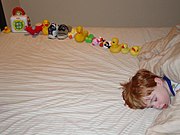
Young boy asleep on a bed, facing the camera, with only the head visible and the body off-camera. On the bed behind the boys head is a dozen or so toys carefully arranged in a line, ordered by size.
A young boy with autism, and the precise line of toys he made

Autistic individuals display many forms of repetitive or restricted behavior, which the Repetitive Behavior Scale-Revised (RBS-R) categorizes as follows.

    Stereotypy is repetitive movement, such as hand flapping, making sounds, head rolling, or body rocking. Compulsive behavior is intended and appears to follow rules, such as arranging objects in a stacks or lines. Sameness is resistance to change; for example, insisting that the furniture not be moved or refusing to be interrupted. Ritualistic behavior involves an unvarying pattern of daily activities, such as an unchanging menu or a dressing ritual. This is closely associated with sameness and an independent validation has suggested combining the two factors. Restricted behavior is limited in focus, interest, or activity, such as preoccupation with a single television program, toy, or game.
  • Self-injury includes movements that injure or can injure the person, such as eye poking, skin picking, hand biting, and head banging. A 2007 study reported that self-injury at some point affected about 30% of children with ASD.

No single repetitive behavior seems to be specific to autism, but only autism appears to have an elevated pattern of occurrence and severity of these behaviors.

Savant syndrome

Savant syndrome, sometimes abbreviated as savantism, is not a recognized medical diagnosis, but researcher Darold Treffert defines it as a rare condition in which persons with developmental disorders (including autism spectrum disorders) have one or more areas of expertise, ability or brilliance that are in contrast with the individual's overall limitations. Treffert says the condition can be genetic, but can also be acquired.

According to Treffert, about half of persons with savant syndrome have autistic disorder, while the other half have another developmental disability, mental retardation, brain injury or disease. He says, "... not all autistic persons have savant syndrome and not all persons with savant syndrome have autistic disorder". Other researchers state that autistic traits and savant skills may be linked, or have challenged some earlier conclusions about savant syndrome as "hearsay, uncorroborated by independent scrutiny".

Though it is even more rare than the savant condition itself, some savants have no apparent abnormalities other than their unique abilities. This does not mean that these abilities weren't triggered by a brain injury of some sort but does temper the theory that all savants are disabled and that some sort of trade-off is required. (see Prodigious Savants below)

According to Treffert:

    One in ten autistic persons has savant skills. 50% of savants are autistic; the other 50% often have different disabilities, mental retardation, brain injuries, or brain diseases.
  • Male savants outnumber female savants by about six times.

A 2009 British study of 137 autistic individuals found that 28% met criteria for a savant skill, that is, a skill or power "at a level that would be unusual even for normal people"; the study suggested that the number is likely to be an underestimate, with the true value being at least a third of individuals with autism.

Prodigious savants
See also: People speculated to have been autistic

A prodigious savant is someone whose skill level would qualify him or her as a prodigy, or exceptional talent, even in the absence of a cognitive disability. Prodigious savants are those individuals whose abilities would be considered phenomenal or genius even in a person without any limitations or special diagnosis of impairment. The most common trait of these prodigious savants is their seemingly limitless mnemonic skills, with many having eidetic or photographic memories. Indeed, prodigious savants are extremely rare, with fewer than one hundred noted in more than a century of literature on the subject. Darold Treffert, the leading researcher in the study of savant syndrome, estimates that fewer than fifty or so such individuals are believed to be alive in the world today. The website of the Wisconsin Medical Society lists 29 savant profiles. Darold Treffert is past-president of the society.

The following are not autistic but are in the spectrum:

  • Kim Peek, speed reader and calculator

The following are autistic artists of above-average talent in their fields:

    Daniel Tammet, British high-functioning autistic savant (mathematical synesthaesia, language absorption, and memory). Alonzo Clemons, American clay sculptor. Tony DeBlois, blind American musician. Leslie Lemke, blind American musician. Jonathan Lerman, American artist. Thristan Mendoza, Filipino marimba prodigy. Derek Paravicini, blind British musician. Gilles Trhin, artist, author James Henry Pullen, gifted British carpenter. Matt Savage, U.S. autistic jazz prodigy. Henriett Seth-F., Hungarian autistic savant, poet, writer and artist. Stephen Wiltshire, British architectural artist.
  • Richard Wawro, British artist..

Edited by 2009Rule - 16 years ago
realitybites thumbnail
20th Anniversary Thumbnail Stunner Thumbnail + 5
Posted: 16 years ago
#33
Hi all, Please note that the link to this post has been put in AKA article archive thread:
Thanks.
sparkle08 thumbnail
18th Anniversary Thumbnail Explorer Thumbnail
Posted: 16 years ago
#34
This dropped from a sticky??

Related Topics

Top

Stay Connected with IndiaForums!

Be the first to know about the latest news, updates, and exclusive content.

Add to Home Screen!

Install this web app on your iPhone for the best experience. It's easy, just tap and then "Add to Home Screen".