


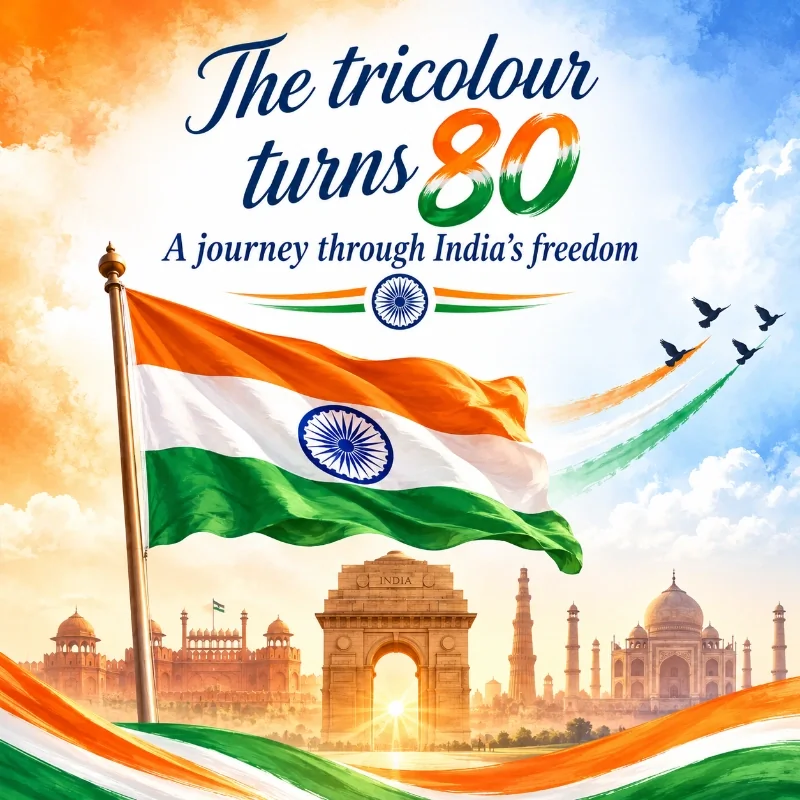
Every year, on 15th August, we see the tricolour hoisted with pride.
We hear the national anthem, remember our freedom fighters, and celebrate Independence Day. But sometimes, in the middle of all these celebrations, we forget to pause and think about what this flag actually represents.
The tricolour is not just a flag.
It carries a long and often difficult journey of a nation that fought for its freedom.
India's journey towards independence was not the work of one person or one movement. It was shaped by countless struggles, protests, sacrifices and voices from different parts of the country.
The Revolt of 1857 was one of the earliest major challenges to British rule. In the decades that followed, the freedom movement gradually grew stronger. The formation of the Indian National Congress in 1885 gave a political platform to the growing demand for Indian participation in governance.
The twentieth century saw the freedom struggle take a completely different shape. Mahatma Gandhi brought mass participation into the movement through ideas of non-violence and civil disobedience. Movements like the non-cooperation movement, the salt march, and the Quit India Movement brought ordinary Indians into the struggle.
At the same time, there were many other paths and many other heroes. Bhagat Singh, Subhas Chandra Bose, Chandrashekhar Azad, Rani Lakshmibai, Sarojini Naidu, Annie Besant, and countless others became part of India's long story of resistance. There were also thousands of unnamed people whose contributions rarely make it into our history books.
And then came 15 August 1947.
After almost two centuries of British rule, India became independent. The moment was historic, but it was also complicated. Independence came with partition, displacement, and immense human suffering. The joy of freedom existed alongside the pain of millions who were forced to leave their homes.
The tricolour that we know today had already been adopted by the Constituent Assembly on 22 July 1947, just weeks before Independence. Saffron, white and green, with the Ashoka Chakra at its centre - it became a symbol of the new India.
Each time that flag rises today, it carries all these layers with it ... the courage of those who fought, the sacrifices of those who suffered, the hopes of those who imagined a free India and the responsibility of those who live in it today.
As India moves towards 80 years of independence, perhaps the best way to celebrate is not simply to look back at 1947.
It is also to ask ourselves what freedom means today.
Freedom brought us the right to shape our own destiny. What we do with that freedom is now our responsibility.
So, this Independence Day, when the tricolour rises against the sky, maybe we can look at it a little differently.
Not just as a symbol of a historic victory, but as a reminder of a journey that began long before 1947 , and continues even today.
Jai Hind
Write up: nushhkiee
Graphics: AI
Proof reading: Minionite
















 Hindi TV Shows
 Members Lounge
 Cricket
 Mahabharat Katha


8