





HARSHVARDHAN RANE INTERVIEW: "IF I WORK HARD ENOUGH, THEN I CAN SURVIVE ON ANOTHER PLANET"
ADVERTISEMENT

Harshavardhan Rane
At sixteen, Harshavardhan Rane decided to run away from home. For the second time. His parents had separated by then, and Rane lived in Gwalior with his father, a doctor with a small home practice. Rane remembers him "being happy with whatever he made." It wasn't a bad life.
"As a child I never knew hunger," he says. The "uncertainty of the next meal" was the first thing that scared him about leaving home.
But Rane ran away to Delhi anyway. His grand plan was to "see how things go from there," he says, adding, "I had a very blurry vision back then. Where I come from, acting was a recreational activity you do at school. It is never a career option. But there was a strong pull that kept me wanting to become an actor."
Handwriting Himself A Ticket to Mumbai

Harshavardhan Rane
Once in Delhi, he did every job that came his way. With no academic qualifications to his name, he couldn't afford to pick and choose. "I have good handwriting, so I got the job of maintaining records at a phone booth. Later, I did the same job at a cyber-cafe, where I even got a pay hike of ten rupees," he says with some pride. "And later," he goes on, "I got in touch with a DVD shop owner, for whom I used to distribute DVDs around Delhi. I used to make beautiful hand-written DVD wrappers and impressed with my work, I was offered the same job in Mumbai."
I want to ask him if these were legitimate copies, but hearing the note of pride in his voice, I don't.
*****
"Leaving home," he tells me, "was one of the most honest decisions I made in my life. However illogical it may sound, I followed my gut, and I am thankful for that."
*****
Break Behind The Wrong Door
In Mumbai, he went to auditions for roles in television. "My then girlfriend, who is now my best friend and I went to auditions together. One such audition landed me in Left Right Left." Rane played the role of Cadet Rummy Gaur in the second season of the show, about cadets at a military training academy.
Soon, Rane joined the popular academy run by acting coach Barry John, and acting in several plays, including an adaptation of A Streetcar Named Desire. He credits John for his acting career. In an interview with the Hyderabad basedPost Noon, Rane said "I owe him my career. Life's been great since I started taking my acting lessons from him."
*****
The first break happened by chance.
Rane had gone to meet Bollywood filmmaker Abbas Tyrewala at his office, but entered the wrong room. An audition for a Telugu movie was going on in the room, and the director asked Rane if he would be interested in auditioning. The producer of the movie, Bharat Thakur, saw a video of the audition and recognised Rane from a play.
Rane's first Telugu film, Thakita Thakita, would go on to do moderately well at the box office, but he had no more offers.
The break wasn't really a break. Or so it seemed.
*****
"The Telugu Industry Has Been Very Kind to Me"
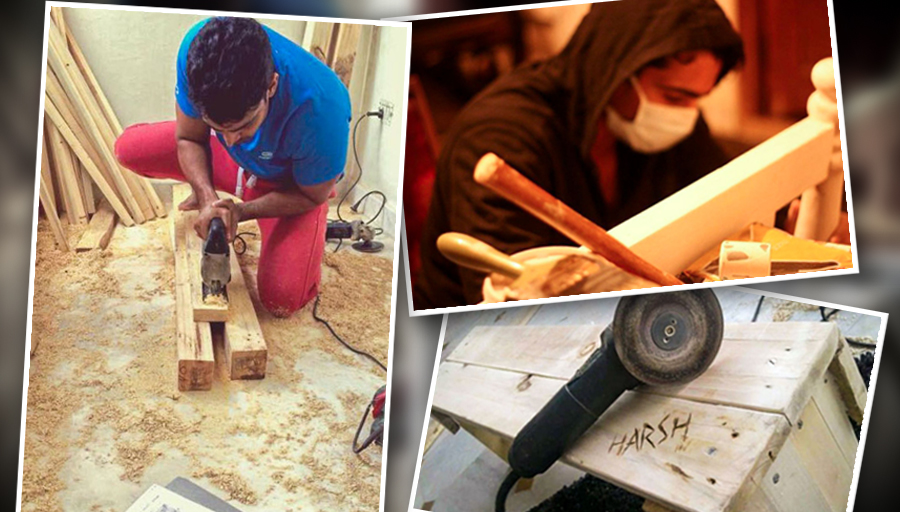
Harshavardhan Rane Working on Carpentry Samples
He was in Hyderabad now, and there were no offers after his first movie. Short of money, Harshavardhan bought old furniture from a store near Nampally station in Hyderabad and sold them after reworking. He also painted restaurants for money. "This is how my interest in carpentry kicked in," he says, "I still do it whenever I find time."
He brushes off a question about how he kept his hopes up in Hyderabad, an unfamiliar city. "I've had a streak of doing what is difficult. Again, I had people asking me questions like how I was going to manage in a city I did not know, a language I had no clue about. I cannot explain this in clear words, but I always have a belief that if I work hard enough, I can survive in a whole other planet. So a new city, new language doesn't really matter."
Fortunately for him, the tide turned, and his second film in Telugu, Avunu was a superhit. "The Telugu industry has been very kind to me," he says, "it is responsible for whatever little I have achieved."
His achievement in Telugu is unique. While the Southern film industries have had no qualms accepting lead actresses from the North of India, not many men from the North have acted in lead roles in the South. Most of the male actors from North India are restricted to supporting characters or villains in Telugu and Tamil. He attributes it to working hard. "I had the strong belief that if I keep working hard enough, people will give me work one day. I believe in people, and that belief has brought me this far."
A string of offers followed, some as the lead and some in supporting roles, and Rane was settling into a career in Telugu films when he decided to change course again.
*****
A False Start In Bollywood And Convincing His Way To Second Chances
Right after Avunu, Rane was offered a role in Sanjay Leela Bhansali's Goliyon Ki Raasleela Ram Leela but he declined because it would have required him to commit nearly a year to the project. Also, he clarified later, he was not comfortable playing a negative role at that point in his career. Instead, he made 3 Telugu movies that year. When he was working on one of them -Maaya - Harshavardhan was offered the lead role in actor John Abraham's third production, Satra Ko Shaadi Hai.
This turned out to be another false start, with the movie remaining unreleased. And he almost lost out on Sanam Teri Kasam, his first Bollywood release. He couldn't audition for the role in time, and by the time he met the filmmakers, the casting was already done. He convinced directors Vinay Sapru and Radhika Rao to let him audition again, and days before the first look of the movie was scheduled to go out, they cast him as their hero.
*****
A Method To The Madness
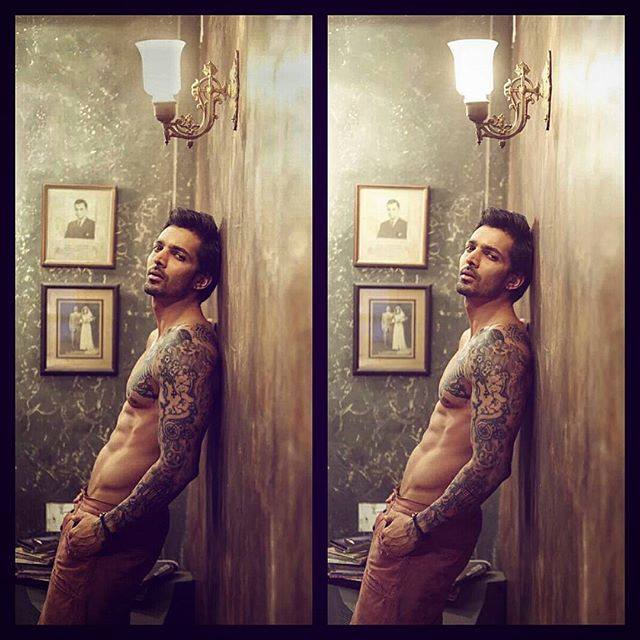
Harshavardhan Rane with his tattoos from Sanam Teri Kasam
In Sanam Teri Kasam, which released earlier this year, Harshavardhan plays a brooding ex-convict who falls in love with the nerdy girl next door. During the filming of the movie, Harshavardhan wrote himself a long backstory about the 8 years his character spends in juvenile prison, so that his performance would be more authentic.
"When God gives you less of something, he balances it out by giving more of something else," he tells me as he starts explaining how he acts. "So I have never been high on IQ but I have a high EQ," he says. "I like doing scenes where my emotional quotient is satisfied. I just cannot go with' a scene without any conviction. Whatever my character does, or says, I need to know the reason behind it. Every actor has a method. This is mine. I have a backstory for every line I say. Even the cat from the film has a story to it."
He pauses before continuing. "Inder, my character sports many tattoos. Even though there is nothing about it in the film, I spun a backstory around it. When I spent my time in jail, someone broke my arm. And that made me want to work on my body, build muscles. And I used the tattoos to cover up the bruises on my arm, until the whole arm started to resemble an armor. A kavach that shielded me from my weak past."
*****
He likes tattoos in real life too. He has a tattoo that he got when he lost his dad, that reads Son Of God.' "I always saw my dad as my hero," he explains to me, "I have deep, immense respect for him."
*****
During the promotions for the movie, Harshavardhan's Hindi was noticeably uncorrupted by English. When I ask him about it, he says, "Back in Gwalior English is very uncommon. If some kid tried talking in English, he would never see the end of all the mocking. So my English used to be bad, but I picked up by watching TV shows and news channels. But I still stick to pure Hindi when I can, thanks to Gwalior."









0