
Happy UGADI GUDI PADWA NEW YEAR CHETI CHAND

PutijaChalhov thumbnail
16th Anniversary Thumbnail Visit Streak 180 Thumbnail + 8
Posted: 14 years ago
#1
Ugadi is the New Year's Day for the people of Andhra Pradesh and also for the Telugu people all over the world. Those who live north of the Vindhya hills observe it as "Barhaspatyamana". People living to the south of the Vindhya hills observe it as "Sauramana" or "Chandramana".

A Unique Ritual
There is a peculiarity about the practices of the various sects of Brahmins; one who is not conversant with them finds it difficult to understand their meaning. Even though they are all Brahmins certain differences in their lineage may be traced among them. These become manifest in their distinctive calendars where the dates and months vary. Some have calculations according to the solar system, and others according to the lunar system; with the result that despite all being Brahmins the New Year differs among different sects. Thus there is a Telugu New Year's Day, a Tamil New Year's Day, and a New Year's distinct from these in the almanac of North India.


According to Chandramana, Ugadi is celebrated on the bright fortnight ('Shukla Paksha') of the first month ('Chaitra Masa') in the first season of the year i.e. Spring ('Vasanta-Ritu'). As all these important elements are present, this day has special significance marking the commencement of a New Year.

Significance
It is believed that the creator of the Hindu pantheon Lord Brahma started creation on this day - "Chaitra Suddha Padhyami" or the Ugadi day. Also the calculations of the great Indian Mathematician Bhaskaracharya proclaim the Ugadi day as the beginning of the New Year, New month and New day. The onset of spring also marks a beginning of new life with plants acquiring new life, shoots and leaves. The vibrancy of life and verdant fields, meadows full of colourful blossoms signify groW*H, prosperity and well-being.

With the coming of Ugadi, the naturally perfumed Jasmine's spread a sweet fragrance, which is perhaps unmatched by any other in nature's own creation. While large garlands of Jasmine are offered to Gods in homes and temples, Jasmine flowers woven in clusters adorn the braids of women.

Predictions Of The Year
Ugadi marks the beginning of a new Hindu lunar calendar with a change in the moon's orbit. On this day, people chant mantras and the pundits make predictions for the coming year. Traditionally, the "Panchangasravanam" or listening to the yearly calendar was done at the temples or at the Town square but with the onset of modern technology, one can get to hear the priest-scholar on television sets right in one's living room.

Preparing For The Occasion
Preparations for the festival begin a week ahead. Houses are given a thorough wash. Shopping for new clothes and buying other items that go with the requirements of the festival are done with a lot of excitement.

Ugadi is celebrated with festive fervour in the states of Maharashtra, Karnataka and Andhra Pradesh. While it is called Ugadi in Andhara and Karnataka, in Maharashtra it is known as "Gudipadava".

On Ugadi day, people wake up before the break of dawn and take a head bath after, which they decorate, the entrance of their houses with fresh mango leaves. The green mango leaves tied to the doorway signify a good crop and general well being. It is noteworthy that one uses mango leaves and coconuts (as in a 'Kalasam', to initiate any puja) only on auspicious occasions to propitiate gods.

People also splash fresh cow dung water on the ground in front of their house and draw colourful floral designs. This is a common sight in every household. People perform the ritualistic worship to God invoking his blessings before they start off with the New Year. They pray for their health, wealth and prosperity and success in business too. Ugadi is also the most auspicious time to start new ventures.

Special Delicacies
It is a season for raw mangoes spreading its aroma in the air and the fully blossomed Neem tree that makes the air healthy. Also, jaggery made with fresh crop of sugarcane adds a renewed flavour to the typical dishes associated with Ugadi.

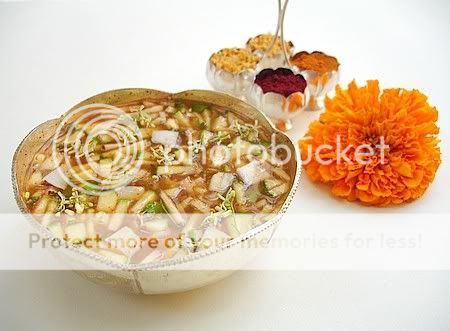
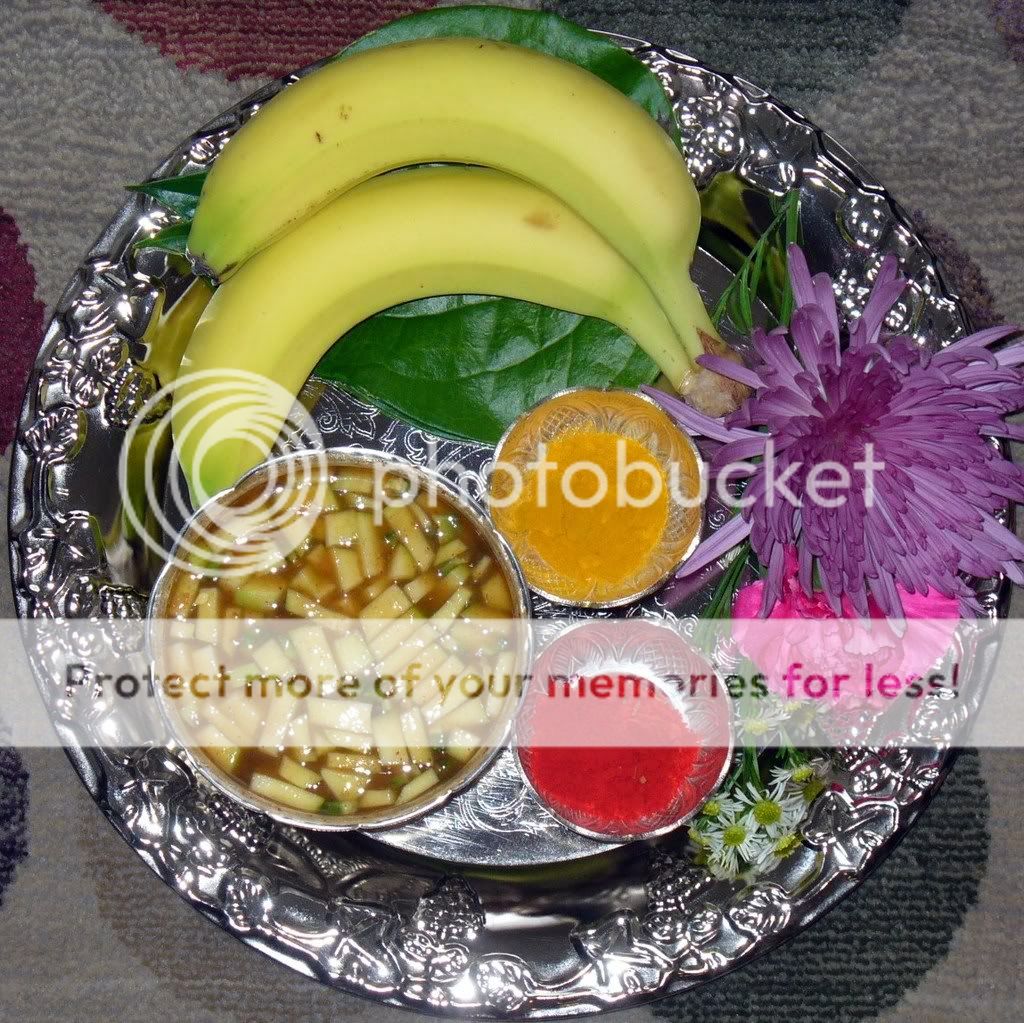
"Ugadi Pachchadi" is one such dish that has become synonymous with Ugadi. It is made of new jaggery, raw mango pieces, Neem flowers and new tamarind. The inner significance of this preparation is to indicate that life is a mixture of good and bad, joy and sorrow and all of them have to be treated alike.

All experiences have to be treated with equanimity. Every one should make a resolve that he will face calmly whatever happens in this year, accepting it with good grace and welcoming everything. Consider everything as for one's own good. Men should rise above sorrow and happiness, success and failure. This is the primary message of the Ugadi festival.

In Andhra Pradesh, eatables such as "Pulihora", "Bobbatlu" and preparations made with raw mango go well with the occasion. In Karnataka too, similar preparations are made but called "Puliogure" and "Holige". The Maharashtrians make "Puran Poli" or sweet 'Rotis'.
ere is the Ugadi Panchanga Sravanam 2011-2012 and Mundane astrology predictions for Khara nama samvatsaram. Ugadi, Telugu New Year and Kannada New Year day or the first day in Chaitra month, onsets the New Year for Andhra Pradesh and Karnataka. 2011 Ugadi is known as Sri Khara nama Samvatsara Ugadhi and the Hindu year is called as Khara Nama samvatsaram. Ugadi Panchangam shravana is recital of astrology predictions (mundane and personal) by the Brahmin or pundit for the Hindu year.

.

In this khara nama samvatsara the kings and the princes will leave their good qualities and embrace bad qualities. They will be engrossed in war. People will be inflicted by diseases. There will be no shortage of food though the rainfall is scanty.



Edited by chalhov - 14 years ago

Created

Last reply

Replies

15

Views

9.8k

Users

15

Likes

75

Frequent Posters

PutijaChalhov thumbnail
16th Anniversary Thumbnail Visit Streak 180 Thumbnail + 8
Posted: 14 years ago
#2
Although the Indian National Calendar is the official calendar for the Hindus, regional variants still prevail. As a result, we have a host of new year festivities that are unique to the particular regions on this vast country. Characteristic of the Indian cultural mlange, Hindus in various states of India celebrate the new year in their own ways. And not all of these fall on the same day!

The Hindus of Kashmir start their new year - Navreh - in mid March. At the same time, the southern Indian states of Karnataka and Andhra Pradesh begin their new year - Ugadi. The Marathas celebrate their new year Gudi Padwa, and the Sindhis observe Cheti Chand, the coming of new year, during the same time. Usually, the Telugu, Kannada, Marathi, Kashmiri and Sindhi New Year falls on the same day - the first day of the month of Chaitra, heralding the advent of spring.

It's Ugadi in Andhra & Karnataka!

The Telugu and the Kannada New Year falls on the first day of the month of Chaitra (March-April). People in Andhra Pradesh and Karnataka states in the South of India believe that Lord Brahma began the creation of the universe on this auspicious day of Ugadi. People prepare for the new year by cleaning and washing their houses and buying new clothes. On the Ugadi day they decorate their houses with mango leaves and "rangoli" designs, and pray for a prosperous new year, and visit the temples to listen to the yearly calendar - "Panchangasravanam" as priests make predictions for the coming year. Ugadi is also an auspicious day to embark on any new endeavor.

Bring in the Goodies on Gudhi Padwa in Maharashtra & Goa!

In Maharashtra, the new year is celebrated as Gudhi Padwa - a festival that heralds the advent of spring (March-April). Early on the morning of the first day of the Chaitra month, people finish their ablutions, wear new clothes and decorate their houses with colorful "rangoli" patterns. A silk banner is raised and worshipped, and greetings and sweets are exchanged. People hang "gudhis" on their windows on this day to celebrate Mother Nature's bounty. A "gudi" is a decorated pole with a brass or a silver vessel placed on it.

Cheti Chand - the Sindhi Thanksgiving Day!

The Sindhis celebrate Cheti Chand on their New Year day which coincides with Gudhi Padwa in Maharashtra and Ugadi in Karnataka and Andhra Pradesh. Cheti Chand falls on on the first day of the month of Chaitra, also called 'Cheti' in Sindhi. This day is observed as the birthday of Jhulelal, the patron saint of the Sindhis. On this day, Sindhis worship Varuna, the water god and observe a number of rituals followed by feasts and devotional music, such as bhajans and aartis.

In mid-April, the Bengalis usher in the new year with the Poila Baishakh celebrations, the Assamese in the northeast with Bihu festivals, and the Tamils in the South with Puthandu. Around this time, Hindus in Punjab get agog with Baisakhi, the springtime harvest festival marking the beginning of their new year, and the people of Kerala in the south of India welcome their new year - Vishu.

The Bright Baisakhi of Punjab

"Baisakhi", traditionally a harvest festival, is celebrated on the 13th of April every year, marking the Punjabi New Year. People celebrate the joyous occasion by performing Bhangra and Giddha to the pounding rhythm of the dhol and rings in the New Year. Baisakhi also marks the founding of the Khalsa brotherhood by Sikh Guru Govind Singh.

Shubho Naba Barsha on Poila Baishakh in Bengal!

The first day of the Bengali new year falls on the 13th or 14th of April every year. Called "Poila Baishakh," it's a state holiday in the eastern state of West Bengal and a national holiday in Bangladesh. To welcome the new year or "Naba Barsha", people clean and decorate their houses and invoke Goddess Lakshmi, the bestower of wealth and prosperity. All new enterprises begin on this auspicious day, as businessmen open their fresh ledgers with "Haal Khata"- a ceremomy in which Lord Ganesha is summoned and customers are invited to settle all their old dues and offered free refreshments. The people of Bengal spend the day feasting and participating in cultural activities. Read more

The Boisterous Bohaag Bihu of Assam

The northeastern state of Assam ushers in the new year with the spring festival of Bohaag Bihu or Rongali Bihu, which marks the onset of a new agricultural cycle. Fairs are organized where people revel in gay games. The celebrations go on for days together, and it's a good time for young people to find a companion of their own choice! Young belles in traditional attire sing "Bihugeets" and dance the traditional "Mukoli Bihu". The festive food of the occasion is the "pitha" or rice cakes. People visit each other's houses, exchange gifts and sweets and, greet each other a Happy New Year!

Kerala, Wish You a Happy Vishu!

"Vishu" is the first day in the first month of Medam in Kerala, the beautiful coastal state in southern India. The people of this state - the Malayalees - begin the day early in the morning by visiting the temple and seeing any auspicious sight, which they call "Vishukani." The day is full of the elaborate traditional rituals with tokens called "Vishukaineetam", usually in form of coins, being distributed among the downtrodden. People wear new clothes - "Kodi vastram" - and celebrate the day by bursting firecrackers and enjoying a variety of delicacies at an elaborate lunch called the "sadya" with family and friends. The afternoon and evening is spent in the "Vishuwela".

Tamil New Year: Varsha Pirappu / Puthandu Vazthukal

The Tamil speaking people across the globe celebrate 'Varsha Pirappu' or 'Puthandu Vazthukal', the Tamil New Year, in mid-April. It is the first day of Chithirai, the first month in the traditional Tamil calendar. The day dawns by observing Kanni or viewing auspicious things such as gold, silver, jewelry, new clothes, new calendar, mirror, rice, coconuts, fruits, vegetables, betel leaves, and other fresh farm products. This ritual is believed to usher in good fortune. It is followed by a ritualistic bath and almanac worship called Panchanga Puja. The Tamil Panchangam, a book on New Year predictions, is anointed with sandalwood and turmeric paste, flowers and vermilion powder, and is placed before the deity. Later, it is read or listened to either at home or at the temple.

On the eve of Puthandu, every household is thoroughly cleaned and tastefully decorated - the doorways are garlanded with mango leaves strung together and Vilakku Kolam decorative patterns adorn the floors. Donning new clothes, the family members gather and light a traditional lamp, the kuthu vilakku, and fill niraikudum, a short-necked brass bowl with water and embellish it with mango leaves while chanting prayers. Then they visit neighboring temples to offer prayers to the deity. Traditional Puthandu meal consists of pachadi - a mixture of jaggery, chillies, salt, neem leaf or flowers, and tamarind; green banana and jackfruit preparation and a variety of sweet 'payasam' dessert.


bvs7691 thumbnail
16th Anniversary Thumbnail Voyager Thumbnail Commentator Level 1 Thumbnail
Posted: 14 years ago
#3
Happy New Year to All those who celebrate this joyous occasions.😃
One more part of our Colourful India!
Edited by bvs7691 - 14 years ago
Radev_AvinaFan thumbnail
14th Anniversary Thumbnail Explorer Thumbnail
Posted: 14 years ago
#4
Happy Ugadi to all CBians

In Andhra Pradesh, eatables such as "Pulihora", "Bobbatlu" and preparations made with raw mango go well with the occasion. In Karnataka too, similar preparations are made but called "Puliogure" and "Holige". The Maharashtrians make "Puran Poli" or sweet 'Rotis'.
ere is the Ugadi Panchanga Sravanam 2011-2012 and Mundane astrology predictions for Khara nama samvatsaram. Ugadi, Telugu New Year and Kannada New Year day or the first day in Chaitra month, onsets the New Year for Andhra Pradesh and Karnataka. 2011 Ugadi is known as Sri Khara nama Samvatsara Ugadhi and the Hindu year is called as Khara Nama samvatsaram. Ugadi Panchangam shravana is recital of astrology predictions (mundane and personal) by the Brahmin or pundit for the Hindu year.

It is a season for raw mangoes spreading its aroma in the air and the fully blossomed Neem tree that makes the air healthy. Also, jaggery made with fresh crop of sugarcane adds a renewed flavour to the typical dishes associated with Ugadi.

"Ugadi Pachchadi" is one such dish that has become synonymous with Ugadi. It is made of new jaggery, raw mango pieces, Neem flowers and new tamarind. The inner significance of this preparation is to indicate that life is a mixture of good and bad, joy and sorrow and all of them have to be treated alike.

All experiences have to be treated with equanimity. Every one should make a resolve that he will face calmly whatever happens in this year, accepting it with good grace and welcoming everything. Consider everything as for one's own good. Men should rise above sorrow and happiness, success and failure. This is the primary message of the Ugadi festival.
chipak thumbnail
16th Anniversary Thumbnail Voyager Thumbnail + 2
Posted: 14 years ago
#5
Thanks Chalhov for thw Wishes and complete informatica😃 earlier just knew Ugadi to be new year for Andhra and Karnataka...
Happy Ugadi to all
jsre thumbnail
15th Anniversary Thumbnail Navigator Thumbnail
Posted: 14 years ago
#6
This Ugadi, may you be blessed with good fortune as long as Ganeshji's trunk, wealth and prosperity as big as his stomach, happiness as sweet as his ladoos and may your trouble be as small as his mouse. Happy Ugadi
radev24 thumbnail
15th Anniversary Thumbnail Stunner Thumbnail + 2
Posted: 14 years ago
#7
Thank you Putija for such a detailed information on our colourful festivals ! 👏😃
So amazing to know the divesities yet similarities in all these joyous events !
misti73 thumbnail
16th Anniversary Thumbnail Sparkler Thumbnail + 4
Posted: 14 years ago
#8
Happy New Year to everybody who are celebrating.
ashna26 thumbnail
15th Anniversary Thumbnail Sparkler Thumbnail + 2
Posted: 14 years ago
#9
Thanks Chalhov for this info.
Happy Ugadi Gudi Padwa to everyone who celebrate
Edited by ashna26 - 14 years ago
MysteryGirl101 thumbnail
16th Anniversary Thumbnail Voyager Thumbnail Networker 1 Thumbnail
Posted: 14 years ago
#10
thx for the info
Happy Ugadi Gudi Padwa for all who celebrate this

Related Topics

Top

Stay Connected with IndiaForums!

Be the first to know about the latest news, updates, and exclusive content.

Add to Home Screen!

Install this web app on your iPhone for the best experience. It's easy, just tap and then "Add to Home Screen".