We can divide the above question into 3 sub-questions:
- Why 1947?
- Why 15th August?
- Why midnight?
Let us look into each of the above and find out the answers
Why 1947?
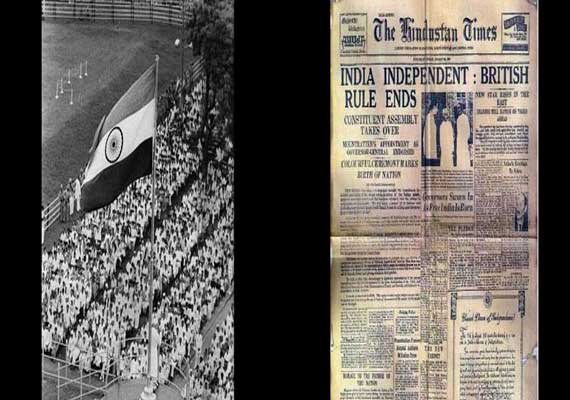
The awakening of masses by Gandhiji and the activities of Bose behind the scenes (of strengthening Indian National Army) which had intensified during 1940s were already a cause of concern for the British.
By the time the World War II had come to an end in 1945, the British were financially weak (sources indicate they were in the verge of bankruptcy) and were struggling to rule their own country, let alone their colonies. The victory of Labour party in the Britain elections of 1945 was received very well by our freedom fighters because the Labour party had promised to work on granting independence to English colonies including India.
Link to their 1945 election manifesto:
https://www.labour-party.org.uk/manifestos/1945/1945-labour-manifesto.shtml/
Lord Wavell initiated talks with Indian leaders for Indian Independence and despite several disagreements and disruptions, it was gaining momentum. In Feb 1947, Lord Mountbatten was appointed as the last viceroy of India to oversee the transfer of power.
Lord Mountbatten presiding over the "June 3 plan
The plan initially was to transfer power from Britain to India by June 1948. Immediately after assuming power in Feb 1947, Lord Mountbatten had begun series of talks with Indian leaders for a consensus. But things were not so simple especially due to conflicts between Jinnah & Nehru on the matter of partition. Jinnah's demand for a separate nation had instigated large scale communal disturbances across India and upon passing of each day, situation was going out of control. This was certainly not something expected by Mountbatten and hence such circumstances forced him to prepone the date of independence by almost an year, from 1948 to 1947. It was decided in the meeting (related to independence & partition) on June 3, 1947 which was aptly titled "June 3 Mountbatten plan".
Why 15th Aug?
It was Lord Mountbatten who had personally decided the date of Aug 15 because he had considered that date to be "very lucky" for his career. During the World War II, it was on Aug 15, 1945 (Japan timezone) that the Japanese Army had surrendered before him (Lord Mountbatten was the commander of the allied forces).
Why midnight?
When the date of independence was decided in "June 3 plan" and announced to public, there was an outrage among astrologers across the country because 15-Aug-1947 was an "unfortunate & unholy" date according to astrological calculations. Alternative dates were suggested but Lord Mountbatten was adamant on Aug 15 (since it was his lucky date). As a workaround, the astrologers suggested the midnight hour between Aug 14 and 15 due to the simple reason that the day according to English starts at 12 AM, but according to Hindu calendar, starts at sunrise.
Detailed reasons can be found in this astrological analysis:
https://www.journalofastrology.com/article.php?article_id=371
https://www.journalofastrology.com/article.php?article_id=364
The astrologers had insisted that the speech of acknowledgement of transfer of power be done within the 48 minutes window (referred to as "Abhijeet Muhurta") which lasted between 24 minutes before and after 12:15am i.e between 11:51pm & 12:39am. Nehru had to deliver a speech only within that timeframe and an additional constraint was that the speech had to end by 12 AM, so that the holy conch (Shanka) be blown to herald the birth of a new nation at the stroke of midnight hour, and the rest is history.
More about Nehru's speech of 15th Aug 1947:
https://guruprasad.net/posts/nehrus-tryst-with-destiny-speech/
Here is a very rare, color video mini-documentary (6 mins) covering the events of 1947 leading to Indian Independence:
https://www.youtube.com/watch?v=LXFc0biIhV4
Today is a day of celebration and to realize our freedom. Thousands of our freedom fighters sacrificed their lives and millions of them struggled in order to drive away British rulers and constituted a system of democracy centered around us i.e voters, so that we have a say in the Govt. How our nation has fared over the last 67 years is something we cannot change but the future is in our hands. Let us ensure that we exercise our rights and proudly participate in our democracy so that our nation heads in the right direction
Happy Independence Day
Jai Hind!!
Saare Jahaan Se Accha Hindustan Humara...
Did You Know?
Indian Railways has total 1.4 million employees which is equivalent to the entire population of many countries such as Trinidad and Tobago, Estonia, Mauritius, Bahrain, Cyprus, Luxembourg, Iceland, Liechtenstein, Monaco, Vatican City and more. I have only mentioned a few countries names here not all.
Shani Shingnapur is one of the most amazing village of India. All houses in the village didn't have doors including their shops and halls. They have never kept their valulable things in lock and key. No theft has been reported yet in the village, it is the most amazing fact about India. This village is situated in Nevasa taluka of Ahmednagar district of Maharashtra state in India.

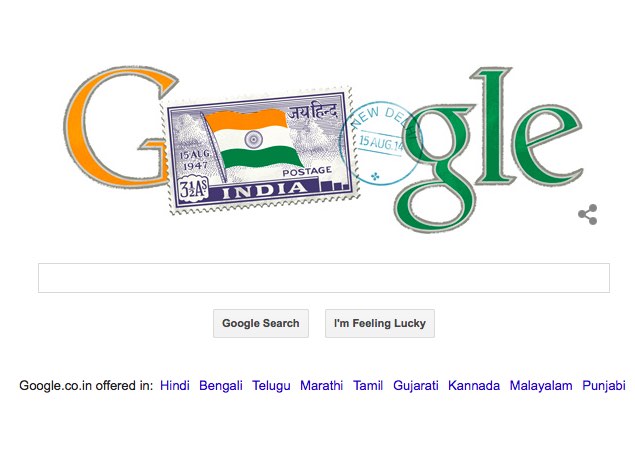
India has a long history to tell about itself since independent till now. On the occasion of India's 68th Independence Day, here are some interesting and unknown facts related to India and independence.
National flag was hoisted first on August 7, 1906 at the Parsee Bagan Square in Calcutta. The flag was composed of horizontal strips of red, yellow and green. The red strip at the top had eight white lotuses embossed on it in a row. The green strip had a white sun on the left and a white crescent and star on the right.
The name 'India' is derived from the River Indus, the valleys around which were the home of the first inhabitants of India. The Sanskrit name for India is Bharat Ganarajya. That is the reason why it is also called Bharat. The name "India" comes from the Indus River, which is where earliest settlers made their homes.
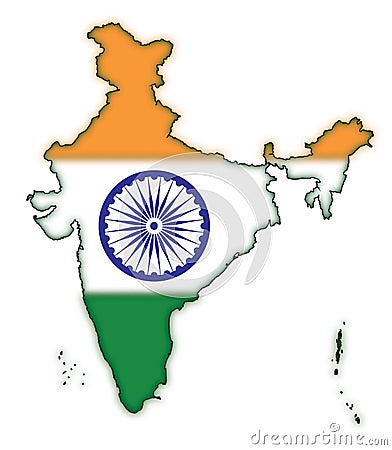
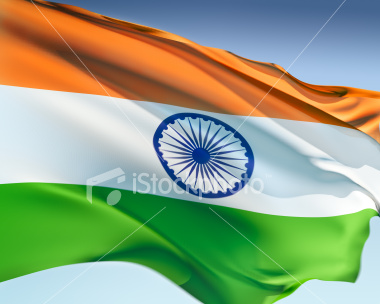
The current flag has three colours in it. The top strip saffron stands for courage and sacrifice; the middle portion white for peace, truth, purity and green for faith, fertility and chivalry. The Ashok Chakra at the centre of the flag " righteousness.
India never invaded any country in her last 100000 years of history.
It is said that the first version of the current national flag was made by Pingali Venkayya at Bezwada in 1921. It was made up of two colours-red and green-representing the two major communities. Gandhiji suggested the addition of a white strip to represent the remaining communities of India and the spinning wheel to symbolize progress of the Nation.
North Korea, South Korea, Bahrain and Republic of the Congo share their independence day with India.
India is the world's largest producer of tea, milk and mangoes and also the second largest producer of wheat and rice, the world's major food staples.
"Chess" and "Snakes and Ladders" were invented in India.
India never invaded any country in her last 100000 years of history.
The world's largest road network is in India-over 1.9 million miles of roads cover the country.
Cherrapunji & Mausynram (Meghalaya) is the wettest spot on earth. It receives at least 425 inches of rain every year, which is over 5 times more than the tropical rain forests of South America!
There are 300,000 active mosques in India, more than in any other country, including the Muslim world.
Rani Laxmi Bai, the Queen of Jhansi, lead her people into a battle against the British in which she fought like a tiger, and was killed heroically.
Mahatma Gandhi, the father of the nation, lead the country to freedom with his non-violent ideals. He remains a symbol of peace to this day.
Sardar Vallabhai Patel was responsible for uniting the princely states into one country.
Bal Gangadhar Tilak, remembered for his court statement in which he proclaimed 'Swaraj is my birthright, and I will have it!'
Bhagat Singh, threw a bomb when the Legislature was in session, and was arrested and hung.
Maulana Abul Kalam Azad was elected President of the Congress when he was just 35.
Dr. Annie Besant, a Britisher, supported India's freedom struggle wholeheartedly and founded the Home Rule league in India.
Ashfaqualla Khan, a revolutionary who was given the death sentence, kissed the noose before it went around his neck.
Vanchinathan (1886 to 1911)
Vanchinathan was born in Shenkottai, Tamilnadu. He obtained his masters degree from Thiruvananthapuram. As a youth, he participated in the freedom movement of India. He could not tolerate the atrocities committed by the British. He wanted to take revenge on them. On June 17, 1911, he assassinated Ashe, the District Collector of Tirunelveli. He shot Ashe at point blank range when Ashe's train stopped at the Maniychi Junction on the way to Madras. The British response was brutal. He committed suicide to avoid capture by the British.
Tiruppur Kumaran (1904 to 1932)
Kumaran was a revolutionary who participated in the Indian freedom movement. He was born in Erode district of Tamilnadu. One day he participated in a freedom march in Tiruppur. He was holding the Congress flag. The police ordered him to drop the flag on the floor. Kumaran refused. The police beat him to death in the street in front of hundreds of people. Finally he died unable to withstand the beatings from the police. His body fell down on the street. His hand was still holding the flag high.
Alluri Sita Rama Raju (1897 to 1924)
Alluri Sita Rama Raju still remains an inspiring model of people who fought oppression. He led the Ramba Rebellion. Raju raided many police stations in and around Chintapalli and killed many British officers. Despite having fewer weapon and men, he exacted tremendous damage to the British. The British campaign to arrest him lasted more than one year. He was finally captured in the forests of Chintapalli. He was tied to a tree and short dead with a rifle. British were proud of their justice system but followed the law of the jungle.
Rani Channamma and Sangolli Royanna
Rani Channamma, the Queen of Kittur, refused a surrender offer by the British and instead attacked the enemy surrounding her fort. The Queen and her small army put up a heroic fight but was eventually defeated. She was imprisoned.
Sangolli Royanna, an employee of Kittur State, gathered a considerable band and carried forward the fight. He was later overpowered, arrested, and hanged in 1830.
Tipu Sultan (Urdu : )(Kannada: ), (20 November 1750 - 4 May 1799), also known as the Tiger of Mysore and Tippoo Sahib,was a ruler of the Kingdom of Mysore and a scholar, soldier and poet. Tipu was the eldest son of Sultan Hyder Ali of Mysore and his wife Fatima Fakhr-un-Nisa.Tipu introduced a number of administrative innovations during his rule, including the introduction of a new coinage, a new Mauludi lunisolar calendar,and a new land revenue system, initiating the growth of Mysore silk industry.Tipu expanded the iron-cased Mysorean rockets which he deployed in his resistance against military advances of the British
Nawab Siraj-ud-Daula
Mirza Muhammad Siraj ud-Daulah (Urdu: , Bengali: -), more commonly known as Siraj ud-Daulah (1733 - July 2, 1757), was the last independent Nawab of Bengal. The end of his reign marked the start of British East India Company rule over Bengal and later almost all of South Asia.
Siraj succeeded his maternal grandfather, Alivardi Khan as the Nawab of Bengal in April 1756 at the age of 23. Betrayed by his own uncle Mir Jafar, then commander of Bengal's army, Siraj lost the Battle of Plassey on 23 June 1757. The forces of the East India Company under Robert Clive triumphed and the administration of Bengal fell into the hands of the Company.
Pazhassi Raja (1753 to 1805)
Pazhassi Raja was known as the Lion of Kerala. He was a prince from the royal dynasty of Pazhassi Kottayam. Pazhassi Raja resisted British imperialism from 1793 onwards till his death in 1805. He fought two wars to resist English intervention in domestic affairs of his kingdom. On November 30, 1805, the Raja and his assistants were camping near the stream named Mavila. Raja and party were caught by surprise and an intense but short fight followed. Six rebels were killed. One of the earliest rebels to be killed was Pazhassi Raja.
Captain Lakshmi (Born October 24, 1914)
Captain Lakshmi participated in the Indian Independence Movement. She is a doctor by profession. At the end of World War II, she joined Indian National Army, an armed force formed by Subash Chandra Bose. Captain Lakshmi served as the Commander of the Rani of Jhansi Regiment of the INA. She was also a Minister in Subash Chandra Bose's Azad Hind Government. She was taken as a prisoner in Burma. (Even though she became a Lt.Col., at the time of her arrest she was a Captain. Therefore, this title for her became popular.)
Some of the more prominent freedom movements were:
The Mutiny of 1857
This mutiny was the turning point of the freedom movement, though it was suppressed by the British. It was the first organized freedom struggle on such a large scale, and paved the way for further struggles for freedom.
The Civil Disobedience Movement of 1929
It was decided to celebrate Indian Independence Day on the 26th of January. On this day the freedom fighters, spearheaded by Mahatma Gandhi, hoisted India's national flag. It was decided to completely disregard the orders of the British Government.
The Dandi March of 1930
Gandhi lead a 241-kilometer march to Dandi at the age of 61, and proceeded to make salt in defiance of the law by non-violent means. The British had to arrests millions to enforce the law, causing panic in the administration. This march, in fact, was the first strategy of the Civil Disobedience Movement.
The Quit India Movement of 1942
The year 1942 is now identified more with the movie 1942: A Love Story, than it is with the Quit India Movement! This movement called for a widespread, non-violent struggle for India's freedom. Before long there were revolts all over the country, demanding that the British 'quit India'.



















 Health and Fitness
 Kyunki Saas Bhi Kabhi Bahu Thi 2

