
🏏IPL 2026:Royal Challengers Bengaluru vs Gujarat Titans, Final🏏

Kickoff Legends: FIFA World Cup 2026 Prediction Game (Sign up Open)

Episode dtd 31.5

Ranveer Singh at UEFA (PSG vs Arsenal match)
Kyunki To Get Another Spinoff
13 years of Yeh Jawaani Hai Deewani

How cbse rewrote rules to favor coempt eduteck

Jis Awaaz Se Pyaar Hua - ArYa FS



image and sentence formation credit to chat gpt
║ The Devotion of Attendants ║
══════════════════════
The Hall of Offerings did not empty quickly.
Farewells never do.
People imagine grief as something loud.
Wailing.
Collapsed bodies.
Broken voices.
But palace grief was different.
It wore discipline.
Straight backs.
Folded hands.
Eyes lowered while hearts came apart quietly.
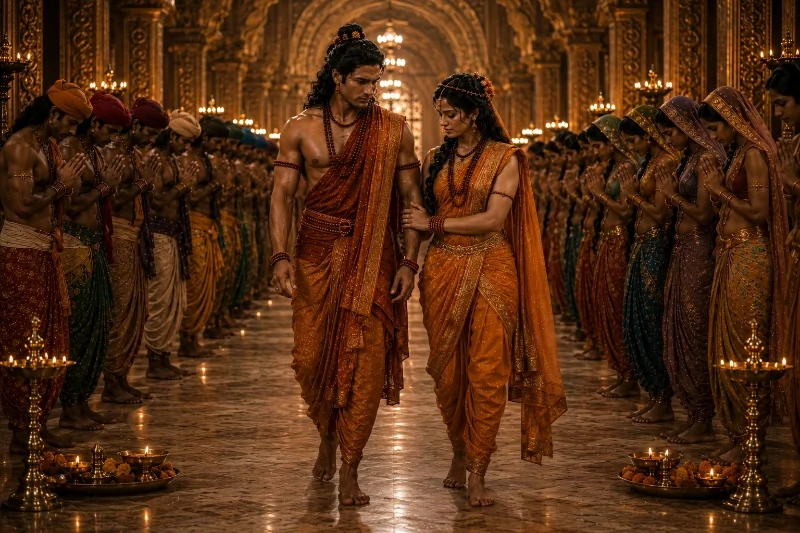
The lamps had burned lower now.
Wax gathered near brass edges.
The shadows lengthened.
Still no one left.
Because everyone understood without saying it:
This might be the last ordinary night.
Not last sight.
Not last memory.
Ordinary.
After tonight, every remembrance would become sacred.
Every word reexamined.
Every glance preserved.
The way people preserve the final fragrance on abandoned clothes.
Lakshman and Urmila, walking through the corridors, the attendants with hands joined and heads lowered, stood on either sides.
The royal couple stood before rows of men and women who had spent years surrounding their life.
Not at the center.
Around the edges.
The people history rarely records.
Yet kingdoms stand because such people exist.
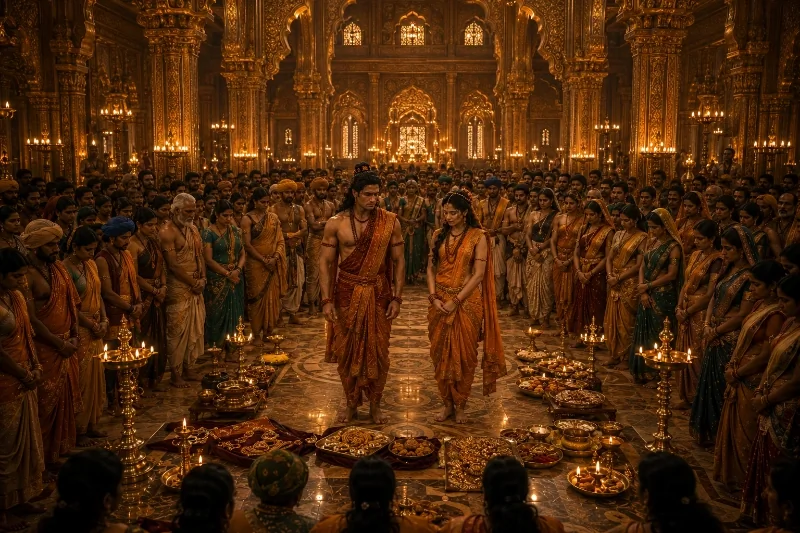
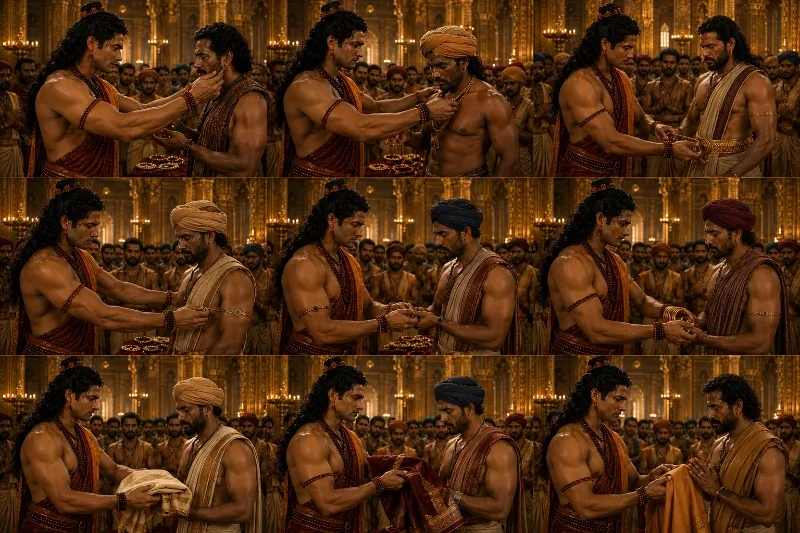
Various types of jewelry and costumes kept on the large tables.
Lakshman took a pair of bracelets from the table and handed it to Vir
Although after repeated protests, he obeyed the commands of the prince.
Vir remained clutching the bracelets against his chest.
Unable to move.
His large hands looked strange holding something delicate.
He had spent decades holding swords.
Shield straps.
Bloodied armour.
Not gifts.
Not farewells.

Nearby another man stepped forward slowly.
Kirit.
Chief among ceremonial attendants.
Responsible for dressing Lakshman before assemblies, festivals, royal appearances.
Many believed such work simple.
It wasn't.
Kirit knew which colours Lakshman preferred after difficult weeks.
Which fabrics irritated old training scars.
How tightly arm guards should be fastened before archery demonstrations.
Tiny knowledge.
Accumulated through years.
Love often disguises itself as observation.
Kirit bowed deeply.
Lakshman took an embroidered shawl from the table.
Ancient.
Heavy.
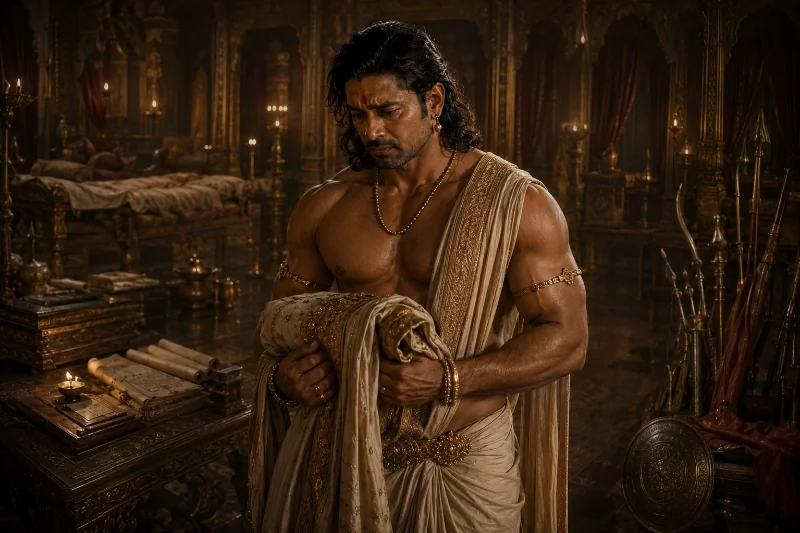
Kirit froze.
His lips parted.
Then closed.
His breathing became uneven.
Finally:
"My prince..."
His voice sounded old.
Older than his years.
Lakshman waited.
Kirit looked at the shawl and whispered:
"Do you remember the spring festival thirteen years ago?"
Lakshman's brows drew together faintly.
Kirit continued:
"You were angry."
A small smile trembled through tears.
"Prince Bharat had defeated you during horse races."
A few attendants lowered heads to hide weak laughter.
Lakshman remembered.
Barely.
Kirit did not.
Because servants remember strange things.
He continued:
"You refused ceremonial robes."
Another shaking breath.
"You said silk slowed warriors."
Silence.
Then:
"You stood arguing while I followed carrying three different garments."
Even Lakshman's expression softened.
Kirit laughed once.
A broken sound.
"I spent two hours persuading you to wear proper attire before court."
His eyes filled completely.
"And afterward..."
His throat tightened.
"...afterward you thanked me."
Lakshman stared.
Kirit looked downward.
"As if I had done something extraordinary."
Tears slipped freely now.
"I returned to my quarters and told my family..."
His voice broke.
"...I told them our prince thanked attendants as though they were equals."
The room went still.
Because many there remembered similar moments.
Not grand gestures.
Tiny ones.
The dangerous thing about kindness—
is people begin loving you without permission.
Kirit accepted the shawl.
Then suddenly dropped to his knees.
Not protocol.
Instinct.
His forehead touched Lakshman's feet.
His shoulders shook violently.
Not with duty.
With grief.
And Lakshman's hand moved immediately—
lifting him before full prostration finished.
Because he never liked it.
Never had.
"Enough," Lakshman murmured.
But his own voice sounded strained.
Kirit looked at him with reddened eyes.
And whispered:
"Who will remind you to eat after training now?"
The question struck harder than tears.
Because it was ordinary.
Human.
Because grief often hides inside practical concerns.
Who will prepare medicines?
Who will notice exhaustion?
Who will argue over meals?
Love survives through repetition.
—
Another approached.
Charcoal-skinned.
Broad.
Scarred forearms.
Dhruv
He supervised wrestling grounds.
Physical training.
Oil massages after combat practice.
Muscle recovery.
Herbal treatments.
For years he had witnessed Lakshman's body transformed through discipline.
He knew the timings of his training sessions.
Ready with herbal oil after his trainings ended.
He remembered his scratches.
One faint mark on wrist earned protecting Shatrughn as children.
Lakshman offered him a waistbelt.

Dhruv stared.
Then laughed unexpectedly.
A bitter sound.
The hall looked up.
Dhruv wiped his eyes roughly.
"Forgive me."
Silence.
Then:
"I was remembering..."
His voice roughened.
"The first time you defeated me in wrestling."
Lakshman's mouth moved slightly.
Almost smiling.
Dhruv continued:
"You were sixteen."
Another laugh.
"You celebrated for days."
Some attendants smiled through tears.
Lakshman said quietly:
"I celebrated because you stopped treating me like a child afterward."
Dhruv's face crumpled instantly.
Because memory became unbearable.
His hands covered his mouth briefly.
Then he whispered:
"You kept training until your hands bled."
His chest shook.
"And afterward..."
His eyes filled.
"...you apologized whenever my joints hurt from sparring."
His expression collapsed entirely.
"My prince..."
Tears came without restraint.
"What kind of man apologizes to servants for pain earned protecting him?"
No answer.
Only silence.
Because everyone present wondered similar things.
What kind of prince leaves attendants grieving like family?
—
Near the far pillars, where shadows gathered thicker and conversations had become whispers, stood Megh.
One among chief attendants.
Simply present.
Always present.
Years in service had made him nearly invisible in the way devotion often becomes— people stop noticing what never fails.
Megh had served near Lakshman's private quarters since youth. Carrying messages. Preparing weapons before dawn hunts. Waiting outside during sleepless nights. Fetching medicines after injuries. Silent work. Endless work.
The kind history erases.
His eyes remained lowered now.
Because he had watched everyone receive something.
And expected nothing.
People who spend years serving often become skilled at expecting little.
Lakshman noticed.
Of course he noticed.
His gaze shifted toward the man standing near the back.
"Megh."
The name cut softly through the hall.
Megh startled.
Looked up immediately.
Straightened from instinct.
"My prince."
Lakshman held something in his hand.
A golden necklace.
Not excessively ornate.
Old craftsmanship.
Heavy.
The kind passed through generations.
The lamps caught against its surface.
Several attendants looked over.
Megh faintly.
Confused.
Lakshman stepped closer.
Not far.
Enough.
Then extended the necklace.
"For you."
Silence.
Megh stared.
Did not move.
His expression changed slowly—
confusion first.
Then disbelief.
Then something sharper.
Fear.
His voice emerged almost inaudible.
"...There must be a mistake."
Lakshman's brows lifted slightly.
"There isn't."
Megh stepped back once.
Actual retreat.
His hands behind him.
"No."
The refusal startled nearby attendants.
Lakshman looked at him quietly.
Megh swallowed hard.
His throat worked.
"My prince..." His breathing grew uneven. "This belongs among nobles."
Lakshman's answer came immediately.
"It belongs where I wish."
Still—
Megh did not take it.
His eyes had reddened unexpectedly.
The hall watched.
Because grief creates strange courage.
And suddenly Megh laughed once.
A terrible sound.
Small.
Broken.
His hands trembled at his sides.
"You know..." he whispered, staring at the necklace, "when I first entered palace service..."
His voice caught.
"...I was thirteen."
Silence.
"I dropped your practice bow."
A faint shift moved through Lakshman's face.
Memory.
Megh laughed again through tears.
"You had spent weeks adjusting its grip."
Another shaking breath.
"I was terrified."
His eyes glistened fully now.
"I thought I'd be dismissed."
The hall remained motionless.
Megh looked downward.
"But instead..."
His mouth trembled.
"...instead you helped me pick up the pieces."
Long pause.
His voice lowered further.
"You apologized."
A tear escaped.
"As though I had been frightened because of your failure."
His chest rose unevenly.
"You were sixteen."
Another tear.
"And afterward..."
His expression collapsed slowly.
"...afterward you remembered my name."
Silence deepened.
Because everyone understood.
The dangerous thing about kindness—
people build entire loyalties around moments the giver forgets.
Megh whispered:
"Princes remember victories."
His eyes lifted toward Lakshman.
"You remembered servants."
The words landed heavily.
His breathing broke.
Years breaking with it.
Then suddenly—
anger appeared beneath grief.
Raw.
Unexpected.
His eyes reddened further.
"Do you know what I hated most?"
The hall stilled.
Lakshman waited.
Megh laughed bitterly.
"You never allowed distance."
Tears slipped freely now.
"When I worked through fever— you noticed."
His voice sharpened.
"When my father had fever — you sent food for my mother every month."
More tears.
"When my younger sister married—"
His throat tightened.
"...you gave gifts anonymously because you knew pride would stop me accepting charity."
His shoulders shook.
He looked wounded.
Actually wounded.
"What was I supposed to do with that?"
The question cracked through the hall.
His voice rose—
not disrespect.
Despair.
"What was I supposed to become after being treated like..." His breathing failed.
Long silence.
Then, broken:
"...like I mattered?"
No one moved.
Because some grief arrives as accusation.
How dare you be kind enough to become necessary.
Megh covered his face briefly.
Then whispered:
"I built my life around serving you."
The confession sounded naked.
Terrifying.
His hands dropped slowly.
His eyes swollen.
"And now..."
Another breath.
"...now you are leaving."
Not prince.
Not master.
Simply—
leaving.
Lakshman's expression changed.
Almost imperceptibly.
Pain.
Quiet pain.
He stepped forward.
Placed the necklace firmly into Megh's trembling hands.
Closed the man's fingers around it.
Not ceremonially.
Personally.
Then spoke.
His voice low.
Steady despite strain.
"Megh."
The younger man looked up immediately.
Always.
Lakshman held his gaze.
"You think your years beside me disappeared into duty."
Silence.
"They did not."
Another breath.
"You remembered my weapons."
His voice softened.
"My routines."
"When anger required silence."
"When exhaustion required food."
"When sleeplessness needed company without conversation."
Megh's face crumpled.
Lakshman continued:
"You protected pieces of my life no one noticed."
His throat moved once.
"And men survive because someone remembers such things."
The hall had gone entirely still.
Then Lakshman said quietly—
more quietly than before:
"I was never served by strangers."
Megh stopped breathing for one terrible second.
Because some sentences undo people.
Lakshman's eyes remained fixed on his.
"I was surrounded by my own."
His own.
The necklace slipped slightly in Megh's shaking grip.
A sob escaped him before he could stop it.
Humiliating.
Human.
He fell—
not fully to his knees—
because Lakshman's hand caught his shoulder first.
Stopped him.
As always.
Megh broke completely then.
Years of restraint dissolving.
His forehead lowered against Lakshman's arm.
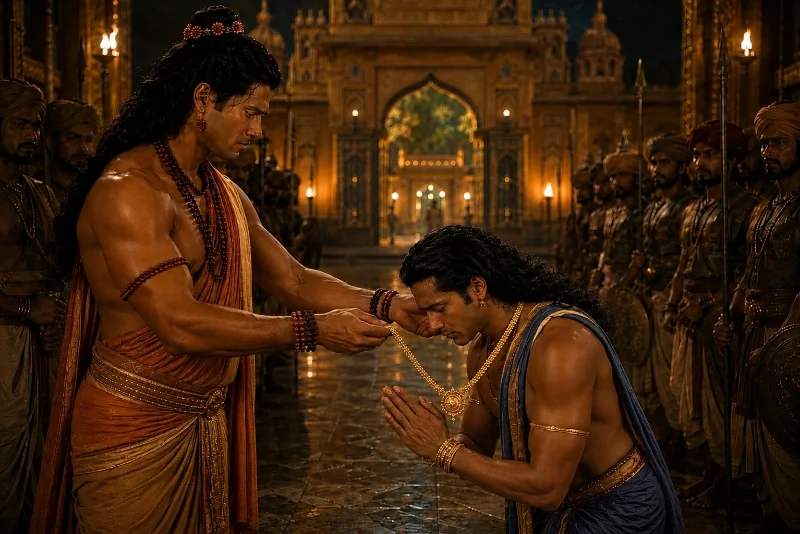
Not protocol.
Not servant and prince.
Someone grieving someone.
And his final words came muffled, destroyed by tears:
"...Then come back."
The hall inhaled sharply.
Because there it was.
Beneath all gifts.
All rituals.
All dignity.
The real prayer.
Not victory.
Not glory.
Only—
Come back.
Please.
Come back victorious.
And for one fleeting moment—
Lakshman closed his eyes.
As though carrying the weight of every person he was leaving behind.
Then opened them again.
Steady.
Always steady.
But his hand remained on Megh's shoulder longer than necessary.
Long enough to answer what words could not.
—
One by one he gifted all of his guards and attendents , either jwellery or costumes.
No one left.
Across the hall—
The women surrounding Urmila had begun unraveling too.
Not loudly.
Slowly.
Like silk threads pulled apart.
Chitra stepped forward.
Youngest among senior attendants.
Responsible for garments and adornment.
Quick fingers.
Gentle temperament.
She had dressed Urmila for festivals.
Ceremonies.
Temple visits.
Mornings after sleepless nights.
Urmila held out gold anklets.
Chitra stared at them.
Unmoving.
Then suddenly tears spilled.
Not delicate tears.
Angry ones.
Her voice emerged sharp:
"No."
Several women looked up.
Startled.
Chitra rarely raised her voice.
Ever.
She stepped backward.
Hands shaking.
"No."
Again.
Urmila blinked softly.
"Chitra—"
The young woman interrupted.
A shocking thing.
"My lady..."
Her breathing turned uneven.

"You once sat three hours while I unpicked damaged embroidery because I feared ruining your wedding sari."
Silence.
Chitra cried openly now.
"And when my parents were ill..."
Her face twisted.
"...you came yourself."
The hall quieted further.
No one knew.
Chitra continued:
"You sat beside me all night."
Tears fell harder.
"You held my hand ."
Her voice shattered.
"My parents were ill..."
A sob escaped.
"...and afterward you remembered which herb is needed to be prepared."
Even Urmila looked stunned.
Because kindness given naturally is often forgotten by the giver.
Never by receiver.
Chitra pressed palms together desperately.
"So tell me—"
Her words came broken.
"How am I supposed to wear jewels from someone who became..."
Her throat closed.
Long silence.
Then:
"...became home?"
The final word destroyed whatever restraint remained.
Women began crying openly.
Madhu.
Charu.
Others.
Even older attendants.
Because grief spreads.
Not through sound.
Recognition.
Urmila moved first.
Always calm.
Always steady.
She stepped forward.
Removed protocol entirely.
And cupped her face.
Not princess and attendant.
Woman and woman.
The younger one collapsed instantly.
Years of restraint dissolving.
The hall looked away.
Not from disrespect.
From reverence.
—
Restraint weakened.
Not shattered.
Softened.
The way first rain loosens earth before storms arrive.
When Chitra finally stepped back, wiping tears with trembling hands, another figure remained standing near the carved pillars.
Madhu.
Older than Chitra.
Not by many years.
But enough.
Her work had never involved jewels or ceremonial garments. Madhu managed smaller things.
Hair oils.
Medicinal herbs.
Night lamps.
Warm water during winters.
Things unnoticed unless absent.
She had served quietly for years.
The dangerous thing about quiet people.
—
is everyone assumes they need less love.
Urmila's eyes found her immediately.
Of course they did.
"Madhu."
The woman startled faintly, as if caught hiding grief.
Her hands folded automatically.
"My lady."
Too formal.
After all these years.
Urmila studied her a moment.
Then slowly took the delicate nosepin from her table.
Small.
Gold.
A tiny pearl at the center.
Simple by royal standards.
Yet unmistakably hers.
Madhu frowned immediately.
Confused.
Then alarmed.
"My lady—"
Urmila stepped closer and placed it into her palm.
The older attendant stared.
Unmoving.
As though the object burned.
Silence stretched.
Then Madhu whispered:
"...No."
Not refusal.
Fear.
Her fingers trembled beneath the ornament.
Urmila smiled faintly.
The exhausted kind.
"You have adjusted this before every festival for years."
Madhu inhaled sharply.
Because it was true.
The clasp was difficult.
Tiny.
Once, during winter, her fingers had been numb and she had pricked Urmila's skin accidentally.
She remembered apologizing repeatedly.
And Urmila had laughed.
Laughed.
At a princess's dressing mirror.
As though blood and mistakes meant nothing.
Madhu stared at the nosepin.
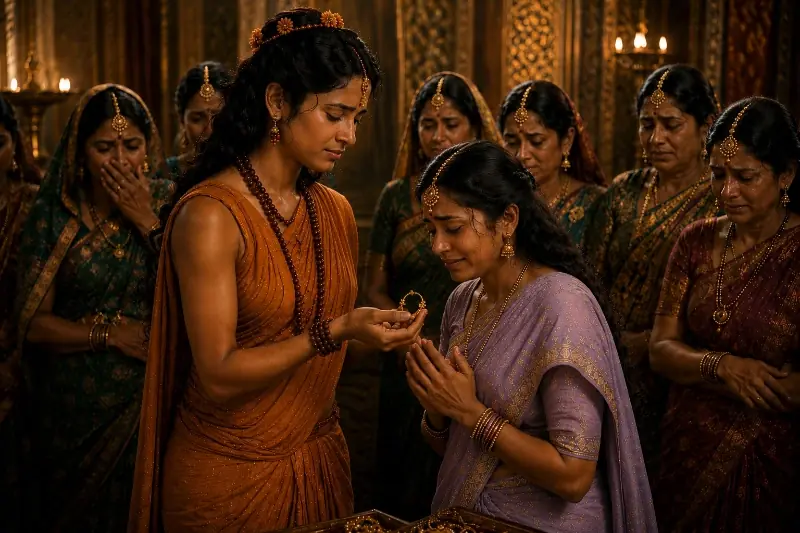
Then spoke without lifting her head.
"You hated wearing this after crying."
The hall quieted.
Urmila blinked.
Madhu continued softly:
"Your nose would redden."
A shaking breath.
"So whenever difficult letters arrived from Mithila..."
Her voice faltered.
"...you stopped wearing pearls for days."
The younger attendants looked up.
Because they hadn't known.
Madhu knew.
Of course she knew.
Women who prepare another woman every morning become witnesses to invisible wars.
Madhu's throat moved painfully.
"I learned your sadness by which ornaments remained untouched."
Tears gathered despite resistance.
"You smiled."
One tear escaped.
"...and I would know whether it was real before anyone else."
Her fingers closed around the nosepin desperately.
Almost protectively.
Then came the whisper:
"What will I do with hands trained to care for someone who is leaving?"
The question entered the room and stayed there.
No answer followed.
Only Urmila reaching forward—
holding Madhu's face briefly between her palms.
Not queenly.
Not noble.
Only affectionate.
Only grateful.
Madhu broke immediately.
Silent tears.
The worst kind.
A few steps away stood Charu.
Always composed.
Among the most skilled with adornments.
Necklaces.
Wedding jewels.
Festival arrangements.
She carried herself with unusual precision.
Because some women survive by becoming useful.
And useful people often forget they are loved.
Her eyes remained lowered.
Too lowered.
Urmila noticed.
Again—
of course she noticed.
Slowly, Urmila took her necklace resting on the table.
Moonstones surrounded by fine gold work.
Charu saw.
Her entire body stiffened.
Instantly.
"No."
Barely audible.
Urmila approached anyway.
The necklace lay across her palms between them.
Years.
The object contained years.
Charu stepped back once.
An involuntary movement.
"My lady…"
Her voice sounded strained.
"I cannot."
Urmila tilted her head slightly.
The same expression she used when attendants skipped meals.
Patient.
Waiting.
Charu's control fractured unexpectedly.
Not tears first.
Anger.
"Do you know—"
Her words emerged uneven.
"—how many nights I untangled these chains after ceremonies because you fell asleep before removing them?"
Silence.
Her breathing changed.
"How many times I scolded you because your hair caught in clasps?"
Another breath.
Sharper.
"And every single time—"
Her voice cracked.
"—every single time you apologized."
Now tears arrived.
Fierce.
Unwanted.
Charu looked at the necklace with wounded eyes.

Then whispered:
"When my daughter married..."
Her throat closed.
The hall waited.
"...you removed your own jewels and sent them quietly because I worried my gifts were insufficient."
Shock moved among several attendants.
Charu covered her mouth briefly.
Trying.
Failing.
"I never thanked you properly."
The confession sounded unbearable.
Small.
Human.
Real.
Her shoulders shook once.
Then again.
Finally:
"You gave dignity where there would have been shame."
A tear landed on the necklace.
Then another.
Charu accepted it with both hands.
Not as wealth.
As memory.
As proof.
And for one impossible moment—
the women around Urmila no longer resembled attendants surrounding royalty.
Only people.
Bound together by years of ordinary tenderness.
Which, in the end,
becomes the most devastating love of all.
—
Near the back stood Kanta.
Still rigid.
Still not able to digest.
Because some people grieve through fury.
Her thick hands remained clenched.
Urmila noticed.
Of course she noticed.
"You have not come forward."
Kanta sniffed.
Refusing tears.
"I dislike farewells."
A weak laugh escaped nearby.
Kanta glared.
Then looked at Urmila.
Really looked.
As if memorizing.
Her expression shifted.
Suddenly old.
"You arrived from Mithila too thin."
Her voice rough.
"I spent months correcting palace kitchens."
Silence.
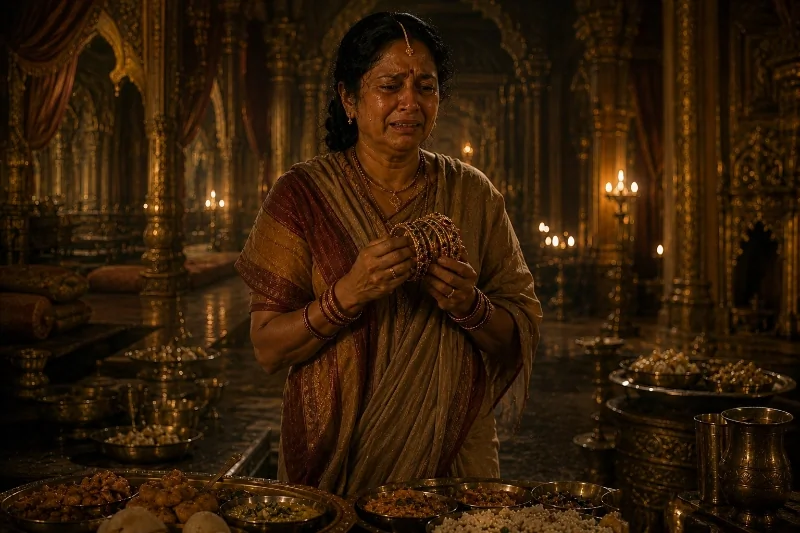
"You disliked certain spices."
Another pause.
"You pretended not to."
Her jaw tightened.
"I noticed."
Her eyes reddened.
"You became quieter during monsoon."
Her breathing changed.
"You fasted too often when worried."
Now tears appeared.
Reluctantly.
Like surrender.
Kanta whispered:
"I have measured your life in meals."
The words stunned the hall.
Because they sounded simple.
Yet contained years.
Years.
"I knew your sadness by untouched plates."
Her voice cracked.
"I knew happiness because you asked for sweets unexpectedly."
More tears.
"I knew homesickness because you wanted Mithilan recipes."
Her shoulders trembled.
Then softly:
"Who am I when there is no one left to feed?"
Urmila stared.
And for the first time—
truly the first—
her composure cracked.
Only slightly.
Her eyes glistened.
Because sometimes people love you through service so consistently
you mistake it for routine.
Until departure reveals:
No.
That was devotion.
Quiet devotion.
Every day.
For years.
—
She gifted each of the attentendents not with gold alone, but with quiet gestures of care—earrings placed gently, bangles slipped on with tenderness, a sari draped like a blessing. Every ornament became a symbol of respect, belonging, and shared womanhood. In the warm glow around them, love was not spoken; it was gifted, one tradition at a time.
—
The night deepened.
Outside, Ayodhya slept uneasily.
Inside—
the Hall of Offerings remained suspended between present and loss.
Jewels changed hands.
Silks folded away.
Bracelets.
Armlets.
Necklaces.
Objects.
No one left.

But beneath every exchange lived another sentence:
Remember me.
Return safely.
Do not forget.
Live.
Please live.
And one by one the attendants accepted gifts—
not because wealth tempted them—
but because someday,
years later,
when grief returned unexpectedly,
they would hold those ornaments in trembling hands
and think:
We are overwhelmed with their services .
I knew them before legends swallowed them.
I knew the prince who apologized.
The princess who remembered mothers.
I knew them
when they were simply
two people
walking toward exile—
while an entire palace stood helpless,
loving them,
and unable to follow.








 Anupamaa
 Music Corner
 Cricket

