Qwest thumbnail
19th Anniversary Thumbnail Rocker Thumbnail Networker 1 Thumbnail
Posted: 18 years ago
#1

Sangam was Raj Kapoor's first colour film.

Dinesh Raheja Sangam hspace5Sangam was Raj Kapoor's first colour film. Its bright colours, European locales and glamour dazzled the eye and senses, and went a long way into turning the film into a blockbuster.
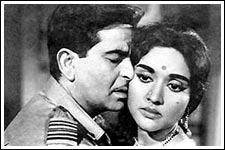
Besides the visual brio, Sangam is also memorable because the untidy human relationships it portrays throb with intensity. The husband-wife relationship between Raj Kapoor and Vyjayanthimala with its messily intermingled strands of love and hurt, for example, is moving, multi-layered and complex.

CREDITS
Producer Director Music Stars
Raj Kapoor Raj Kapoor Shanker-Jaikishan Raj Kapoor, Vyjayanthimala, Rajendra Kumar
Sangam pleads for understanding the very human chinks in its characters' armour, encapsulated in lyricist Shailendra's immortal line, Yeh dharti hai insaanon ki; kuch aur nahin insaan hai hum. Sangam begins with a brief prologue which offers a psychological underpinning in the childhood of the three main characters --- Sundar, Radha and Gopal. Rich Gopal is protective of his friend Sundar; Sundar is obsessed with Radha. The film first shows them as adults in a North By North West-like sequence where Sundar (Raj Kapoor), a pilot, is in a plane and chases Radha (Vyjayanthimala), running petrified on the ground. He steals her clothes while she is swimming and pertinently asks Bol Radha bol sangam hoga ke nahin? But Radha's heart flutters for Gopal (Rajendra Kumar), who has just returned to India. Before she can express her feelings to Gopal, Sundar has already told his beloved friend about his love for Radha. Gopal decides to sacrifice his passion for Radha. Dard paraya jisko paya woh kya apni baat kahein, he sings eloquently during Har dil jo pyar karega. Radha bemoans in the film that her wishes don't seem to have been taken into consideration. Having put his friend and his love on a pedestal, Sundar indulges himself with nary a thought to what they want. He is innocent, but his innocence is perhaps just another face of acute selfishness which refuses to register what it doesn't want to see. When Radha's family rejects Sundar's proposal, he is determined to prove his worth and joins the air force. He volunteers to go on a suicidal mission and is believed dead, becoming a posthumous hero. The Gopal-Radha romance finally blossoms. Two years later, when news filters in that Sundar is alive after all, Gopal experiences a crisis of conscience. A heartbroken Radha follows her parents' wishes and marries Sundar when Gopal refuses to marry her. Once married, Radha gives her heart to Sundar. An extended honeymoon in Europe follows. When Gopal comes visiting on Sundar's insistence, Radha bluntly asks him to cease being a part of their lives. Sundar accidentally discovers a love letter in Radha's jewellery box. The drama escalates as Radha tears up the letter. Raj Kapoor visually captures the extent of debasement that jealousy can cause by showing Sundar on all fours furtively picking up the pieces of the letter. An agonised Sundar threatens to shoot the man who has written the letter but Radha refuses to divulge his name. Their home life suffers a vertiginous spiral as Sundar is consumed by his inability to accept the situation. The drama about a suspicion-ridden husband is not uncommon. But Sangam scores in the fact that, through all this, the characters are believably shaded. It is also deeply affecting because through the climax, the love between the mentally estranged couple is still palpable. Sundar heartlessly tortures Radha even as he himself hurts. But when she asks him to look in her eyes, he can still see "pyar aur sachhai [love and truth]." When Radha wants to walk out, he pleads, "Mat jao Radha, apna ghar chhodke mat jao [Don't go, Radha, don't leave your home]." Yet, perversely, he can't help himself fight his own demons, as is evident in his anguished plea: "Bolo, mein kya karoon [Tell me, what should I do?]?" Radha's reaction is not the stereotyped wailing about her broken heart. The reason she proffers is, "Mujhse tumhara dukh bardaasht nahin hota [I cannot bear your sorrow]." Kapoor juggles these emotions expertly, tantalisingly leaving just enough unsaid for the viewer to interpret it. I see it as Kapoor having to finally come to terms with seeing the people he loves as they really are; not seeing them in the light that suits him. If God is in the detail, here the details are certainly well-etched. Just before leaving her marital house, Radha stops to straighten a vase. When Sundar speaks of Radha, Gopal, in the midst of offering him a cigarette, momentarily withdraws the box. Rajendra Kumar looks dashing in overcoats and is kept in rein. He corners a major share of sympathy by dying in the end. Vyjayanthimala is, to put it simply, radiant. And the maturity with which she tackles her character, the insouciance as well as the agony, makes it one of commercial cinema's most unforgettable performances. It is fun to see Raj Kapoor as the lighthearted human whirlwind who even dances a bit during O mehbooba; but he's more watchable as the broken, suspicious husband with the brittle smile and jagged mouth. Famous Dialogue:
Gopal's last line: "Ganga aur Jamuna ka milan hone ke liye Saraswati ko lupt hona hi padta hai [Saraswati needs to disappear if Ganga and Jamuna are to meet]." Sidelights: *Sangam was the granddaddy of films shot abroad. After its thumping success in '64, it started a vogue for foreign shoots with Love In Tokyo ('66), Evening In Paris ('67), Around The World ('67). *Dilip Kumar was offered Rajendra Kumar's role first but it was not to be. *While doing the film, Raj Kapoor and Rajendra Kumar became friends. Years later, they even got their son and daughter engaged but they are happily married to other people now. After Sangam, Raj and Vyjayanthimala fell out as she got involved with Raj's physician, Dr Bali. *The jubilee star had a hat-trick when his two other films that year --- Zindagi and Ayee Milan Ki Bela -- also proved successful. The Music:
Famous songs from Sangam
Song Singers
Bol Radha bol sangam
hoga ke nahin

Mukesh, Vyjayanthimala
Har dil jo pyar karega Lata Mangeshkar, Mukesh,
Mahendra Kapoor
O mehbooba Mukesh
Yeh mera prem patra padhkar Lata Mangeshkar, Mohammed Rafi
Buddha mil gaya Lata Mangeshkar
Dost dost na raha Mukesh
O mere sanam Lata Mangeshkar, Mukesh
I love you Vivian Lobo
*The Shanker-Jaikishan-Hasrat-Shailendra-Raj Kapoor combo ensured that each number was a superhit. *Dharmesh Darshan points out that Lata's last line addition to Yeh mera prem patra adds so much to the song. But Lata is said to have been miffed at being asked to sing the salty Buddha mil gaya.

She didn't sing a note for Kapoor's next Mera Naam Joker. They made up again for Bobby.

Edited by Qwest - 18 years ago

Created

Last reply

Replies

14

Views

7.6k

Users

6

Likes

1

Frequent Posters

Qwest thumbnail
19th Anniversary Thumbnail Rocker Thumbnail Networker 1 Thumbnail
Posted: 18 years ago
#2
Bol Radha Bol

Movie Name: Sangam (1964)
Singer: Mukesh
Music Director: Shankar-Jaikishan
Lyrics: Shailendra
Year: 1964
Producer: RK Films
Director: Raj Kapoor
Actors: Raj Kapoor, Rajendra Kumar, Vaijayanti Mala


Mere Man Ki Ganga Aur Tere Man Ki Jamuna Ka
Bol Radha Bol Sangam Hoga Ke Nahin
Are Bol Radha Bol Sangam Hoga Ke Nahin
Nahin...Nahin...Nahin

Kitni Sadiyan Beet Gayi Hain Hai Tujhe Samjhane Mein
Mere Jaisa Dheeraj Wala Hai Koi Aur Zamane Mein
Dil Ka Badhta Bojh Kabhi Kam Hoga Ke Nahin
Bol Radha Bol Sangam Hoga Ke Nahin
Nahin...Nahin...Kabhi Nahin...Chup

Do Nadiyon Ka Mail Agar Itna Paavan Kehlata Hai
Kyon Na Jahan Do Dil Milte Hain
Swarg Wahin Ban Jata Hai
Har Mausam Hai Pyar Ka Mausam Hoga Ke Nahin
Bol Radha Bol Sangam Hoga Ke Nahin
Jaoo Na Kyon Satate Ho...Hoga ...Hoga... Hoga.
Qwest thumbnail
19th Anniversary Thumbnail Rocker Thumbnail Networker 1 Thumbnail
Posted: 18 years ago
#3

<> hello(); Sunday, May 28, 2006


Sangam revisited

The movie occupies a unique place in the annals of Hindi film history. It has possibly inspired maximum number of producers to make movies with romantic themes. Surendra Miglani pays a tribute to Raj Kapoor whose death anniversary falls on June 2

Sangam marked the entry of Raj Kapoors cinema into the colour era
Sangam marked the entry of Raj Kapoor's cinema into the colour era

Raj Kapoor's Sangam (1964) was a great confluence of art, glamour and entertainment. Though most of the films made under the banner of RK films set one trend or the other, this love story occupies a unique place in the annals of Hindi film history. It has possibly inspired maximum number of producers to make movies with romantic themes, not to speak of those who ended up blindly imitating the magnum opus.

So strong was the impact and the popularity of the movie that down the years filmmakers have lifted even the titles of their movies from its songs (Mere Sanam, Bol Radha Bol, Radha ka Sangam, Har Dil Jo Pyar Karega, et al). And if there is Sangam Hotel, Sangam Restaurant or Sangam cinema hall in your vicinity, don't rack your brain too much to find out what made their owners choose that name!

Incidentally, Sangam marked the entry of Raj Kapoor's cinema into colour era (its technicolour prints were reportedly processed in London). This was also the first film of Raj Kapoor shot abroad. In fact, the picture postcard kind of foreign scenes, shot by Radhu Karmakar, had such a hypnotic effect on the viewers that shooting films on foreign soil became a fad among filmmakers in the wake of Sangam. So we had An Evening in Paris, Night in London, Around the World, Spy in Rome and so many other movies hitting the screen in the 1960s.

Raj Kapoor was actually desirous of making this film in the late 1940s under the title of Gharonda with Dilip Kumar, Nargis and himself in the main roles. Inder Raj Anand even penned its story around the time RK was making his first film Aag.

For one reason or the other, however, the showman kept on postponing the project before he finally came down to making it around 1962. Nargis had by then said goodbye to films following her marriage to Sunil Dutt. When Raj approached Dilip Kumar to play the role of Gopal, the latter said that he would not mind doing any of the two main roles provided he was given the right to edit the final copy of the film. RK, who would not accept any such condition, then approached Dev Anand for the role. However, he too declined the offer, citing "date problems" as the reason. The role ultimately fell into Rajinder Kumar's lap.

Incidentally, Sangam had a special significance in Raj Kapoor's film career as this was the first time he was wielding the megaphone for a movie after the marriage of Nargis who was known to be his love and inspiration till then. In fact, one wonders if it was Nargis' marriage that finally inspired him to translate his 15-year-old idea on the screen. After all, there were a number of situations where reel life seemed to be imitating real life. For instance, Vyjayanthimala who decided not to look back after marriage seems to be a straight lift of the similar resolve of Nargis in real life.

It is said that Raj Kapoor cast Vyjayanthimala as the heroine so that he could pull her out of his archrival Dilip Kumar's "camp". Dilip-Vyjayanthi was one of the most popular screen pairs at that time.

In any case, the beautiful tale of love, misunderstanding, separation, sacrifice, rejection and dejection backed by great performances and melodious music simply mesmerised the moviegoers. Cinema halls of several small centres, in fact, witnessed advance booking for a film for the first time for this movie.

The love triangle of Sangam was an appropriate analogy for the confluence of Ganga, Yamuna and Saraswati. Remember the climax scene where Rajinder Kumar is about to die after having shot at himself. He utters Sangam Ganga aur Jamuna ka hi hota hai aur sangam ke liye Saraswati ko lupt hona hi padta hai while we see his face going down gradually before disappearing from the screen (an analogous of Saraswati). What remains on the screen are the faces of Raj Kapoor and Vyjayanthimala (metaphorical Ganga and Yamuna). So now you know why Raj Kapoor is called a cinematic genius.

Sangam

fetched Raj Kapoor the coveted Filmfare Award for Best Direction and Best Editing while Vyjayanthimala walked away with the Best Actress trophy.

Incidentally, Shanker and Jaikishan tricked Lata Mangeshkar into singing a number for this movie of the kind which she always abhorred – Main ka karoon Ram mujhe Buddha mil gaya'85 . Several years later, Lata said in a TV interview that in her entire career she had felt embarrassed only while recording this number!

Incidentally, the movie also became the cause of an unfortunate controversy between Shanker and Jaikishan. The number Dost dost na naha'85 composed by Shanker found rubbing shoulders on the popularity charts with Ye mera prem patra padh kar'85 which was Jaikishan's composition. Shanker accused Jaikishan of having revealed this in an interview in violation of an understanding between them that the tunes, despite being composed separately by them, would always be publicly identified as Shanker-Jaikishan's. The bitterness generated by the controversy took its toll on a number of subsequent assignments as they reportedly stopped entertaining suggestions from the other.

Incidentally, the piano riffs in Dost dost... which were highly appreciated by lovers of music were played by Shanker himself!


Edited by Qwest - 18 years ago

Guardian Angel thumbnail
19th Anniversary Thumbnail Sparkler Thumbnail
Posted: 18 years ago
#4
Aaaw..... Thanks tons Bobda!!

Love the bol radha....... glad you found it.

I have been trying to find the clips of the English song in Sangam...I love you and Mei Ka Karu Ram muje budha mil gaya....... but no go so far😕

Thanks for the post. 😊
Qwest thumbnail
19th Anniversary Thumbnail Rocker Thumbnail Networker 1 Thumbnail
Posted: 18 years ago
#5
??? ???? : Sangam ??????? : Mukesh
??? ???? : Bol Radha Bol ??????? : Shankar Jaikishan
Edited by Qwest - 18 years ago

Qwest thumbnail
19th Anniversary Thumbnail Rocker Thumbnail Networker 1 Thumbnail
Posted: 18 years ago
#6
Dil hai Hindustani...
Trtibute was paid to showman Raj Kapoor and singer Mukesh at a function in the city recently.
Illustration: Manoj
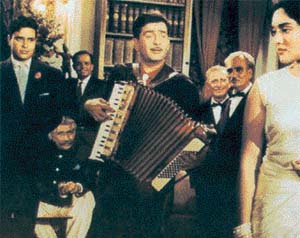
EVEN AFTER becoming a popular singer, through films such as 'Neel Kamal', 'Lakhon Mein Ek' and 'Ek Din', Mukesh pursued his interest in classical music. To learn the nuances of ragas, he sought the help of Pandit Jagannath Prasad. Another young man too used to visit Prasad to learn music. Hearing Mukesh practising a raga once, the young man introduced himself, "I am Raj Kapoor. I've fallen in love with your voice. My own pales in comparison." "Don't worry," Mukesh said with a smile. "I'll give you mine." And he did - in the following years - creating some of the beautiful moments in mainstream Indian cinema, infusing feeling into the oeuvre of one of its greatest showmen. A programme was held in the city recently by the Russian Culture Centre to pay tribute to the actor-director and the singer. Asked how he rated himself, Mukesh once jested, "Know why Lata Mangeshkar is the greatest singer in the world? Because she has an out-of-tune singer like Mukesh for company." Admire the singer's modesty, for his countless fans and composers such as Salil Chowdhury thought otherwise and rated him the best. "His vocal timbre is out of the world," observed Chowdhury, who, along with the singer, created magic with songs such as Suhana safar, Kahin door jab din dhal jaaye and Kayi baar yun bhi dekha hai. Music of the Raj Kapoor-Mukesh era evokes a sentiment similar to that expressed by the showman's famous number, Mera joota hai Japani... Phir bhi dil hai Hindustani (sung at the programme by Mohan). The instruments and the orchestration may have been western, but the songs were essentially Indian, covering the entire gamut of classical and folk sounds. So you had a Mera joota hai Japani or a Dost dost na raha (from 'Sangam') invoking the mystique of Bhairavi even as it sported a colourful look, thanks to the brilliant arrangement of strings. And what contrast and variation of colour did the arrangement of Lakshmikant- Pyarelal or Shankar-Jaikishan offer! The tasteful choice of raga and the rich polyphony of the period, which less talented composers of later years have found it difficult to emulate, also spoke of the supreme understanding between the filmmaker, composer, lyricist and singer. Do these songs have an audience in these days of frightfully adventurous tastes? Yes, if the response to the show was any indication. Pradeep Somasundaran led the band of singers, crooning Kisi ke muskurahaton pe ho nisar ('Anadi'), Hamne tujhko pyar kiya ('Dulha Dulhan') and Main shayar to nahin ('Bobby'). The singing was commendable, with a keen sense of sruti, something rarely seen among musicians at stage shows. Eh sanam jisne tujhe chand si surat di he, with pleasant notes in the major scale, followed the melancholic Bhairavi song from 'Shree 420', and added contrast. The singer was Suresh Chandra. Forgive the poor pronunciation of lyrics, for the singing was rich in feeling. Among the other notable presentations were Pyar hua ikraar hua, Jaane kahaan gaye woh din (by Narayanan), Satyam Shivam Sundaram (Preetha), Ram teri Ganga maili and Yeh mera prem patr padhkar (Prakash). The orchestra, especially the keyboard player, Joy, deserves a word of praise. The song, Mere man ki Ganga, aur tere man ki Jamuna ka, bol radha bol sangam hoga ke nahin, was reminiscent of one of the touching love stories in Indian cinema. Before the shooting of the film, Raj Kapoor dashed off a telegram to Vyjayantimala, asking, "Sangam hoga?" She wrote back, "Hogaa, hogaa, hoke rahega... " Seeing the telegram, the lyricist was quick to pen the first stanza. The song also remains a testament to the sangam of some of the brilliant minds of Indian screen. K.S.

Illustration: Manoj

Edited by Qwest - 18 years ago

Qwest thumbnail
19th Anniversary Thumbnail Rocker Thumbnail Networker 1 Thumbnail
Posted: 18 years ago
#7


Jaikishan Raj Kapoor Shailendra
& Mukesh On Harmonium
Edited by Qwest - 18 years ago

Qwest thumbnail
19th Anniversary Thumbnail Rocker Thumbnail Networker 1 Thumbnail
Posted: 18 years ago
#8


Mukesh & Raj Kapoor
Edited by Qwest - 18 years ago
Qwest thumbnail
19th Anniversary Thumbnail Rocker Thumbnail Networker 1 Thumbnail
Posted: 18 years ago
#9

Mukesh & Raj Kapoor
Edited by Qwest - 18 years ago

Qwest thumbnail
19th Anniversary Thumbnail Rocker Thumbnail Networker 1 Thumbnail
Posted: 18 years ago
#10

Mukesh & Raj Kapoor In Cheerful Mood
Edited by Qwest - 18 years ago
Related Topics

Top

Stay Connected with IndiaForums!

Be the first to know about the latest news, updates, and exclusive content.

Add to Home Screen!

Install this web app on your iPhone for the best experience. It's easy, just tap and then "Add to Home Screen".