





"Nava-ratri" literally means "nine nights." This festival is observed twice a year, once in the beginning of summer and again at the onset of winter.
What's the Significance of Navratri?
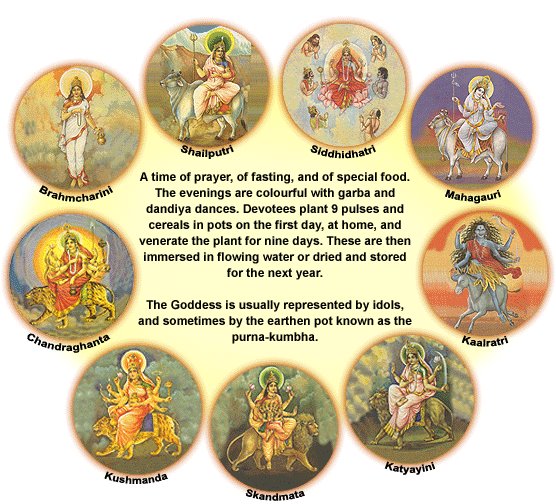
During Navaratri, we invoke the energy aspect of God in the form of the universal mother, commonly referred to as "Durga," which literally means the remover of miseries of life. She is also referred to as "Devi" (goddess) or "Shakti" (energy or power). It is this energy, which helps God to proceed with the work of creation, preservation and destruction. In other words, you can say that God is motionless, absolutely changeless, and the Divine Mother Durga, does everything. Truly speaking, our worship of Shakti re-confirms the scientific theory that energy is imperishable. It cannot be created or destroyed. It is always there.Why Nine Nights & Days?
Navaratri is divided into sets of three days to adore different aspects of the supreme goddess. On the first three days, the Mother is invoked as powerful force called Durga in order to destroy all our impurities, vices and defects. The next three days, the Mother is adored as a giver of spiritual wealth, Lakshmi, who is considered to have the power of bestowing on her devotees the inexhaustible wealth. The final set of three days is spent in worshiping the mother as the goddess of wisdom, Saraswati. In order have all-round success in life, we need the blessings of all three aspects of the divine mother; hence, the worship for nine nights.The beginning of spring and the beginning of autumn are two very important junctions of climatic and solar influence. These two periods are taken as sacred opportunities for the worship of the Divine Mother Durga. The dates of the festival are determined according to the lunar calendar.
Navarathri represents celebration of Goddess Durga, the manifestation of Deity in form of Shakti [Energy or Power]. The Navarathri festival or 'Nine Nights festival' becomes 'ten days festival' with the addition of the last day, Vijayadashami which is its culmination. On all these ten days, the various forms of Mother Mahisasura-mardini (Durga) are worshiped with fervor and devotion.Food during Navratri Fast
The Navratri fast is observed from the first day to the ninth day. Some devotees only observe fast during three days i.e., first fast during any one of the first three days and second fast during any one of the next three and last in any one of final three days. Some people confine to milk and fruits during the nine days. Most devotees take a single meal during the day. Non-vegetarian food is totally avoided.
Navratri Dishes

- Sabudana vada, the mouth watering crispy snack
- Sabudana Khichadi
- Makhane Ki Sabzi
- Sawank Ke Chawal
- Dahi Pudine Wale Aloo
- Makhane Ki Sabzi
- Shakarkandi Ki Chaat
- Sabudana Papad
- Banana Raita
- Aloo Raita
- Singhare Ke Pakode
- Banana Chips
- Kaddu Ka Raita
- Malaiwale Kofte
- Fruits/Fruit Juices
- Sabudana Khir
- Bhagar






























 Kyunki Saas Bhi Kabhi Bahu Thi 2
 Indian Premier League

