
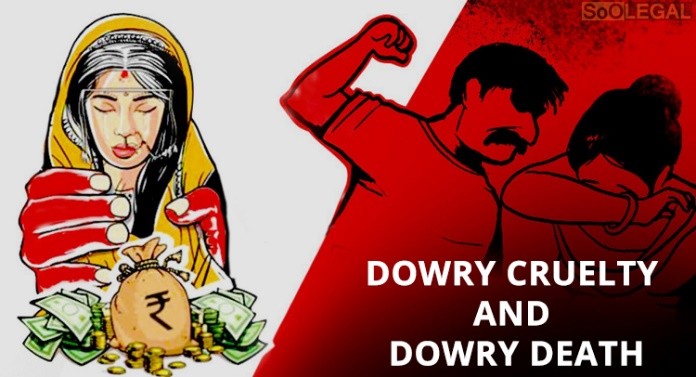
Dowry Deaths in India – Another Daughter Lost, A Society Questioned.

Viswasruti thumbnail
Posted: 9 hours ago
#1

Dowry Deaths in India – JICE IAS


A marriage should never become a transaction. A daughter should never become a financial obligation.

India’s Unhealed Social Scar | Reflection on the Twisha Sharma Case.

It is time to confront a persistent social evil that continues to dominate women's social status, living conditions, and questions surrounding suspicious deaths and murders in India.

Dear Members,

The recent death of Twisha Sharma has shaken many people across the country and reopened painful conversations about one of India’s longest-standing social evils — dowry-related harassment and dowry deaths. Her death, occurring within months of marriage and now under intense legal scrutiny and investigation, has drawn national and international attention, including judicial intervention and demands for an impartial probe, which rarely happens in a male-dominated universe!

However, beyond one case lies a larger and more disturbing reality.

According to recent crime statistics, India continues to record thousands of dowry deaths every year, meaning many women still lose their lives due to coercion, abuse, harassment, or pressure linked to marriage and financial expectations. Reports indicate that more than 5,700 dowry deaths were recorded in a year, averaging about 15 women every day.smiley3

Dowry today does not always appear in the traditional form of openly demanded cash or gifts. It may emerge as continuous financial expectations after marriage such as ---

Pressure for expensive gifts, vehicles, properties, or investments, emotional intimidation and humiliation, domestic violence and isolation, control over a woman’s finances, choices, career, or dignity, mental harassment masked as “family adjustment," etc.

The Twisha Sharma case has particularly disturbed many because it reflects concerns repeatedly seen in similar incidents — allegations of harassment, emotional suffering, questions about investigation procedures, and a grieving family seeking answers. The case has now led to wider public debate and legal attention.

If discussions can create awareness, educate young people, strengthen family support systems, and help someone seek assistance, then such discussions serve a meaningful purpose.

Let this discussion become not merely about one tragic case, but about the larger question:

How many more daughters must become statistics before society truly rejects dowry in every form???


Edited by Viswasruti - 9 hours ago

Created

Last reply

Replies

14

Views

338

Users

7

Likes

19

Frequent Posters

Life_Is_Dutiful thumbnail
Posted: 2 hours ago
#2

Its really sad and disheartening to know that even today dowry harassment is still happening. According to law taking or giving dowry is illegal but nobody cares nobody follows. Unfortunately even women are involved in harassing the woman and her family for dowry.

Its high time the Government reminds people of the dowry prohibition act of 1961. Parents should give gifts only to their daughter and refuse to give *expensive gifts* to the guy and his family like house, car, gold or even honeymoon trips. The *gifts* should be limited to just clothes and nothing more than that.

heyhellen thumbnail
Posted: an hour ago
#3
Thank you for sharing this thoughtful reflection. The issue you’ve highlighted is indeed complex and deeply rooted in social and cultural practices that cannot be changed overnight. Awareness is an important first step, but real change also depends on education, stronger enforcement of existing laws, and collective responsibility from families and communities. It is also important, as you mentioned, to separate emotional reactions from verified facts in individual cases, while still acknowledging the broader patterns that deserve attention and reform. Conversations like this can help keep the focus on dignity, equality, and safety in marriage, rather than material expectations or pressure. Appreciate you raising such a sensitive topic in a constructive way.
Clochette thumbnail
Posted: an hour ago
#4

AI tells me that dowry is a still existing practice in:

  • India: Despite being illegal since the Dowry Prohibition Act of 1961, the exchange of cash, vehicles, and valuables remains widespread and is a primary driver of marital coercion and violence.
  • Pakistan: Known locally as Jahaiz, the system of transferring trousseaus, cash, and appliances to the groom's household is deeply embedded in cultural tradition.
  • Bangladesh: Dowry demands continue to persist despite strict governmental bans, frequently placing extreme financial strain on the bride's family.
  • Nepal: Remains common across various communities and cultural backgrounds.
  • Kenya & Rwanda: Some communities in Western Kenya require the bride's family to give contributions to the groom's father, while Rwanda features a traditional negotiation practice known as Gusaba.
  • Southeast Asia: Variations of bride price and dowry systems are frequently observed in countries like Vietnam, Indonesia, and China.
  • Middle East: Various dowry and bride price models exist across Arab countries and rural communities.

Because the practice is heavily driven by deeply embedded cultural traditions rather than law, it also persists within immigrant diasporas originating from these regions, including communities in the UK, USA, and Canada. (source AI)

Well, the - more or less important - "deeply embedded cultural traditions" may also have another 'source' - very human flaws: greed from the groom's (family) side...and giving away the (financial) responsibility for the daughter... (and then, there are those who do the 'match-making' - they also gain).

Clochette thumbnail
Posted: an hour ago
#5

Solutions??? We are at it again... it's the view a society allows relative to the position of its female members insisting on the supremacy of its male ones...

Viswasruti thumbnail
Posted: an hour ago
#6

Originally posted by: Life_Is_Dutiful

Its really sad and disheartening to know that even today dowry harassment is still happening. According to law taking or giving dowry is illegal but nobody cares nobody follows. Unfortunately even women are involved in harassing the woman and her family for dowry.

Its high time the Government reminds people of the dowry prohibition act of 1961. Parents should give gifts only to their daughter and refuse to give *expensive gifts* to the guy and his family like house, car, gold or even honeymoon trips. The *gifts* should be limited to just clothes and nothing more than that.

In the Twisha murder case, the judge herself is involved. That is the state of affairs in our societysmiley3

The mother-in-law (MIL) angle in the Twisha Sharma death case revolves around Giribala Singh, a retired Principal District and Sessions Judge. She is a central figure in the ongoing investigation regarding allegations of dowry harassment, evidence tampering, and the mysterious death of her 33-year-old daughter-in-law.

The primary aspects of her role and the ensuing controversy include

  • Legal Status & Bail: Giribala Singh was named in the initial police complaint by Twisha's family and has been booked under charges including dowry harassment. She has secured anticipatory bail but has been served notices to record her statements. The Madhya Pradesh High Court is currently reviewing petitions challenging this bail.
  • Family Allegations: Twisha's family (including her brother, an Indian Army officer) alleges that Giribala and her son (Twisha's husband, Samarth) subjected Twisha to sustained mental cruelty, domestic violence, and dowry pressure. They also allege that Giribala made numerous phone calls to senior officials and judicial associates shortly after Twisha's murder to tamper with evidence and delay the FIR.
  • Public Defense & Backlash: Giribala has publicly defended herself and her son. She claimed Twisha had mental health issues and drug dependencies, and alleged that Twisha had independently decided to terminate her pregnancy. These media appearances caused major public outrage, with critics accusing her of victim-blaming.
  • Husband's Status: Twisha's husband, Samarth Singh, initially fled but later surrendered. The Madhya Pradesh state government recommended a CBI investigation into the case, which has drawn national attention. But we know that the case will take a few decades to be resolved.
Viswasruti thumbnail
Posted: an hour ago
#7

Originally posted by: Clochette

AI tells me that dowry is a still existing practice in:

  • India: Despite being illegal since the Dowry Prohibition Act of 1961, the exchange of cash, vehicles, and valuables remains widespread and is a primary driver of marital coercion and violence.
  • Pakistan: Known locally as Jahaiz, the system of transferring trousseaus, cash, and appliances to the groom's household is deeply embedded in cultural tradition.
  • Bangladesh: Dowry demands continue to persist despite strict governmental bans, frequently placing extreme financial strain on the bride's family.
  • Nepal: Remains common across various communities and cultural backgrounds.
  • Kenya & Rwanda: Some communities in Western Kenya require the bride's family to give contributions to the groom's father, while Rwanda features a traditional negotiation practice known as Gusaba.
  • Southeast Asia: Variations of bride price and dowry systems are frequently observed in countries like Vietnam, Indonesia, and China.
  • Middle East: Various dowry and bride price models exist across Arab countries and rural communities.

Because the practice is heavily driven by deeply embedded cultural traditions rather than law, it also persists within immigrant diasporas originating from these regions, including communities in the UK, USA, and Canada. (source AI)

Well, the - more or less important - "deeply embedded cultural traditions" may also have another 'source' - very human flaws: greed from the groom's (family) side...and giving away the (financial) responsibility for the daughter... (and then, there are those who do the 'match-making' - they also gain).

Blue--You make a very valid point. Beyond tradition, dowry has often been sustained by human weaknesses and social conditioning. Greed from the groom’s side turns marriage into a transaction, while the mindset of “handing over responsibility” for a daughter places an unfair burden on women and their families. Even those involved in matchmaking may sometimes become silent beneficiaries of this system.

What began as a cultural practice in some contexts has, in many cases, been distorted by financial expectations, social prestige, and personal gain. Unless these underlying attitudes change, legal measures alone may not be enough to heal this social wound.

Viswasruti thumbnail
Posted: an hour ago
#8

Originally posted by: Clochette

Solutions??? We are at it again... it's the view a society allows relative to the position of its female members insisting on the supremacy of its male ones...

From Tradition to Tragedy: There are many phases and transformations.

What may once have begun as voluntary gifts and familial support gradually transformed, in many places, into expectation, obligation, and social pressure. A custom meant to symbolise affection and goodwill became, for some, a measure of status, wealth, and entitlement.

When marriage becomes a financial negotiation rather than a union of hearts, traditions lose their meaning. The burden falls not only on families but, tragically, on women who face emotional, financial, and sometimes physical consequences.

The journey from tradition to tragedy is not created by culture alone, but by human greed, social acceptance, silence, and the normalisation of inequality. It is time to preserve values while rejecting practices that diminish human dignity and cost lives.

spain thumbnail
19th Anniversary Thumbnail Navigator Thumbnail
Posted: an hour ago
#9

Thank you for sharing this important topic.

I have followed the Twisha case carefully.

Really admired her army brother for fighting for his sister both before and after her death.

He said he would never forgive himself when his sister asked him to touch the feet of the monster mother-in-law and say "sorry" to her for standing up for his sister.

There are many brothers and parents who do not get involved in such difficult confrontations of the girl's in-laws side. He did it and yet he lost his beloved sister.

A lot of desperation and agony goes unnoticed because the voice eventually gets silenced. And those who are aware or witness the disharmony around us also keep silent.

Silence is the first step to slow isolation and the final step to tragedy.

Let's face it. There is unofficial bullying happening in most marital households.

There is gaslighting of the newly-married victim, where she feels she may have "over-reacted" or became "too sensitive" to in-laws triggering behaviour and the silent hope and prayers that things will eventually get better with "adjustment".

Of course, the lovely in-laws are always ready to give their feedback on matters related to them as "trivial" and "no big deal" and the girl "just needs to adjust". However, when the finger is pointed at the girl, she is labelled as "difficult" and "atrocious"!!!

Why do parents give dowry in the first place?

Even though they know it is illegal?

Because they trust their daughter's future will be well-looked after.

Because there is indirect pressure from the in-laws that they are a "good catch" and they are deserving of high-class treatment.

Because they do not want their daughter to be ill-treated after marriage.

What they do NOT see, however, are the false promises in exchange of "gifts".

They do NOT see the chameleon faces of the future groom and the in-laws. They are deceived and trapped from the start.

Worse, after marriage, they do not see the dilemma many women silently face in their own marital household.

The sudden realisation that a girl does not feel "safe" living in her own "new marital home".

The sudden realisation that there is no sense of belonging anywhere - either in her own birth home or in her new marital home.

The need to constantly smile like a happy new bride but cry in isolation in the bathroom. And then come out, with make-up intact and jewellery intact, and of course with that big, bright flashy smile!

Parents and family can see their daughter's fake smile when they visit - and they panic and worry and pray that the forbidden shouldn't happen.

Every girl wants her marriage to work. It has been a fairytale dream since her childhood. She would not want to throw away her marriage under the bus without giving every drop of hope and effort that things would change for the better.

Deaths happen because of feeling suffocated. Can't go here, can't go there, can't say this, can't say that, can't do this, can't do that. It kills the soul and chops off its wings in one smooth, silent blow.

Chilling. But true.

Sanskruthi thumbnail
11th Anniversary Thumbnail Visit Streak 180 Thumbnail + 8
Posted: an hour ago
#10

Twisha's inlaws are highly educated people and her mother in law is from judiciary background. It should tell us that this evil custom has no link to poverty, class or education. It's absolute reduction of a woman to a commodity.n

Her MIL already started sl*t shaming that poor dead woman in front of the media, had her bail in advance... She seems to know exactly how system works by trying to forge a media trial. There needs to stricter implementation of law and order at ground level. Media should not give an accused a platform.

Related Topics

Haven For Her thumbnail

Posted by: Viswasruti · 18 days ago

Violence Against Women: A Crisis Society Can No Longer Ignore Violence against women is one of the gravest human rights issues in the modern...

Expand ▼
Top

Stay Connected with IndiaForums!

Be the first to know about the latest news, updates, and exclusive content.

Add to Home Screen!

Install this web app on your iPhone for the best experience. It's easy, just tap and then "Add to Home Screen".