Originally posted by: Swetha-Sai
@EkPaheli
I haven’t seen Damini, Nandini and Shobha wear mangalsutra at all. Ok.. they’re modern, need not wear at all times.. Tulsi and Shobha MIL has given them the freedom. Also, Nandini and Shobha have lived in US so it’s not required to wear it there..
But, when she sitting here in a Pooja / Hawan yesterday shouldn’t she be wear mangalsutra and sindoor? It’s an auspicious occasion..
Whereas Tulsi is wearing mangalsutra and sindoor 24*7. Even after her legal divorce.. 
P.S. Bollywood married actress are so modern. They don’t wear mangalsutra and sindoor 24*7. But, they definitely wear during Karvachauth, Godh bharai, Baby naming ceremony, etc For eg: look up Sonam Kapoor pics in India during these auspicious occasions.
It’s the Bollywood influence which in turn is influenced by the black money of underworld that wants to promote their ideology and the missionary agenda that wants to promote theirs tbh. The first season had the bahus sport a mangalsutra at least regularly if not sindoor. Even a modern Tanya who was a grey character who oscillated between a good character and a vamp or a Komolika who was always an all out vamp donned them when they were shown as married women onscreen.
IRL, I have never seen any women of the Kutchi communities without a mangalsutra if they’re married. Rather most women I know have multiples of them and use them per the occasion. Lightweight ones that can handle a bit of rough handling are used for daily wear, the more expensive ones are worn for any special occasions in the family like a wedding, a pooja or a havan or any religious ceremony other than those, could even be worn when for the opening or first day in a new home/shop/office/business owned by the family. Then there are the imitation ones worn for travelling usually in daily trains or for long distance train journeys too so in case they’re lost or go missing or literally snatched in what now are rare occasions, the loss is minimal and there’s no heartache. If they can afford it, there are even women who have multiple gold ones with diamond pendants and gold pendants which they wear for any special occasions depending on their outfit. An outfit with silver/diamond work is usually paired with a mangalsutra with black beads entirely barring the diamond pendant which can be as big or small as their budget allows. An outfit which leans towards gold more in terms of accent and details is similarly paired with a mangalsutra that can have golden beads as well as a golden pendant.
In fact, there are so many different kinds of mangalsutra pendant designs dependent on the community itself that usually when you walk into a jewellery store they recognise your preferences with a few questions if you’re a new customer and obviously know what to get for you if a regular one. Like for example in South Indian communities, temple jewellery is a motif so you can find women who wear mangalsutras with a goddess on the pendant design usually Lakshmi Maa or Ganpati Bappa. In the Maharashtrian community they go for what is know as the Watti design iirc, basically looks like two or three small bowls inverted as the pendant. It can have some precious stone or some designs on top or around it or be very practical and simple.
For Kutchi women there’s no such fixed motif or designs for the mangalsutra pendant so they pick per their choice.
But what I think Ekta and her team have missed and never gotten right in either of the two seasons of Kyunki is that a Kutchi bride will always have 2 sarees when getting married. One is a red and white saree known as Panetar and the other is a red and golden saree called Gharchola.
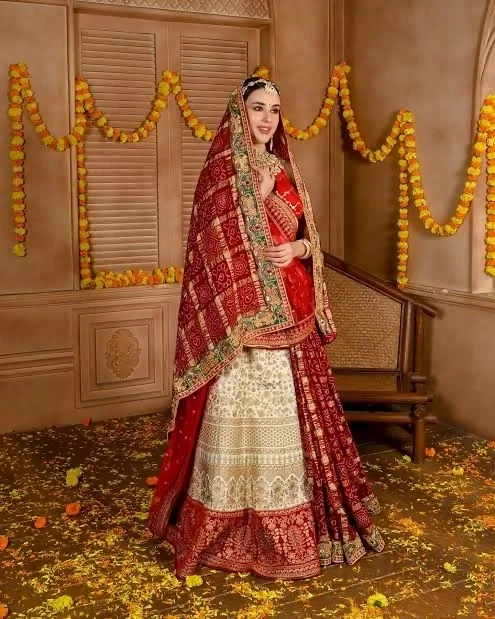
The model/bride here is seen wearing both.
The red and white is usually gifted by the Mama of the bride on her wedding day with the Shagun ke bangles worn for the wedding ceremony are a gift from the Nanihal as a blessings of her maternal family. The father of the bride gets her the jewellery and sandals. The groom’s family gifts her the red saree with golden checks patterns you see here. It’s called the Gharchola and it’s pleated and kept in the wedding mandap near the couple when the ceremony begins and then as the presiding Pandit/Maharaj directs after the initial rituals are over, this saree is then tucked in at the waist in the mandap and the palla is draped over the head which is then used for the eventual Gathbandhan with the stole that the groom dons on his shoulders.
The different sarees signify the merging of the two families. The red and white one is not usually very elaborate though it can have a lot of intricate work and is usually in silk. The golden and red saree with checks design has a lot of motifs used in ancient India that are for prosperity, fertility, blessings etc. like an elephant, a Kalpavriksha tree, peacocks, Swastiks etc. The checks are also made using zari that’s of real gold if the family can afford it and the border is similarly customised as well and can be as simple and affordable as one wants or as elegant, heavy and expensive as it can get. The sarees can cost anything from 2000 to lakhs, all based on what the family in question can afford and the bride herself likes. The two families go to these special shops which sell these sarees and they usually have a discussion before regarding the budget factor so that there’s no heartbreak or humiliation later on publicly.
The bride then is shown the sarees which can have really big checks or smaller ones, and then the salesperson shows borders that will go well with her selection when paired. You can get these borders changed after a couple of years but only by shops that know how to do this work else you can kiss your precious bridal saree goodbye.
The Gharchola is preserved and you will see a Kutchi married woman will wear if when she has to sit for a special Pooja and Havan with her husband without fail. Even if she may wear another saree, this will be still be draped around her shoulders and then be placed back immediately in a safe bag or the cupboard depending on the situation.
To date, I haven’t seen one Kyunki bride don both of these ever. Not a single one. I have also never seen one with a Gharchola for a Pooja and Havan sequence even if it’s just draped around the shoulders.
So that tells you everything about accuracy and research put into these things.
























 Indian Premier League
 CID
CID
 Health and Fitness


1.5k