





FOR ALL THOSE WATCHING THE RE-RUN OF JODHA AKBAR AND MY OLD READERS
Folks,
Those of you who still visit the Jodha Akbar forum, and used to read my almost daily episode analyses for Jodha Akbar between June 2013 and April 2014, would be surprised, if not startled, to see me popping up again, like Rip van Winkle😉, well after the serial has been (clumsily) wound up. It is not a long story, so here goes.
My very good friend Mandy (ghalibmirza) had persuaded me, somewhat against my better judgement, to write episode analyses once again for those watching the rerun of Jodha Akbar. This began on her Jodha Akbar Discussion thread at
https://www.indiaforums.com/forum/zee-anmol/4447559/jodha-akbar-discussion-corner
and I have so far done Episodes 1-10. These were fresh ones for me, since I had posted first in this forum only 2 weeks after Jodha Akbar started, on June 30, 2015. I had thus done these new ones on a daily basis.
But from now on, I shall be doing biweekly posts for 3 episodes at a time, on Thursdays and Sundays.
As for reviving these posts in the main Jodha Akbar forum, this is in response to requests from some of my regular readers, who felt that there might be interest in reading them even among casual visitors to this forum. I am not very sure of this, but I am willing to make experiment, so here goes with the post for Episode No.1: Sound and Fury.
I send PMs about these posts to a certain number of regular readers who want that, and if you want to be included in that list, all you need to do is to send me a PM to that effect.
If you read this post or the follow up ones and happen to like them, do hit the Like button without fail. I want to keep track of my regular readers even if they are silent readers, and this is the only way I can do that. So please do not forget the Like button!
Shyamala B.Cowsik
________________________________________________________________Jodha Akbar 6: Amer ki pukar
Folks,
This one had only 2 scenes worth analyzing: the first one right at the beginning, between Jalal and the kiledaar of Jodhpur, with Bairam Khan as a silent partner in the goings on, and the other right at the end as our D'Artagnan rides at breakneck speech responding to the Amer ki pukar, and the as yet unknown kashish that draws him there.
Trust unbounded and unwise: This is of course the trust of Jalal in his Khan Baba. At this point, it is still endless and unconditional, and this is the major reason for Bairam Khan's swelling arrogance. In the whole of this segment, his body language is far more important than what he says, for he says nothing, after his initial blunt dismissal of the kiledaar from his post, except for one word in response to Jalal's question as to whether he had sacked the man. And that is a very emphatic Beshaque!
The first thing to note is that Bairam Khan does not think it necessary to rise when the Shahenshah approaches him, nor does he ever address him by his title even in public. In fact, as Jalal poses that query to him, his Khan Baba does not even bother to look at him when he responds with that one word. In anyone else, this would be the height of arrogance and insult towards the emperor.
But why would Bairam Khan bother with even these surface amenities vis a vis the Shahenshah ? Jalal is, for him, a toy emperor whom he has created, a dummy who can fight superbly and win, and whose mohar he needs so that he can rule in his name and pursue his policies of conquest and subjugation unfettered by any contrary opinions.
So he sees no need to add anything to his Beshaque!, much less to offer even a minimal explanation of why he sacked that chap. He could not have gone down that road in any case, for the real reason is that he wants to totally control the access of any of the Mughal officials to the Shahenshah except thru him and with his permission. It is on this control that part of his power rests, but he can hardly explain that even to this supine Jalal!
So he says nothing, remains seated while the emperor is standing next to him, and simply awaits developments. I looked for some tension in his profile, betraying at least slight uncertainty as to Jalal's reaction, but there was none.
In the event, Bairam Khan was right to be as cool as a cucumber, for Jalal's reaction must have exceeded even the wildest expectations of his Khan Baba. The kiledaar was rash and uncontrolled in the tone of his complaints against the Khan-e-Khana, and he would have done better to have taken a couple of discreet lessons from Maham Anga in h0w to do Bairam Khan down without your hand showing at all! But Jalal, faced with his factually valid complaint, was so overflowing with blind faith in his mentor, that I felt like clobbering him as he railed at the poor chap with his shamsheer at his throat, while Bairam Khan's profile radiated arrogant smugness.
After this display of puppet-like behaviour from the Shahenshah-e-Hind, we were next treated to another put down by Bairam Khan of Jalal's eager decision that they should immediately wage war on Amer and the Rajput assemblage there. He does make a token gesture of letting Jalal down a little lightly by calling his jazba kaabil-e-tareef, but the end result is that he nixes the idea bluntly, asserting that they should not think of war just now, but sahi waqt ka intezaar karna hoga.
Adiana and Gargi, where are you? Undoubtedly grinding your teeth at this Urdu version of uchit samay ki prateeksha karni chahiye!
And Jalal yields without even a token protest when Sharifuddin's more carefully worded vote for caution is accepted by Bairam Khan (who, it be noted, has more and accurate information about what is going on in Amer) over his own vote for war. Not then, nor when his Khan Baba declares that he will decide when the sahi waqt will be there, and that he is now off to Jaunpur to settle some mansabdari issues, while all that Jalal has to do in the meanwhile is apna khyal rakhna.
Of course Bairam Khan sees no need to consult Jalal about these issues - whether of war or of the mansabdaris - for he does not seem interested in training him in hands on administration or even military strategy or tactics at all. Again, why would he, when all he is interested in is Jalal as a never failing fighting machine? So he looks on indulgently as Jalal smashes into a rock with his freshly honed shamsheer, and declares rhetorically: Jab Jalal apni shamsheer chalata hai, to chattan bhi raasta deti hai! But when he adds: Ab ek hi raasta hai: jung!, he is promptly shushed and put in his place!
A creation of gratitude: The sum and substance of this very revealing scene is that just as Jalal is, at this point, almost entirely Bairam Khan's creation, this arrogant, self-aggrandising Wazir-e-Sultanat is almost entirely Jalal's creation, due to Jalal's almost boundless sense of gratitude and loyalty towards his Khan Baba.
Incidentally, this gratitude for anything good done to him is one of Jalal's most endearing qualities, for all that it is pushed to excess here. For this is a concept almost alien to most of royalty, who have a very pronounced sense of entitlement, and take such loyalty and services from others for granted.
Admirable forbearance: Another small point that highlights Jalal's unusual forbearance towards his servants. When the swordsmith is unable to hone the edge of Jalal's shamsheer to the desired razor sharpness, he does not snap at him or kick him for his failing. He simply says that the dhaar is not good enough, and proceeds to complete the job himself. How many absolute monarchs in that, or indeed any age, would have been so accommodating of such a failing?
NB: It is interesting to note that even though Bairam Khan is standing next to him by now, Sharifuddin addresses his report about the Amer situation only to the Shahenshah. Probably he remembers the feel of Jalal's khanjar at his throat!
Amer ki pukar: This is an intensely romantic segment, though not in the conventional sense. Jalal is romancing something here , but it is not Amer, though it looks like that at first sight, nor the Registan ka gulab. He is romancing a boyish spirit of adventure, of untrammeled freedom to take risks, to indulge in the kind of rakish derring do that he has perhaps never been allowed to do, hemmed in as he has always been by (the very real and justified ) concerns of his guardians about his safety.
As Jalal stands in his tent and calls imperatively over his shoulder Abdul!! , his face and eyes are already alight with the anticipation of what might come. And there is in those eyes also a smug certitude that he can pull off this adventure without any hitch, and cope with whatever challenges it might throw at him. It was a fascinating expression.
Here again, there is a glimpse of the special consideration that Jalal shows to those who are loyal to him. When Zaheer, having saved the Shahenshah from the rearing snake, raises objections to his Amer plan, citing Bairam Khan's strict injunction, Jalal - who does not even bother to acknowledge Abdul's vocal reservations about this reckless plan - does not slap him down verbally and tell him to get lost.
Instead, he goes out of his way to explain to Zaheer that while he understands his objections, Zaheeer too should have faith in him, say that he had gone for shikar, and trust in his Shahenshah's promise that he would return before his Khan Baba got back. But fate decrees otherwise, with terrible consequences. But of that later.
The road to a dream: The whole sotto voce narrative by Jalal during his breakneck journey to Amer is worth going over once more, so beautiful and evocative is it.
Amer mujhe pukar raha tha. Na jaane wo kaunsi kashish thi jo mujhe apni or kheench rahi thi..Raasta lamba tha, par manzil ki chah itni ki na din ka khyal tha na raat ka.. Na dushman ka na mausam ke mizaz ka.. Bas tha to sirf ek jazba, Amer ke sarzameen ko choone ka, uski tapish ko mehsoos karne ka, use paane ka.
Amer ki sarzameen hamare kadam choom rahi thi.. Amer ki taqdeer hamari taqdeer se jud rahi thi..
Now what can one make of this reckless young man, pursuing the dream of he knows not what, pulled along by barely understood and even less acknowledged emotions, riding straight into the lion's den, and for what ? Not for waging war, at least not yet. Not for scouting out the terrain preparatory for waging war, for that is being done by the spies of Sharifuddin and Bairam Khan far better than Jalal, dragging a crippled Abdul along, can ever hope to do. What then?
I would like to believe that it was the pull of Jalal's kismet, of Fate that was to bring him face to face with his own destiny. Not Amer, but Jodha. Otherwise, for an emperor who has already conquered many kingdoms far larger than Amer without a single backward glance , where is the question of Amer ki taqdeer ka uski taqdeer ke saath judna?
So we have Jalal standing on the promontory overlooking Amer, where the Gangaur festival is at its height on its last day, and exclaiming to himself : Amer ka pehla deedar hua tha humein - and this said with the arrogance of a would-be conqueror looking at the his target - ab sirf us Rajkumari ( not shehzadi ), ke deedar ki chahat thi! Famous last words!
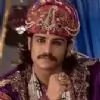
In his Rajput attire with a large red tika, Jalal looks, to use the correct word, smashing. As he grasps a handful of the soil of Amer and holds it close to his face, the sharp planes of his features stand out and his deep set, lambent eyes glow with a hidden fire.
Mystical act of near homage: He whispers: Ai zameen, aapko Jalal ka salaam.. Jalal aapko haasil karne ki kwahish rakhta hai.. It was an almost mystical pronouncement from a young king normally so brash, as if, while declaring his intent to make Amer his own, he wishes it to sound like a declaration of homage, not one of aggression. And as he hurls the handful of earth as far from him as he can, leaves his shamsheer with the fearful Abdul, and somersaults down the steep slope, only to rebound on to his feet like a circus gymnast, the surreal quality of the scene is complete.
My favourite shot in the whole episode is the very last one, of Jalal smiling widely in delighted anticipation of what was to come. Thus might D'Artagnan and his swashbuckling musketeer friends have looked at the instant of going into battle, against the enemies of France or, in times of peace, against Cardinal Richelieu's guards!
Jodha: emotion over reason: I am not going into all the spiel of a raging Sukanya, a placatory Jodha and her unsuccessful demarche with Bharmal in favour of a Suryabhan -Sukanya wedding. But two things struck me here.
One is Jodha's markedly traditional outlook towards marriage; she takes it for granted that her parents will choose her groom, and her assent would not enter into it at all. The oblique way in
mehndi mein kiska naam dhoodhna hoga?
The other is her being alien to logic and rationality. She is concerned only with getting Sukanya what she wants, and not for an instant does she pause to consider that Suryabhan has chosen her, Jodha, so why would he agree to marry Sukanya instead? And if as a result of such an Ameri switch proposal, if he were to sheer off the whole idea of marrying into the Amer royal family, what would happen to her father's grand plan of uniting all the Rajput kings and getting them to pull his chestnuts out of the fire lit by the Mughals?
It is the same much later with her persistent advocacy of the Salim-Anarkali marriage, despite Anarkali being a rakasa. Not for an instant does it occur to her to look beyond their prem, and understand that Jalal to Jalal, there is no way the awaam would ever accept a rakasa as the Mughal empress.
At least Jodha does not lack consistency, even if it is consistency in illogicality and a lack of commonsense!
Ok, folks, this is it for now. Take care, and let us look forward to a wonderful week ahead as Jalal sets Amer by its ears!
Shyamala (B.Cowsik) /Aunty/Akka/Di






 Naagin 7
 Kyunki Saas Bhi Kabhi Bahu Thi 2


377