CASE IS DONE 6.11

Kartik Aryan Sympathy

No Sympathy For Hrithik
PARTY AT PODDARS 7.1.26

Happy 1st Anniversary Manvikians
SRK explains the actual meaning of most misunderstood word "Jihad"

Mahadev and Sons-Colors
Katrina and Vicky's son name is Vihaan Kaushal
SSKTK - VD Says Chalo Film Phir Bhi Chal Gayi Thodi

Mahadev and Sons-First Thoughts!
Nache Nache Video Song - The Rajasaab

JA ep 246 consummation hits 40 M views uploaded a year back



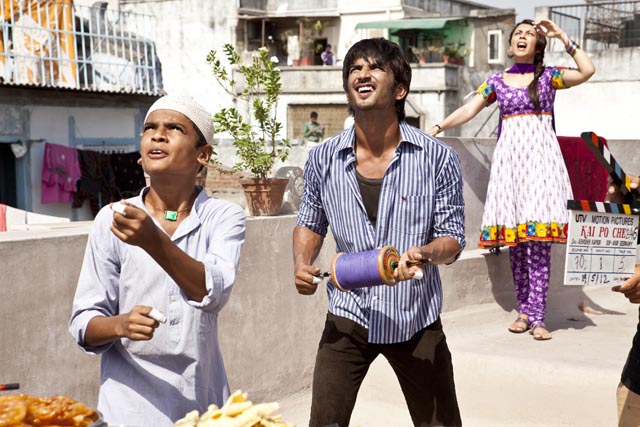
Digvijay Deshmukh, Sushant Singh Rajput and Amrita Puri in 'Kai Po Che'
India is like a gigantic Hall of Mirrors – so many reflections, some magnified, some distorted. Which is the true India? And who is the true Indian? In 'Kai Po Che', Abhishek Kapoor's stunning new film, you realize there are no easy answers as you step into the complex, complicated terrain that is India.
'Kai Po Che', based on Chetan Bhagat's best-selling novel 'The Three Mistakes of My Life', takes you into the innards of the bustling city of Ahmedabad and introduces you to real people in situations taken right out of real life, such as the 2001 earthquake and the Godhra killings. You are relentlessly drawn into the ugly, unpredictable vortex of current events, of unforgiving real life as it happens.
Abhishek Kapoor deftly gets you involved by weaving the lives of three ordinary people, close friends Ishaan, Omi and Govind – into these events. Each has modest dreams of achieving happiness. They are starting a sports business against great odds and you find yourself rooting for them and wanting them to succeed. But what could have been a light-hearted story about friendship escalates into something much more deeper and darker.
Sushant Singh Rajput, Rajkumar Yadav, and Amit Sadh inhabit the characters of Ishaan, Govind and Omi perfectly. No big star names here and that's actually an advantage. (No big leading ladies either – Amrita Puri as Vidya, Ishaan's sister, is the only female presence, and she's good.) These actors are relatively unknown faces and so bring little celebrity baggage with them; they are regular guys you might encounter on the streets – each is three-dimensional and a person in his own right. What is wonderful is the chemistry among the three men – you feel they've known each other forever.
The English name of the film is 'Brothers…for Life' and all three, especially Sushant Singh Rajput, have a palpable screen presence which keeps you hooked. 'Kai Po Che's strong script – usually never a strong point in Indian cinema – is what gives the film its internal architecture and strength. The script was written by Bhagat, along with Pubali Chaudhuri, Supratik Sen, and Abhishek Kapoor, and directed by the latter with a sure hand.
Everything is honest and from the heart in 'Kai Po Che', from the locations to Amit Trivedi's music which is embedded in the culture and tempo of Gujarat. No song just for the sake of a song scenario and certainly no item numbers. As the film ricochets to its powerful climax, you are fully invested in its outcome and the lives of the three friends. And later you mull about deeper things such as the nature of friendship and family and values – and think some more about where India is headed. It is a fully satisfying movie which stays with you long after it's over. Yes, India is shining but it's tarnished too, and you get to see it, warts and all.
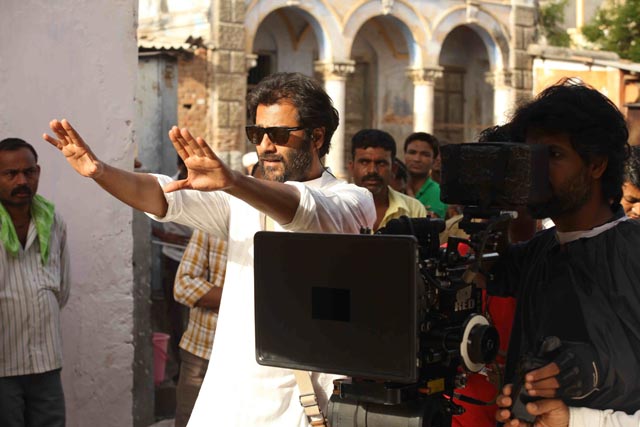
Abhishek Kapoor on the sets of 'Kai Po Che'
Abhishek Kapoor was in New York for two days on his way to the Berlin Film Festival, and sat down for a chat with me at the Ritz Carlton Hotel. Having worked crazy schedules to finish the film and send it out into the world, he was sleep-deprived and plain exhausted but clearly excited about finally completing something which has been a passion and occupied his life for four years.
Ever since Kapoor read Chetan Bhagat's book, "The Three Mistakes of My life", he knew he wanted to make a film of it. He's been working on the script for two and a half years, and the making of the film took a year. But that's alright with him because he loves the project.
Cinema has pretty much occupied his world, growing up in a film family as he did. His uncle is the popular superstar of yesteryear, Jeetendra, and his cousins are Ekta Kapoor and Tusshar Kapoor. He's also related to Aditya Chopra. Although his own father was not in the film business, Abhishek did go for several shoots as a kid and recalls watching Rishi Kapoor and Tina Munim shoot outdoors for Subash Ghai's 'Karz'.
He certainly grew up on a steady diet of Hollywood and Bollywood: films ranging from 'Guns of Navarone' and 'McKenna's Gold' to Hindi films like 'Mother India', 'Amar Akbar Anthony', 'Ram Teri Ganga Maili, 'Bobby', 'Deewar', and 'Sholay'.
Abhishek Kapoor went on to win the prestigious National Award for 'Rock On!' so it's a surprise to learn that he had a really tough time breaking into the film industry, first as an actor and then as a filmmaker.
" Either you were mainstream Bollywood or you were nothing," he recalls of the tough, early grind of his career as an actor. " I don't think it was a very good time for Indian film business – in the late 80's and 90's really crappy movies were being made. I made my foray into acting at that time and I didn't see any success. Maybe I wasn't good enough or maybe the films were not good enough. I didn't enjoy the process at all and just took a backseat. I felt so uncomfortable, so not-in-control of the way my career was going – it was very scary."
Gradually he got into writing and wrote a film 'Aryan'. It took him 4-5 years to make it; there were money woes and the film got stuck and he chased it. It didn't do well at the box-office but it was well-received by critics and Kapoor finally discovered what his true calling was.
Then he made "Rock On!" and the rest is history. With a National Film Award under his belt, the backing of Disney UTV as producers and distributors of 'Kai Po Che', and the support of his parents and girlfriend Pragya, life seems pretty 'Kai Po che!' (which means a victorious 'I have cut it!' in Gujarati kite-flying lingo.)
So having seen both ups and downs, what are his thoughts on success and failure?
"I think failure is very important because it can teach you something. Success, I think, is just mere garnish, it will just get you more money and that's great because it makes your life more comfortable but it doesn't teach you anything," he says.
He shares some of the truths his ups and downs have taught him: " I realize that nothing is more important than enjoying your work. If I'm not going to enjoy making my movies, I might as well not do it. I love this movie and I put my heart into it. I want people to see it. If it was a movie I was not proud of, then every step of the way would be painful. So it's important to love what you do – and that's something I really believe."
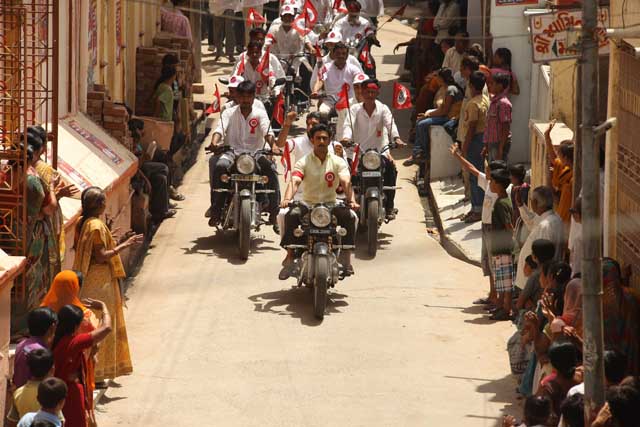
Real life and reel life mix in 'Kai Po che'
1. Does 'Rock On!' have anything in common with 'Kai Po Che'?
The only common factor is that both are about friendship: 'Rock On!' was more urban, it's with rock music as a backdrop, it's got a different style to it – characters, people in cities are more responsive, they're a little bit more cerebral. But this is about middle India, middle-class India, where people are more reactive. There's so much familiarity because people live in such small homes and so close to each other, you can hear people whispering in their homes. It's like one big family – everyone knows about everything. Just the way they react to each other, the rawness of the space – it's diametrically opposite."
2. 'Kai Po Che' has been called a movie about male bonding but it seems so much deeper than that – it's about people's lives, their values and how random acts can change everything.
When I read the book what really got me was the fact that it was about real events, the earthquake, the riots and the India-Australia cricket test match. I saw it as a great opportunity to make a real Indian film because of the fact that it was about real events and make the rest of the film also as real as the events. As a filmmaker I saw great potential.
3. This was your first visit to Gujarat – how did you manage to capture the many nuances, the soul of the city?
I had never been to Gujarat before. Making movies is more about unlearning – clearing your slate, starting afresh and asking questions all over again, without having any preconceived answers as if you know it all. You have to go and immerse yourself in the geography, culture and value system of the people and embrace it – and only then I think can you make a movie about a place.
We did not shoot the film on any set – we looked everywhere – and finally got these locations because if you get the locations right, then half the battle is won. The location is part of the character – it's not just there for show. To find the correct temple was a struggle. In Gujarat especially temples are everywhere – temples are the centrifugal force of the community – so it had to be right.
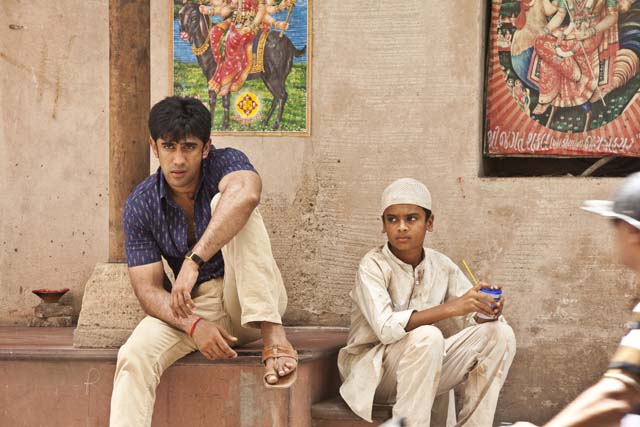
Amit Sadh and Digvijay Deshmukh in Kai Po Che
4. This movie has no big star names yet there is a star quality to these actors.
I think it's in the characters. You show different dimensions to these characters but I believe that there is a hero in everyone. I do believe that – when the moment arises I'm sure the hero will also arise. Some people just don't have the moment, but there is something sitting dormant in everyone.
These actors are fabulous actors – they haven't had much exposure in films except for Raju who's done a few films but the other two have not been seen much on this platform. They are very seasoned, very professional and very dedicated actors.
There may be so many like them out there but they aren't getting an opportunity because people are so unsure of themselves that they just keep chasing stars to make proposals. I think it's important for people to believe in themselves, in their script and to have a producer who can back you up. Only then can you give an opportunity to actors like these.
5. That is really such a shame. We are losing out by just staying with 7- 8 big star names.
It's regressive. We make excuses by saying the audience only wants this. I don't think the audiences want that. Why would the audience want to eat the same thing again and again – nobody would want that – but we force it down their throats! Indian audiences love their films – there's no other entertainment in our country, it's the cheapest form of entertainment. And they love their stars.
So somewhere we exploit that faith and love the audience gives us. It's important to give them back, give them something new, even at the risk of failing. You don't have to spend 50 crores. When these movies are making 50-60 or 100 crores – half the money goes to the stars. Writers are given a minuscule sum of money, they are not given any importance. It's important to invest in talent, not just in your stars.
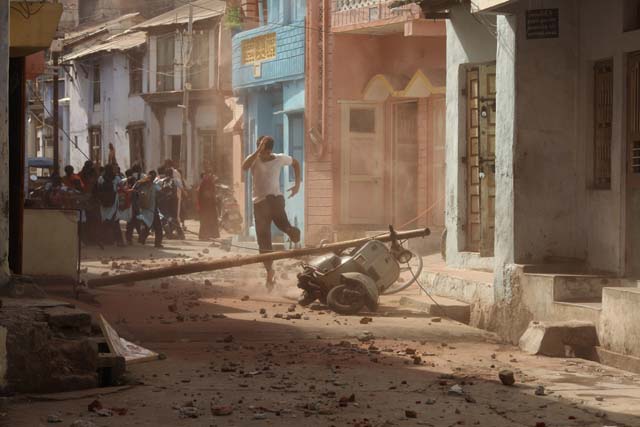
Kai Po Che mirrors real events
6. In many films the music feels tacked on, and there has to be a mandatory item number. In 'Kai Po Che' the music is natural, almost part of the skin.
It was important to keep everything organic from the script. Whether it was acting, characters, locations or the music, it all had to come from the script. The script demanded that the score be very authentic Indian, soulful and raw because that's how the film is, that's how these characters are, that's how the geography of this place is. So we didn't want to step out of the realm of that. It's a big story – we need the narrative to go on – you can't stop the narrative with a song coming in. It just makes the story go further.
7.What do you hope viewers will take away from 'Kai Po Che'?
I made this film to showcase my country as I see it, as I've understood it while I made it. I want people to come and take a piece of India with them – I'm talking of a global audience. We are showcasing at the Berlin Film Festival and premiering it there – I'm hoping the world over people will understand my country a little bit more, understand the value system of this country a little bit more.
8.The film touches poignantly on the Hindu-Muslim divide, on ordinary people living together in neighborhoods and yet not connecting.
Shit happens, you know, but what is important is to let it go and to move ahead. Whatever happened to these boys something good came out of it but it will only come about if you let it go. If you keep picking on what happened 10 years ago and taking political mileage out of that, you're going to ruin the future of this country. You have to shut the book and forgive and move on. Forgive the other person and forgive yourself. There are two people to a fight; both have to let go of things, and shut the book.
Related Articles
Anurag Kashyap, Godfather of Wasseypur
Matru Ki Bijli Ka Mandola-Cinematic Feast
 Kai Po Che works because of its earnest and very talented cast, writes Aseem Chhabra.
We can blame Farhan Akhtar [ Images ] for it. Or maybe even thank him for starting the trend of male bonding in Hindi films with Dil Chahta Hai [ Images ], where each actor had practically equal time, although there was one big star, Aamir Khan [ Images ], among the three.
The idea was to look at male friendships in more or less real terms, have the characters speak, act, and live like normal people do, and to de-Bollywoodise a Bollywood film.
That trend continued in Farhan's home production Rock On!! (directed by Abhishek Kapoor), and to some extent in his sister Zoya's first feature, Luck By Chance [ Images ], and then again in her second film, Zindagi Na Milegi Dobara.
Meanwhile, Chetan Bhagat [ Images ] -- that self-appointed, but hugely successful, observer of the lives and aspirations of middle class India [ Images ]n youth -- was writing his own tales of male bonding in modern India. His novel Five Point Someone became the immensely popular 3 Idiots, giving additional meaning to friendship among men.
And now we have one more case of the Indian male buddy movie inspired by another novel by Bhagat, The 3 Mistakes of My Life.
The author was so impressed by Kapoor's Rock On!! that he sent the filmmaker a copy of his book. Now a few years later, we have Kai Po Che, perhaps the first film in the genre, not to be entangled in the Bollywood star system.
Instead, the film uses keen and talented raw actors, who will not be judged by their star status as one would do with a Hritikh Roshan or Aamir Khan.
The result is that Kai Po Che is a very fine film, refreshing in its approach, as it is set in Ahmedabad [ Images ] and not among the elite of Mumbai [ Images ]. The film's stars Sushant Singh Rajput, Amit Sadh and Raj Kumar Yadav (he has had the most big screen exposure among the three in films such as Talaash, Shahid, Chittagong, LSD and Gangs of Wasseypur) appear to be very comfortable in the middle class settings.
By their own admission, Kapoor and Bhagat (the two co-wrote the script along with Pubali Chaudhuri and Supratik Sen) cut the novel to a minimum level, leaving out chunks of the book's narrative while focusing on the friendship of the three protagonists, and how their relationships are tested during the devastating earthquake in Gujarat in 2001, followed by the communal riots in 2002.
Bhagat has stated that Kapoor's film is much better than his book, an improvement over what he wrote. I have not read the book, but I have no reason to doubt him.
In the world that Kapoor creates we have three young men, who start with the goal of opening a cricket shop outside a temple, and also an academy for young teens. But their hopes and aspirations take different shapes.
Govind (Yadav), the quieter, and most balanced of the three, has the head for business and the store is his primary focus; Omi (Sadh), in seeking financial support for the shop, gets drawn into a Hindu political party led by his uncle; and Ishaan (Rajput), the most charismatic and impulsive, finds his faith in the sport of cricket and especially in a young Muslim prodigy, who he accidentally discovers.
Their commitments will pull them in different directions. But suffice is to say that there is a reason why Kai Po Che's English title is Brothers For Life.
A former actor, who struggled to find a footing in Bollywood, Abhishek Kapoor is in strong command in this small film (it is definitely smaller in its feel as compared to Rock On). He ably captures the details of connections between the three protagonists, some thrilling cricket moments, earthquakes scenes and the aftermath, and one very intense and believable moment of communal violence.
Unlike some loud, over-the-top scenes of Gujarat violence in Parzania, Kai Po Che projects the complex scenario in a believable and gripping manner. It is very difficult to stay real while handling violence of this nature. Mani Ratnam set the bar towards the second half of Bombay, but in a smaller way, Kapoor also succeeds in bringing the frightening reality of the Gujarat riots.
If Kapoor fails to a small extent, it has to be in his attempts to minimise the political tone of the film. And so, he deliberately gives the Hindu party a red flag and the Muslim group some form of a green one.
In trying to camouflage the political organisations, while still referring to real events -- the Godhra train killings, for instance -- Kai Po Che somewhat confuses the situation. But then, as the past has shown, bringing up complex and ugly issues such as religious violence always riles up one group or another in India. Hopefully, that will not happen with Kai Po Che.
The film is beautifully shot and brightly lit by Anay Goswami (The Japanese Wife and No One Killed Jessica). Amit Trivedi's compositions set to the lyrics of Swanand Kirkire produce some memorable songs, especially Manja.
Ultimately, Kai Po Che works because of its earnest and very talented cast -- Yadav, Sadh and especially Rajput, who gives a new meaning to the expression, 'the idealism of the youth.'
Amrita Puri is very likable as Vidya, Ishaan's sister and Govind's love interest. Together, these actors have created a special film.
credit - Ashu