Henna 786 thumbnail
20th Anniversary Thumbnail Stunner Thumbnail + 3
Posted: 18 years ago
#1

Hey

Happy Holi to ALL!!

Hope you all have a blast throwing colours!!

* Got any holi stories to share.?
* Ever had Bhaang like Jai in yday episode?(😆 im still worried about that)
* Whats been your most memorable Holi day?
* If you've never played Holi.. Whats the most memorable day that included colours or throwing anything at some else..
* Whats your favourite holi song?

Back to KS..

* What do you want to happen on Holi day in the serial?
* will Jai blabber all sorts seen as hes drunk?
* Will Bani's forhead be filled with the colour red?
* Whom will Laxmi get coloured by?
* Will there be a dance and sing along?
* What will be the DAMAKA.. afterall wen thres a party thres always somit goin wrong 😆

If you could throw a colour at an KSian what colour would it be and why?

Now to the Holi significance..

Holi (Hindi: ????) or Phagwah (Bhojpuri) is an annual and popular Hindu spring festival. It takes place over two days in the later part of February or early March. As per the Hindu calendar, it falls on the Phalgun Purnima (or Pooranmashi, Full Moon). It is also called the Festival of Colours. In West Bengal, it is known as Dolyatra (Doljatra) or Boshonto Utshob ("spring festival").

On the first day, a bonfire is lit at night to signify burning Holika. On the second day, known as Dhulandi, people go around until afternoon throwing colored powder and water at each other. A special drink called thandai is prepared, sometimes containing bhang (Cannabis sativa). People invite each other to their houses for feasts and celebrations later in the evening. Rangapanchami occurs a few days later on a Panchami (fifth day of the full moon), marking the end of festivities involving colours.
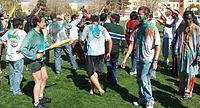
Celebration of Holi
Celebration of Holi

This festival occurs at the onset of spring. This period, during which the weather changes, is prone to cause viral fever and cold. Thus, the playful throwing of the coloured powders has a medicinal significance as the coloured powders are made of Neem, Kumkum, Haldi, Bilva, and other medicinal herbs prescribed by yurvedic doctors.

In 2007, Holi will be celebrated on March 3rd, the burning of Holika will be on March 4th, and then Dhuleti on March 5.

Although a Hindu celebration, other religions in India celebrate it as well. In fact, some of the best Holi celebrations are said to happen in Punjab, where Hindus and Sikhs celebrate together. This celebration in Punjab typically involves Dholi's and other musical instruments as kids and adults celebrate.

< =text/> //

Significance

A painting from the collection of Smithsonian Institute depicting Krishna-Radha and Gopis celebrating Holi

In Vaishnava Theology, Hiranyakashipu is the king of demons, and he had been granted a boon by Brahma, which made it almost impossible for him to be killed. The boon was due to his long penance, after which he had demanded that he not be killed "during day or night; inside the home or outside; not on earth or on sky; neither by a man nor an animal; neither by astra nor by shastra". Consequently, he grew arrogant, and attacked the Heavens and the Earth. He demanded that people stop worshipping gods and start praying to him.

Despite this, Hiranyakashipu's own son, Prahlad, was a devotee of Lord Vishnu. In spite of several threats from Hiranyakashipu, Prahlad continued offering prayers to Lord Vishnu. He was poisoned but the poison turned to nectar in his mouth. He was ordered to be trampled by elephants yet remained unharmed. He was put in a room with hungry, poisonous snakes and survived. All of Hiranyakashipu's attempts to kill his son failed. Finally, he ordered young Prahlad to sit on a pyre on the lap of his sister, Holika, who could not die by fire by virtue of a shawl which would prevent fire affecting the person wearing it. Prahlad readily accepted his father's orders, and prayed to Vishnu to keep him safe. When the fire started, everyone watched in amazement as the shawl flew from Holika, who then was burnt to death, while Prahlad survived unharmed, after the shawl moved to cover him. The burning of Holika is celebrated as Holi.

It is also said that later Lord Vishnu came in the form of a Narasimha (who is half-man and half-lion) and killed Hiranyakashipu at dusk (which was neither day nor night), on the steps of the porch of his house (which was neither inside the house nor outside) by restraining him on his lap (which is neither in the sky nor on the earth) and mauling him with his claws (which are neither astra nor shastra).

In Vrindavan and Mathura, where Lord Krishna grew up, the festival is celebrated for 16 days (until Rangpanchmi in commemoration of the divine love of Radha for Krishna). Lord Krishna is believed to have popularized the festival by playing pranks on the Gopis here. Krishna is believed to be complained to his mother about the contrast between his dark colour and his consort Radha's fair colour. Krishna's mother decided to apply colour to Radha's face. The celebrations officially usher in spring, the celebrated season of love.

There is another story about the origin of holi. Kamadeva is a god of love. Kama's body was destroyed when he shot his weapon at Shiva in order to disrupt his penance and help Parvati to marry Shiva. Shiva then opened his third eye, the gaze of which was so powerful that Kama's body was reduced to ashes. For the sake of Kama's wife Rati (passion), Shiva restored him, but only as a mental image, representing the true emotional and mental state of love rather than physical lust. The Holi bonfire is believed to be celebrated in commeration of this event.

An environmentally sensitive Holi

In recent times, like most other Indian festivals, the festival of Holi too is having a significant impact on the environment and on personal health. While, traditionally, Holi was a festival that celebrated the coming of spring, and therefore was deeply connected to natural cycles, these days its social significance has overtaken its roots in Nature. Several groups are now proposing a return to more natural ways of celebrating Holi.

The three main issues around Holi are related to the use of toxic chemical colours, the use of wood for burning Holi fires, and the wasteful use of water during Holi.

Toxic impacts of chemical colours

"Chemical Colours may affect your health", 2005-03-25. Retrieved on 2007-02-19. (in English)

Originally, the colours that were used to celebrate Holi, came from the flowers of trees that blossomed during spring, such as the Indian Coral Tree and the Flame of the Forest, both of which have bright red flowers. These and several other blossoms provided the raw material from which the brilliant shades of Holi colours were made. Most of these trees also had medicinal properties and were beneficial to the skin.

Over the years, with the disappearance of trees in urban areas, these natural colours came to be replaced by industrial dyes manufactured through chemical processes.

Around 2001, two environmental groups called Toxics Link [1]and Vatavaran, based in Delhi, did a study on the contents of these chemical colours and published its results in a factsheet on Holi. This research revealed that Holi colours come in three forms; pastes, dry colours and water colours.Toxics Link (February 2000). "The Ugly Truth Behind The Colourful World Factsheet no 8". 8.

The pastes contain very toxic chemicals that can have severe health effects as follows: Black contains Lead oxide and can cause Renal Failure
Green contains Copper Sulphate and can cause Eye Allergy, Puffiness and Temporary blindness
Silver contains Aluminium Bromide which is Carcinogenic
Blue contains Prussian Blue whcih can lead to Contract Dematitis
Red contains Mercury Sulphite which is highly toxic and can cause skin cancer
Source: Vatavaran

The dry colours, commonly known as gulals, have two components – a colourant that is toxic and a base which could be either asbestos or silica, both of which cause health problems. Heavy metals contained in the colourants can cause asthma, skin diseases and adversely affect the eyes.

Wet colours, mostly use Gentian violet as a colour concentrate which can cause skin discolouration and dermatitis.

These days, Holi colours are sold loosely, on the roads, by small traders who often do not know the source. Sometimes, the colours come in boxes that specifically say 'For industrial use only'.

Playing a Natural Holi in Pune

Following the publication of these studies several environmental groups took up the cause to encourage people to return to a more natural way of celebrating Holi. Amongst these, Navdanya,[2] Delhi published a book called Abir Gulal, which spoke of the biodiversity that was the source of natural colours. Groups such as Development Alternatives, Delhi and Kalpavriksh, Pune [3]have developed educational tools to teach children simple ways of making their own natural Holi colours. The CLEAN India campaign[4] has been teaching children how to make beautiful natural colours.

The Holi bonfire

The burning of fuelwood to create the bonfire for Holika dahan presents another serious environmental problem. According to a news article, [5]studies done in the state of Gujarat reveal that each bonfire uses around 100 kg of wood, and considering that approximately 30,000 bonfires are lit in the state of Gujarat just for one season, this leads to a staggering amount of wood.

Groups such as Sadvichar Parivar are now advocating one symbolic community fire, rather than several smaller bonfires across the city as a way to reduce wood consumption. Others are also suggesting that these fires be lit using waste material rather than wood.

A dry Holi?

In the current situation of water scarcity faced by most India cities, the wasteful use of water during Holi, is also being questioned. It is common for people to douse each other with buckets of water during Holi, and children often resort to throwing water balloons at each other. The idea of a dry Holi seems alien at first, especially as the climate becomes warmer around Holi, and the water provides welcome relief from the heat. However, considering that in some urban areas, citizens can go without water for several days, it seems wasteful to use so much water simply for a celebration.

In these ways, the awareness about the environmental impacts of celebrating Holi are being brought to light and more and more Indians are choosing to turn to a more natural and less wasteful way of playing Holi.

Henna x

PS.. im sorry if any info is wrong PM me or tell me in replies ill edit! 😳

Edited by Henna 786 - 18 years ago

Created

Last reply

Replies

10

Views

1.4k

Users

9

Frequent Posters

honey11 thumbnail
19th Anniversary Thumbnail Navigator Thumbnail
Posted: 18 years ago
#2
Tooooo many questions Heena 😃 ,i'll answer but later,now

happy holi to all the k'sians.


honey11
HumaG thumbnail
19th Anniversary Thumbnail Rocker Thumbnail
Posted: 18 years ago
#3

Originally posted by: Henna 786

Hey

Happy Holi to ALL!!

happy holi!

Hope you all have a blast throwing colours!!

i wont be throwing any colours but wot about paint does that count?😆

* Got any holi stories to share.?

nope...but would love to hear sum..have never celebrated holi but i would love to!
* Ever had Bhaang like Jai in yday episode?(😆 im still worried about that)

hehehe no...dnt think i wuld be able to handle it and i wouldnt be preapred for the consequencess!
* Whats been your most memorable Holi day?
* If you've never played Holi.. Whats the most memorable day that included colours or throwing anything at some else..

well does paintballing count cos i always dot hat every year with my firends...ooo once we were so bored we had a paint fite that was hilarious we were completley coloured! and then there are the gr8 water fites....in all of these every1 seeems to be ganging up on me!
* Whats your favourite holi song?

do me favour and lets play holi...it cracks me especially when the lady is singing it

Back to KS..

* What do you want to happen on Holi day in the serial?

hopefully we will sum JDD scences minus the body doubles (though i doubt it!) and lots of flriting betweeen amma and buddha. i would lvoe to see the nattu, lakshmi, tarun love triangle progressing...and i would lvoe it if raashi doesnt cry! and even better there shuldnt be any flashback galores!
* will Jai blabber all sorts seen as hes drunk?

hopefully he will flirt with bani shamelessly and play holi wiht her! hmmm even beteer he could just screma bani i love you aain and again in fornt of evryone!
* Will Bani's forhead be filled with the colour red?

i think it shuld and jai shuld do it not tarun! he wuld be drunk come upto her and say happy holi and fill her forehead and then she would touch it and then thats the cue for the flashback glaores to come in!
* Whom will Laxmi get coloured by?

i would be laughing if she gets coloured by nattu while she colours tarun! 😆😆😆 i can just seee that happening!
* Will there be a dance and sing along?

definiltey its a walia party it has to happen! and hopefuly everyone including bani and jai will join in!
* What will be the DAMAKA.. afterall wen thres a party thres always somit goin wrong 😆

well hopefully bani wont give brith! but i think sahil mite be exposed or tarun mite say no to getting maried to lakshmi...hmmm after all he doesnt seem to like her in that manner! i dunno why cant they have a good dhamaka =...like raashi has bn cured or pia has left with pushkar to timbaktu to nevr return

If you could throw a colour at an KSian what colour would it be and why?

i would throw a mixture of colurs on everyone cos we all are lyk that!we are a colourful forum..!

Now to the Holi significance..

Holi (Hindi: ????) or Phagwah (Bhojpuri) is an annual and popular Hindu spring festival. It takes place over two days in the later part of February or early March. As per the Hindu calendar, it falls on the Phalgun Purnima (or Pooranmashi, Full Moon). It is also called the Festival of Colours. In West Bengal, it is known as Dolyatra (Doljatra) or Boshonto Utshob ("spring festival").

On the first day, a bonfire is lit at night to signify burning Holika. On the second day, known as Dhulandi, people go around until afternoon throwing colored powder and water at each other. A special drink called thandai is prepared, sometimes containing bhang (Cannabis sativa). People invite each other to their houses for feasts and celebrations later in the evening. Rangapanchami occurs a few days later on a Panchami (fifth day of the full moon), marking the end of festivities involving colours.

Celebration of Holi
Celebration of Holi

This festival occurs at the onset of spring. This period, during which the weather changes, is prone to cause viral fever and cold. Thus, the playful throwing of the coloured powders has a medicinal significance as the coloured powders are made of Neem, Kumkum, Haldi, Bilva, and other medicinal herbs prescribed by yurvedic doctors.

In 2007, Holi will be celebrated on March 3rd, the burning of Holika will be on March 4th, and then Dhuleti on March 5.

Although a Hindu celebration, other religions in India celebrate it as well. In fact, some of the best Holi celebrations are said to happen in Punjab, where Hindus and Sikhs celebrate together. This celebration in Punjab typically involves Dholi's and other musical instruments as kids and adults celebrate.

< =text/> //

Significance

A painting from the collection of Smithsonian Institute depicting Krishna-Radha and Gopis celebrating Holi

In Vaishnava Theology, Hiranyakashipu is the king of demons, and he had been granted a boon by Brahma, which made it almost impossible for him to be killed. The boon was due to his long penance, after which he had demanded that he not be killed "during day or night; inside the home or outside; not on earth or on sky; neither by a man nor an animal; neither by astra nor by shastra". Consequently, he grew arrogant, and attacked the Heavens and the Earth. He demanded that people stop worshipping gods and start praying to him.

Despite this, Hiranyakashipu's own son, Prahlad, was a devotee of Lord Vishnu. In spite of several threats from Hiranyakashipu, Prahlad continued offering prayers to Lord Vishnu. He was poisoned but the poison turned to nectar in his mouth. He was ordered to be trampled by elephants yet remained unharmed. He was put in a room with hungry, poisonous snakes and survived. All of Hiranyakashipu's attempts to kill his son failed. Finally, he ordered young Prahlad to sit on a pyre on the lap of his sister, Holika, who could not die by fire by virtue of a shawl which would prevent fire affecting the person wearing it. Prahlad readily accepted his father's orders, and prayed to Vishnu to keep him safe. When the fire started, everyone watched in amazement as the shawl flew from Holika, who then was burnt to death, while Prahlad survived unharmed, after the shawl moved to cover him. The burning of Holika is celebrated as Holi.

It is also said that later Lord Vishnu came in the form of a Narasimha (who is half-man and half-lion) and killed Hiranyakashipu at dusk (which was neither day nor night), on the steps of the porch of his house (which was neither inside the house nor outside) by restraining him on his lap (which is neither in the sky nor on the earth) and mauling him with his claws (which are neither astra nor shastra).

In Vrindavan and Mathura, where Lord Krishna grew up, the festival is celebrated for 16 days (until Rangpanchmi in commemoration of the divine love of Radha for Krishna). Lord Krishna is believed to have popularized the festival by playing pranks on the Gopis here. Krishna is believed to be complained to his mother about the contrast between his dark colour and his consort Radha's fair colour. Krishna's mother decided to apply colour to Radha's face. The celebrations officially usher in spring, the celebrated season of love.

There is another story about the origin of holi. Kamadeva is a god of love. Kama's body was destroyed when he shot his weapon at Shiva in order to disrupt his penance and help Parvati to marry Shiva. Shiva then opened his third eye, the gaze of which was so powerful that Kama's body was reduced to ashes. For the sake of Kama's wife Rati (passion), Shiva restored him, but only as a mental image, representing the true emotional and mental state of love rather than physical lust. The Holi bonfire is believed to be celebrated in commeration of this event.

An environmentally sensitive Holi

In recent times, like most other Indian festivals, the festival of Holi too is having a significant impact on the environment and on personal health. While, traditionally, Holi was a festival that celebrated the coming of spring, and therefore was deeply connected to natural cycles, these days its social significance has overtaken its roots in Nature. Several groups are now proposing a return to more natural ways of celebrating Holi.

The three main issues around Holi are related to the use of toxic chemical colours, the use of wood for burning Holi fires, and the wasteful use of water during Holi.

Toxic impacts of chemical colours

"Chemical Colours may affect your health", 2005-03-25. Retrieved on 2007-02-19. (in English)

Originally, the colours that were used to celebrate Holi, came from the flowers of trees that blossomed during spring, such as the Indian Coral Tree and the Flame of the Forest, both of which have bright red flowers. These and several other blossoms provided the raw material from which the brilliant shades of Holi colours were made. Most of these trees also had medicinal properties and were beneficial to the skin.

Over the years, with the disappearance of trees in urban areas, these natural colours came to be replaced by industrial dyes manufactured through chemical processes.

Around 2001, two environmental groups called Toxics Link [1]and Vatavaran, based in Delhi, did a study on the contents of these chemical colours and published its results in a factsheet on Holi. This research revealed that Holi colours come in three forms; pastes, dry colours and water colours.Toxics Link (February 2000). "The Ugly Truth Behind The Colourful World Factsheet no 8". 8.

The pastes contain very toxic chemicals that can have severe health effects as follows: Black contains Lead oxide and can cause Renal Failure
Green contains Copper Sulphate and can cause Eye Allergy, Puffiness and Temporary blindness
Silver contains Aluminium Bromide which is Carcinogenic
Blue contains Prussian Blue whcih can lead to Contract Dematitis
Red contains Mercury Sulphite which is highly toxic and can cause skin cancer
Source: Vatavaran

The dry colours, commonly known as gulals, have two components – a colourant that is toxic and a base which could be either asbestos or silica, both of which cause health problems. Heavy metals contained in the colourants can cause asthma, skin diseases and adversely affect the eyes.

Wet colours, mostly use Gentian violet as a colour concentrate which can cause skin discolouration and dermatitis.

These days, Holi colours are sold loosely, on the roads, by small traders who often do not know the source. Sometimes, the colours come in boxes that specifically say 'For industrial use only'.

Playing a Natural Holi in Pune

Following the publication of these studies several environmental groups took up the cause to encourage people to return to a more natural way of celebrating Holi. Amongst these, Navdanya,[2] Delhi published a book called Abir Gulal, which spoke of the biodiversity that was the source of natural colours. Groups such as Development Alternatives, Delhi and Kalpavriksh, Pune [3]have developed educational tools to teach children simple ways of making their own natural Holi colours. The CLEAN India campaign[4] has been teaching children how to make beautiful natural colours.

The Holi bonfire

The burning of fuelwood to create the bonfire for Holika dahan presents another serious environmental problem. According to a news article, [5]studies done in the state of Gujarat reveal that each bonfire uses around 100 kg of wood, and considering that approximately 30,000 bonfires are lit in the state of Gujarat just for one season, this leads to a staggering amount of wood.

Groups such as Sadvichar Parivar are now advocating one symbolic community fire, rather than several smaller bonfires across the city as a way to reduce wood consumption. Others are also suggesting that these fires be lit using waste material rather than wood.

A dry Holi?

In the current situation of water scarcity faced by most India cities, the wasteful use of water during Holi, is also being questioned. It is common for people to douse each other with buckets of water during Holi, and children often resort to throwing water balloons at each other. The idea of a dry Holi seems alien at first, especially as the climate becomes warmer around Holi, and the water provides welcome relief from the heat. However, considering that in some urban areas, citizens can go without water for several days, it seems wasteful to use so much water simply for a celebration.

In these ways, the awareness about the environmental impacts of celebrating Holi are being brought to light and more and more Indians are choosing to turn to a more natural and less wasteful way of playing Holi.

Henna x

PS.. im sorry if any info is wrong PM me or tell me in replies ill edit! 😳

thanx 4 the info i never knw the signifgance b4!

Henna 786 thumbnail
20th Anniversary Thumbnail Stunner Thumbnail + 3
Posted: 18 years ago
#4
Hey
Aww thanks happy holi to u too.. (altho i dont celebrate it.. 😳 )

wow loved ur answeres Sxcdevil... i loved the answer to the bani's maang too good 😆 😆

Henna x
~Deep~ thumbnail
19th Anniversary Thumbnail Stunner Thumbnail + 3
Posted: 18 years ago
#5
Happy holi to everyone!

As for the questions I'm to lazy to answer then right now.. 😆 😕 Maybe some other time? 😛

I've never celebrated Holi, but really want to celebrate it properly.. In India or something.. Like the way they did in KS.. It seems like so much fun! 😃
strawberry007 thumbnail
19th Anniversary Thumbnail Voyager Thumbnail + 2
Posted: 18 years ago
#6
Happy Holi to ya'll even though we dont celebrate here in Canada! 😆
judi thumbnail
19th Anniversary Thumbnail Navigator Thumbnail
Posted: 18 years ago
#7
Happy Holi to every one We have lots of celebration all over the country!!!!!
sabsj thumbnail
20th Anniversary Thumbnail Rocker Thumbnail + 2
Posted: 18 years ago
#8

HOLI AAYI RE.......

AND HERE'S ME TO SAY DIL SE

MAY LAUGHTER BRIGHTEN YOUR EVERY DAY

AND

MAY THE BLESSINGS OF HAPPINESS AND JOY

COLOR YOUR LIFE ON HOLI AND ALWAYS

YEHI HAI MY WISH FOR YOU ALL KASAM SE

ISS RANGBIRANGI TUAHAAR MAIN

KHUSIYAAN HO OVERFLOW

FUN KABHI NA HO LOW

HOLI MAIN TUM KARO MASTI

AUR TUMKO MILE SAB KA PYAAR AUR DOSTI

WISHING YOU ALL A HOLI COLORED WITH MANY HAPPY MOMENTS

sigrid thumbnail
19th Anniversary Thumbnail Rocker Thumbnail + 5
Posted: 18 years ago
#9
Happy Holi to the KS family.
khrhun_sheen thumbnail
19th Anniversary Thumbnail Dazzler Thumbnail
Posted: 18 years ago
#10

Originally posted by: strawberry007

Happy Holi to ya'll even though we dont celebrate here in Canada! 😆

Happy Holi to the KSians here!! Strawberry, you dont celebrate Holi in Canada?? I sure do😆..

Henna,

You should add the Bhang and how its associated Lord Shiva and its drunk all over India especially Varansi and such!!

Sheen

Related Topics

Top

Stay Connected with IndiaForums!

Be the first to know about the latest news, updates, and exclusive content.

Add to Home Screen!

Install this web app on your iPhone for the best experience. It's easy, just tap and then "Add to Home Screen".