

Kaal Trighori Review: A slow burn chiller that crawls under your skin
The story simply invites viewers to sit with the possibility that something invisible has been waiting for a long time.
Published: Friday,Nov 14, 2025 06:58 AM GMT+05:30

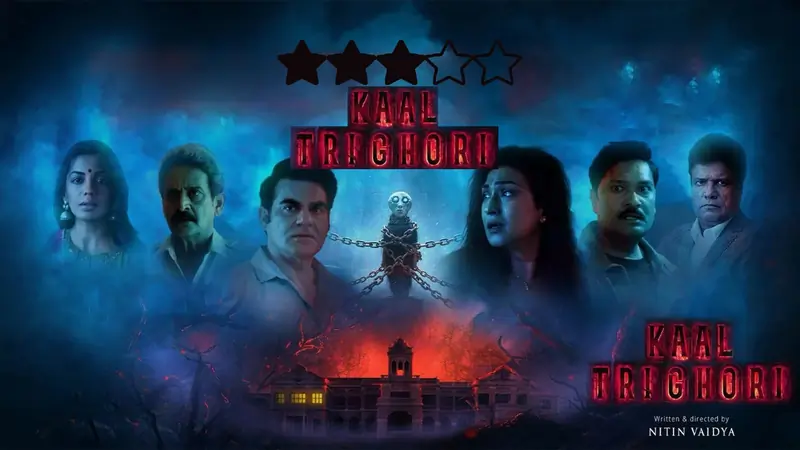
Kaal Trighori
In theaters now
Starcast: Arbaaz Khan, Rituparna Sengupta, Aditya Srivastava, Mahesh Manjrekar, Rajesh Sharma & Mugdha Godse
Director: Nitin N Vaidya
Rating - *** (3/5)
Indian horror often swings between loud jump scares and old school tropes, but this film tries to carve out a stranger, slower and more spiritual path. Nitin N Vaidya steps into the genre with a story that leans heavily on cosmic timing, ancient beliefs and the unnerving idea that some events are far beyond human control.
Instead of throwing ghosts into the frame every few minutes, the film builds its fear from an idea. What if the universe itself chooses a moment to open an old wound.
The narrative revolves around a once in a century alignment of three significant nights in the lunar calendar. The film treats this rare moment not as a superstition but as a force with its own pulse, hinting at an ancient power that stirs whenever these nights fall in the same cycle.
The story is not interested in explaining the science behind it, nor does it insist the audience believe the legend. It simply invites viewers to sit with the possibility that something invisible has been waiting for a long time.
The Mansion That Holds Its Breath

All of this plays out inside an enormous ancestral mansion that carries the weight of many forgotten stories. The setting works almost like a second protagonist. Doors feel too heavy. Silence has a life of its own. Even in daylight, there is a sense that the building is holding its breath.
Into this atmosphere arrive Raviraj, his wife Madhuri and their close friend Dr Manoj. Their visit is meant to be a routine trip, yet a series of strange occurrences begins pulling them into the orbit of the cosmic event.
The film keeps the audience guessing about the nature of the threat. At times the characters appear to be caught in something ancient and divine. At other moments, the plot hints at manipulation by a very human hand.
This uncertainty becomes one of the story's core strengths. Instead of offering quick answers, it constantly shifts the ground beneath the characters, making them question their own fears and beliefs. The more they try to make sense of what is happening, the deeper they sink into a maze that refuses straight lines.
Performances Built on Restraint

Raviraj’s arc is rooted in stillness. Arbaaz Khan plays him like a man who has learned to hide his discomfort behind a steady face. The role gives him enough space to show a different side of himself and he manages it without unnecessary theatrics.
Each time he encounters something strange, he reacts with controlled unease which ends up being far more effective than loud panic.
Rituparna Sengupta brings a quiet turmoil to Madhuri. Her character stands at the intersection of trust and instinct. She wants to rely on logic but senses something that logic cannot break down.
That internal tug gives her performance a rhythm that matches the film’s slow and deliberate mood. Aditya Srivastava plays Dr Manoj with the kind of precision that makes you watch him closely in every scene. He seems scientific, rational and calm, yet the film never fully clarifies whether he is part of the solution or the problem.
Supporting Cast and World Building

Around them, Mahesh Manjrekar, Rajesh Sharma and Mugdha Godse appear in roles that serve the world building more than the plot. They settle into their parts without calling attention to themselves, which helps the story maintain its sense of reality.
Nobody feels like a device created to explain things. Everyone seems to have walked out of some corner of the mansion and joined the story only because the night demanded their presence.
Technically, the film shows impressive discipline. The camera often lingers in narrow halls, dim rooms and foggy exteriors, giving the audience time to absorb the feeling of being trapped inside a place that remembers too much. The lighting swings between shadowy and muted, never drowning the screen in heavy effects. The sound design relies on texture instead of volume.
A small creak can be more unsettling than an orchestra of scare cues. The background score moves like a low heartbeat, rising only when the film needs to jolt the audience back into its rhythm.
A Director Who Trusts His Atmosphere

The most interesting element of the direction is the refusal to explain everything. Nitin N Vaidya seems more interested in the emotional reaction than in creating a puzzle with a clear solution. The film blends mythology with contemporary fears, but it does not marry itself to either side. Instead, it uses both worlds to create a space where anything could be real.
The horror does not come from loud creatures or elaborate effects. It comes from the sense that the characters are standing at the edge of something ancient, something that does not care about their questions.
By the time the final act arrives, the mystery has grown enough to keep the viewer invested. The truth is revealed in a way that respects the slow build and the eerie tone. It never rushes to wrap things neatly. Even when the film ends, a faint residue of doubt remains. That is the kind of fear that stays long after the lights come back on.
Final Word
Kaal Trighori stands out because it tries to honor Indian folklore while speaking to a modern audience. It treats belief as a living thing rather than a relic. The result is a horror film that feels grounded, atmospheric and reflective. It asks the viewer to sit with discomfort instead of running from it.
Join Our WhatsApp Channel
Stay updated with the latest news, gossip, and hot discussions. Be a part of our WhatsApp family now!
Join NowYour reaction
 Nice
Nice Great
Great Loved
Loved LOL
LOL OMG
OMG Cry
Cry Fail
Fail













Post a comment