Lord Mahavir and Jain Religion
Complied by Pravin K. Shah
Jain Study Center of North Carolina 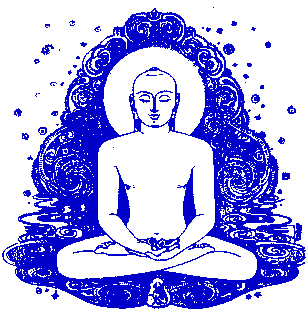 Lord Mahavir
 was the
twenty-fourth and the last Tirthankara of the Jain religion. According to Jain philosophy, all Tirthankaras were born as human beings but they have attained a state of perfection or enlightenment through meditation and self realization. They are the Gods of Jains. Tirthankaras are also known as Arihants or Jinas.

Tirthankara - One who establishes the four fold order (Monk, Nun, Layman, and Laywoman) of religion.
Arihant - One who destroys his inner enemies like anger, greed, passion, ego, etc.
Jina - One who conquers his inner enemies like anger, greed, passion, ego, etc. The followers of Jina are known as Jains. Mahavir was born in 599 B.C. as a prince in Bihar, India. At the age of 30, he left his family and royal household, gave up his worldly possessions, including clothing and become a monk. He spent the next twelve years in deep silence and meditation to conquer his desires and feelings. He went without food for long periods. He carefully avoided harming or annoying other living beings including animals, birds, and plants. His ways of meditation, days of austerities, and mode of behavior furnish a beautiful example for monks and nuns in religious life. His spiritual pursuit lasted for twelve years. At the end he realized perfect perception, knowledge, power, and bliss. This realization is known as keval-jnana. He spent the next thirty years travelling on bare feet around India preaching to the people the eternal truth he realized. He attracted people from all walks of life, rich and poor, kings and commoners, men and women, princes and priests, touchables and untouchables. He organized his followers, into a four fold order, namely monk (Sadhu), nun (Sadhvi), layman (Shravak), and laywoman (Shravika). Later on they are known as Jains. The ultimate objective of his teaching is how one can attain the total freedom from the cycle of birth, life, pain, misery, and death, and achieve the permanent blissful state of one's self. This is also known as liberation, nirvana, absolute freedom, or Moksha. He explained that from eternity, every living being (soul) is in bondage of karmic atoms, that are accumulated by its own good or bad deeds. Under the influence of karma, the soul is habituated to seek pleasures in materialistic belongings and possessions. Which are the deep rooted causes of self-centered violent thoughts, deeds, anger, hatred, greed, and such other vices. These result in accumulating more karma. He preached that right faith (samyak-darshana), right knowledge (samyak-jnana), and right conduct (samyak-charitra) together will help attain the liberation of one's self. At the heart of right conduct for Jains lie the five great vows:
Nonviolence (Ahimsa) - not to cause harm to any living beings
Truthfulness (Satya) - to speak the harmless truth only
Non-stealing (Asteya) - not to take anything not properly given
Chastity (Brahmacharya) - not to indulge in sensual pleasure
Non-possession/Non-attachment (Aparigraha) - complete detachment from people, places, and material things. Jains hold these vows at the center of their lives. The monks and nuns follow these vows strictly and totally, while the common people try to follow the vows as far as their life styles will permit. At the age of 72 (527 B.C.), Lord Mahavir died and his purified soul left the body and achieved complete liberation. He became a Siddha, a pure consciousness, a liberated soul, living for ever in a state of complete bliss. On the night of his salvation, people celebrated the Festival of Lights (Dipavali) in his honor.
Significant points of the life
and teachings of Lord Mahavir.
The spiritual power and moral grandeur of Mahavir's teachings impressed the masses. He made religion simple and natural, free from elaborate ritual complexities. His teachings reflected the popular impulse towards internal beauty and harmony of the soul. His message of nonviolence (Ahimsa), truth (Satya), non-stealing (Achaurya), celibacy (Brahma-charya), and non-possession (Aparigraha) is full of universal compassion. He said that, "A living body is not merely an integration of limbs and flesh but it is the abode of the soul which potentially has perfect perception (Anant-darshana), perfect knowledge (Anant-jnana), perfect power (Anant-virya), and perfect bliss (Anant-sukha)." Mahavir's message reflects freedom and spiritual joy of the living being. Mahavir was quite successful in eradicating from human intellect the conception of God as creator, protector, and destroyer. He also denounced the worship of gods and goddesses as a means of salvation. He taught the idea of supremacy of human life and stressed the importance of the positive attitude of life. Lord Mahavir also preached the gospel of universal love, emphasizing that all living beings, irrespective of their size, shape, and form how spiritually developed or under-developed, are equal and we should love and respect them. Jainism existed before Mahavir, and his teachings were based on those of his predecessors. Thus, unlike Buddha, Mahavir was more of a reformer and propagator of an existing religious order than the founder of a new faith. He followed the well established creed of his predecessor Tirthankara Parshvanath. However, Mahavir did reorganize the philosophical tenets of Jainism to correspond to his times. Lord Mahavir preached five great vows while Lord Parshva preached four great vows. In the matters of spiritual advancement, as envisioned by Mahavir, both men and women are on an equal footing. The lure of renunciation and liberation attracted women as well. Many women followed Mahavir's path and renounced the world in search of ultimate happiness. In a few centuries after Mahavir's nirvana, Jain religious order (Sangha) grew more and more complex. There were schisms on some minor points although they did not affect the original doctrines as preached by the Tirthankars. Later generations saw the introduction of ritualistic complexities which almost placed Mahavir and other Tirthankars on the throne of Hindu deities.
Idol Worship The idols of twenty-four Tirthankaras in the temple are the same because they represent the quality and virtues of Tirthankaras not the physical body. However, at the bottom of each idol a unique symbol is placed to differentiate them. Lord Mahavir's idol is recognized by the symbol of a lion.
Prayer of Jain religion: Every day Jains bow their heads and say their universal prayer, the Navkar-mantra. All good work and events start with this prayer of salutation and worship.
Namo Arihantanam: - I bow to the enlightened souls
Namo Siddhanam: - I bow to the liberated souls
Namo Ayariyanam: - I bow to religious leaders
Namo Uvajjayanam: - I bow to religious teachers
Namo Loe Savva Sahunam: - I bow to all monks of the world
Eso Panch Namukkaro: - These five salutations are capable of
Savva Pava Panasano: destroying all the sins and this is
Mangalancha Savvesin the first happiness among all forms
Padhamam Havai Mangalam: of happiness.
In the above prayer, Jains do not ask for any favors or material benefits from their Gods, the Tirthankaras or from monks and nuns. They do not pray to a specific Tirthankara or monk by name. By saluting them, Jains receive the inspiration from the five benevolent for the right path of true happiness and total freedom from the misery of life.


























 Fan Fictions
 Kyunki Saas Bhi Kabhi Bahu Thi 2
 Anupamaa
 Current Affairs

