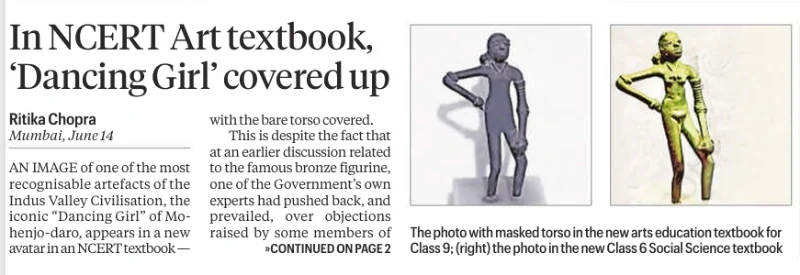
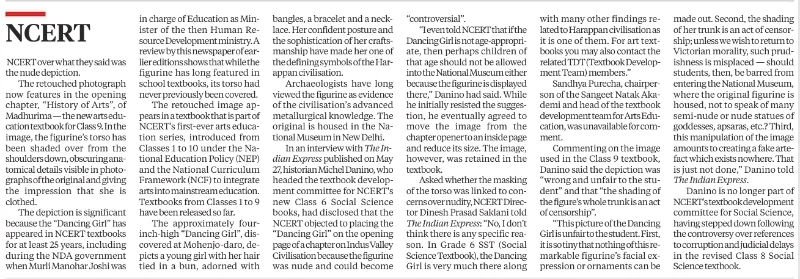
Removing the Dancing Girl from NCERT is a disappointing step. The Indus Valley Civilization's Dancing Girl is not merely a statue; it is a symbol of artistic freedom, confidence, and the cultural sophistication of one of the world's oldest civilizations.
When institutions start altering historical representations to fit present-day sensibilities, it sends the wrong message to students. Education should encourage understanding of our past, not selective discomfort with it. Decisions affecting cultural heritage deserve transparency, debate, and academic reasoning, not such arbitrary moral policing. Erasing such icons risks promoting a narrower and more regressive view of our past. History should be studied, understood, and debated...not selectively hidden.
Not just talks or reports it's happened ...I downloaded textbk from ncert website. Viksit bharat 2047 is gonna happen through open censorship of Indian art and eradication of Indian cuisine from parts of India. People are literally jailed in this country for eating beef and are serving juvie... While some people are let Scott free with an essay writing after killing two people. And this bullshit of ending family incomes in this economy.
Originally posted by: Sanskruthi
Not just talks or reports it's happened ...I downloaded textbk from ncert website. Viksit bharat 2047 is gonna happen through open censorship of Indian art and eradication of Indian cuisine from parts of India. People are literally jailed in this country for eating beef and are serving juvie... While some people are let Scott free with an essay writing after killing two people. And this bullshit of ending family incomes in this economy.
It's a complex topic. Some things i agree with like banning Cow slaughter, not allowing sale of meat & alcohol near temples. But writing veg pulao instead of Biryani is kinda stupid.
I'm a vegetarian myself, and i also support vegetarianism but i don't support enforcing vegetarianism on others against their wish.
Originally posted by: NathuPaapi
It's a complex topic. Some things i agree with like banning Cow slaughter, not allowing sale of meat & alcohol near temples. But writing veg pulao instead of Biryani is kinda stupid.
I'm a vegetarian myself, and i also support vegetarianism but i don't support enforcing vegetarianism on others against their wish.
I agree with not consuming and regulating meat in religious areas but many religious people also do eat meat. It's the sheer hypocrisy I was pointing out. Awadhi cuisine is a huge part of Indian cuisine how can it not make a cut in state cuisine?
Originally posted by: Sanskruthi
I agree with not consuming and regulating meat in religious areas but many religious people also do eat meat. It's the sheer hypocrisy I was pointing out. Awadhi cuisine is a huge part of Indian cuisine how can it not make a cut in state cuisine?
Yes many religious people do eat meat. There are branches like Vama marga of Tantra where not just eating meat but also animal sacrifice is a part of tradition. However eating meat or animal sacrifice is generally discouraged in Sanatan Dharma's Vedic practices or right hand practices (dakshin marga), which most temples follow (at least in UP, afaik).
Being from Lucknow, I agree that a big part of Awadhi cuisine compromises of non veg items especially the various types of kebabs. They should have been included.
The question of vegetarian and non-vegetarian food in Hindu rituals is complex as rightly mentioned by NP. because Hinduism is not a single uniform tradition. Different scriptures, regions, communities, and sects have followed different practices over thousands of years.
Some Hindu traditions, especially certain Shakta and folk traditions, have historically included animal sacrifice and non-vegetarian offerings to deities such as Kali and Durga in specific regions. Ancient Vedic texts and historical records indicate that meat consumption and animal sacrifices were practiced in certain ritual contexts. Even today, some Hindu communities consider such practices part of their inherited religious customs.
There is no single universally accepted Hindu rule declaring that only vegetarian offerings are correct.
In matters of faith and tradition, the government should not impose a single practice on all communities. Religious customs that have been followed for generations should be respected, provided they do not violate fundamental laws or the rights of others. Cultural and religious diversity is a strength, and people should have the freedom to follow their own traditions. Whether one follows a vegetarian or non-vegetarian tradition, respect for differing practices within Hinduism helps preserve its diversity.
I am a strict vegetarian, yet I respect the traditions and cultures of those who are not. Diversity in food habits is a part of human society, and respecting others' choices is a mark of adjustment and tolerance.
In some Bengali Hindu traditions, fish is offered or served during Shraddha (ancestral rites), though practices vary by family, region, and community. This diversity reflects a broader feature of Hindu traditions >> ritual practices often differ according to local customs (deshachara), family traditions (kulachara), and sectarian beliefs.
Originally posted by: Viswasruti
The question of vegetarian and non-vegetarian food in Hindu rituals is complex as rightly mentioned by NP. because Hinduism is not a single uniform tradition. Different scriptures, regions, communities, and sects have followed different practices over thousands of years.
Some Hindu traditions, especially certain Shakta and folk traditions, have historically included animal sacrifice and non-vegetarian offerings to deities such as Kali and Durga in specific regions. Ancient Vedic texts and historical records indicate that meat consumption and animal sacrifices were practiced in certain ritual contexts. Even today, some Hindu communities consider such practices part of their inherited religious customs.
There is no single universally accepted Hindu rule declaring that only vegetarian offerings are correct.
In matters of faith and tradition, the government should not impose a single practice on all communities. Religious customs that have been followed for generations should be respected, provided they do not violate fundamental laws or the rights of others. Cultural and religious diversity is a strength, and people should have the freedom to follow their own traditions. Whether one follows a vegetarian or non-vegetarian tradition, respect for differing practices within Hinduism helps preserve its diversity.
I am a strict vegetarian, yet I respect the traditions and cultures of those who are not. Diversity in food habits is a part of human society, and respecting others' choices is a mark of adjustment and tolerance.
In some Bengali Hindu traditions, fish is offered or served during Shraddha (ancestral rites), though practices vary by family, region, and community. This diversity reflects a broader feature of Hindu traditions >> ritual practices often differ according to local customs (deshachara), family traditions (kulachara), and sectarian beliefs.
Exactly... I don't know why Awadhi cuisine is neglected and why dancing girl is covered. This is not what a good developing country should do.
I do love my mutton kadhai, kebabs and Nihari. And there is this kasmiri pandit cuisine of rogan gosh. I love it! And I'm a disciplined Shiva devotee too.
Being from middle class general category, I totally understand where u are coming from. I agree with most of the things you wrote.
The only things i would still want is to declare Cow the national animal and ban it's slaughter. I also support that selling of alcohol and meat near temples should be discouraged, just like selling of cigarettes near schools and colleges shouldn't be allowed. I don't mean that all meat shops must be relocated outside the city, just don't allow alcohol & meat shops, in a certain radius, near temple or schools (specifically for alcohol).
P.s. - from whatever cases I've seen on Twitter, Bajrang dal seems to be doing some good work in cases of Love Jihad.





 I think I shouldn't be surprised, after all CBSE doesn't think an easily hackable data is anything to worry about because exams are offline.





 Anupamaa
 Cricket
 Iss Pyaar Ko Kya Naam Doon

