image and sentence formation credit to chat gpt
Blood Faced Blood
The forest surrounding Valmiki’s hermitage rested in a silence so deep it felt sacred—like the world itself was holding its breath. Leaves barely stirred, the wind whispered softly, and even the birds seemed hesitant to break the stillness.

Then, far away at first, came a tremor.
Not of nature—
but of men.
War was approaching.
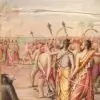
The earth began to shudder beneath the advancing army of Ayodhya. Chariot wheels carved into the soil, armor clashed in steady rhythm, and rising dust blurred the horizon. At the forefront stood Shatrughn—firm, composed, and commanding, his presence as sharp as the weapons he carried.
Before this massive force stood two young boys.
Lav and Kush.
Still. Calm. Watching.

A black horse tied to a tree with a message written on a cloth kept on its back.
The message was from Ayodhya.

Shatrughn studied them carefully, his gaze narrowing. These were no ordinary children—yet they stood where warriors should stand, unafraid before an army.
He spoke, his tone measured but edged with authority:
“Children, you stand before the army of Ayodhya. This is no place for you. Step aside. Release the sacred horse and return to your hermitage. No harm will come to you.”
Kush glanced at Lav, a faint smile passing between them—silent understanding.
Lav stepped forward, folding his hands briefly in respect before speaking, his voice soft but unwavering:
“We know who you are, noble warrior. And we honor your strength. But this horse entered our land freely. By the law it carries, we are bound to challenge its claim.”

A murmur spread through the soldiers.
Shatrughn’s expression hardened slightly.
“You speak of law?” he said. “Do you understand what you challenge? This is the Ashwamedha horse of Ayodhya. To stop it is to invite war. Think carefully—this path leads only to ruin.”
Kush stepped forward now, his tone calm yet firm:
“War does not begin with us. It begins with those who believe strength alone decides truth.”
Lav continued, his eyes steady:
“If the horse claims dominion, then let that claim be tested. If Ayodhya’s power is unquestionable, then surely it has nothing to fear from two boys.”
A ripple of laughter broke out among the soldiers—mocking, careless.
Shatrughn raised his hand, silencing them. His gaze remained fixed on the twins.
“You are either brave… or unaware,” he said quietly. “I will give you one last chance. Step away.”
Lav’s reply came like still water hiding depth:
“We do not step away from what is right.”
Kush added,
“And we do not fear what must be faced.”
For a moment, silence stretched between them—heavy, charged.
Then Shatrughn lowered his hand.
“So be it.”
And just like that—
the stillness broke.
What followed was not merely battle—it was revelation.
Arrows did not simply fly; they moved with purpose, as if guided by something beyond sight. Each one cut through the air with precision, striking exactly where it must. Chariots splintered, banners fell, and seasoned warriors faltered before they could even understand what was happening.
Shatrughn advanced like a storm, swift and relentless—but every strike he attempted dissolved before it could fully form. It was as though the twins were not reacting, but already knew.

Then came the moment that shifted everything.
His bow snapped.
His chariot shattered.
His strength—neutralized without cruelty.
Celestial arrow striked him in place—not to injure, but to declare something undeniable.

And silence returned.
Not the silence of defeat—
but of realization.
When Lakshman entered the forest, the atmosphere changed again—but this time, it deepened. The wind curved gently around him, as if recognizing his presence. His steps were steady, controlled, each one carrying discipline shaped over years of loyalty and sacrifice.
Yet something unsettled stirred within him.
As his eyes fell upon Lav and Kush, a strange familiarity arose—something he could not name.
Before the battle began, he spoke, his voice firm but not unkind:
“You have already faced a great warrior and prevailed. That alone speaks of your skill. But this must end here. Return the horse. Do not force this further.”

Lav and Kush exchanged a glance again.
Kush spoke first this time:
“If ending this means abandoning what we believe is right, then it cannot end.”
Lakshman’s brows furrowed slightly.
“You speak of righteousness,” he said. “But righteousness also demands wisdom. Not every battle needs to be fought.”
Lav responded gently:
“And not every battle can be avoided.”
A pause followed.
Lakshman exhaled slowly, then raised his bow.
“Then show me the strength behind your words.”
The clash that followed shook the very sky.

His arrows burned with intensity, carrying the weight of years. Yet Lav and Kush moved in perfect harmony—like reflections in motion.

Then Kush released a single arrow—subtle, yet profound. It did not wound Lakshman’s body, but drained his strength.
For the first time—
he faltered.
Lav stepped forward and disarmed him without force, only certainty.
Lakshman dropped to one knee—not defeated, but deeply shaken.
And in that moment, he saw them clearly—
not as children,
but as something far greater.
Bharat’s arrival carried a different weight altogether.
He did not rush forward.
He did not display anger.
Instead, he approached with quiet gravity.
Before lifting his bow, he spoke:

“Young warriors… you have shown extraordinary strength. But strength alone does not define truth. Tell me—what do you seek from this path?”
Lav answered softly,
“We seek nothing but to stand by what is just.”
Kush added,
“And to question what claims authority without challenge.”
Bharat’s eyes softened, though his resolve did not.
“Then understand this—dharma is not always clear. It is often a burden, not a victory.”
Lav replied,
“Then let this battle be a question… and its outcome, the answer.”
Bharat nodded slowly.
“So be it.”
Their battle unfolded not with fury, but with depth—each movement thoughtful, each strike meaningful.

Bharat’s defenses unraveled—not violently, but inevitably.
And when he was restrained, he bowed—not in defeat, but in acceptance.

Then Ram came.
And the world itself seemed to pause.
Before any weapon was raised, he looked at the twins for a long moment.
Something within him stirred—deep, unspoken.
He finally spoke, his voice calm yet searching:
“Who are you?”
Lav and Kush hesitated—not out of fear, but confusion of their own.
Kush answered,
“We are students of the forest. Disciples of truth.”
Ram stepped closer, his gaze intense.
“Why do you feel… familiar?”

Lav’s voice softened:
“We could ask the same.”
A silence followed—heavy, almost fragile.
Then duty took hold.
The battle was about to began.
For the first time, Ram faced not resistance—but reflection.

And within both sides, something resisted the fight itself.
Until—
Valmiki stepped forward.
And spoke the truth.
Not loudly.
Not forcefully.
But with a clarity that ended everything.

Weapons fell.
Breaths trembled.
Ram stood still—overwhelmed.
They were not strangers.
Not opponents.
They were his sons.
And the battlefield dissolved—not into victory,
but into truth.
These were never just battles.
They were revelations.

Each clash was a question.
Each fall, an answer.
Not about strength—
but about identity, truth, and the moment when both finally meet.
The sage poured divine water on the fallen warriors and they came back to senses.
Everyone was overwhelmed by the revelation and courage of the boys.
Edited by cuteamanboy - 2 days ago
















 Writers Corner: Books, Stories & Poems
 Seher Hone Ko Hai
 Current Affairs

