


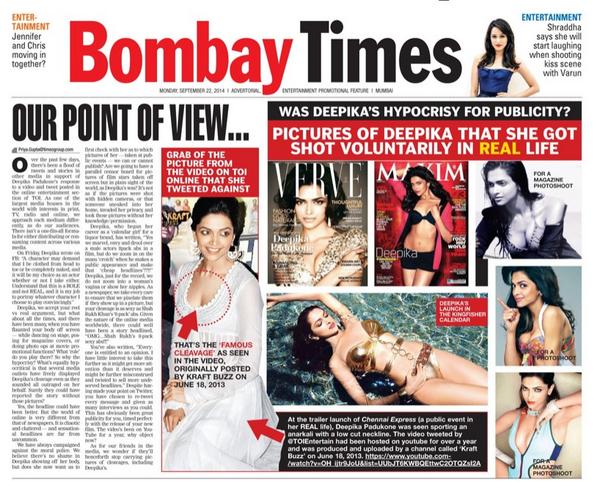
with more red arrows and circling 😆
Dear Deepika, our point of view...
Priya GuptaOver the past few days, there's been a flood of tweets and stories in other media in support of Deepika Padukone's response to a video and tweet posted in the online entertainment section of TOI.
As one of the largest media houses in the world with interests in print, TV, radio and online, we approach each medium differently, as do our audiences. There isn't a one-fits-all formula for either distributing or consuming content across various media.
On Friday, Deepika wrote on FB: "A character may demand that I be clothed from head to toe or be completely naked, and it will be my choice as an actor whether or not I take either. Understand that this is a ROLE and not REAL, and it is my job to portray whatever character I choose to play convincingly.''
Deepika, we accept your reel vs real argument, but what about all the times, and there have been many, when you have flaunted your body off screen " while dancing on stage, posing for magazine covers, or doing photo ops at movie promotional functions? What 'role' do you play there? So why the hypocrisy? What's equally hypocritical is that several media outlets have freely displayed Deepika's cleavage even as they sounded all outraged on her behalf. Surely they could have reported the story without those pictures?
Yes, the headline could have been better. But the world of online is very different from that of newspapers. It is chaotic and cluttered " and sensational headlines are far from uncommon.
We have always campaigned against the moral police. We believe there's no shame in Deepika showing off her body, but does she now want us to first check with her as to which pictures of her " taken at public events " we can or cannot publish? Are we going to have a parallel censor board for pictures of film stars taken off screen but in plain sight of the world, as Deepika's was? It's not as if the pictures were shot with hidden cameras, or that someone sneaked into her home, invaded her privacy, and took those pictures without her knowledge/permission.
Deepika, who began her career as a 'calendar girl' for a liquor brand, has written, ''Yes we marvel, envy and drool over a male actors 8pack abs in a film, but do we zoom in on the mans 'crotch' when he makes a public appearance and make that 'cheap headlines'??!!'' Deepika, just for the record, we do not zoom into a woman's vagina or show her nipples. As a newspaper, we take every care to ensure that we pixelate them if they show up in a picture, but your cleavage is as sexy as Shah Rukh Khan's '8-pack' abs. Given the nature of the online media worldwide, there could well have been a story headlined, "OMG...Shah Rukh's 8-pack sexy abs!!!" You've also written, ''Everyone is entitled to an opinion. I have little interest to take this further as it might get more attention than it deserves and might be further misconstrued and twisted to sell more undeserved headlines.'' Despite having made your point on Twitter, you have chosen to re-tweet every message and given as many interviews as you could. This has obviously been great publicity for you, timed perfectly with the release of your new film. The video's been on YouTube for a year, why object now?
As for our friends in the media, we wonder if they'll henceforth stop carrying pictures of cleavages, including Deepika's.
DNA Argues 😆
TOI responds to Deepika Padukone again;
lack of journalistic ethics flow
Monday, 22 September 2014 - 2:36am IST Updated: Monday, 22 September 2014 - 2:38am IST | Place: Mumbai | Agency: DNA Webdesk
DNA Web Team
The Times of India has come up with bizarre reasoning to defend their point of view in the ongoing tussle with Deepika Padukone regarding a controversial video.
In an article titled, "Dear Deepika, Our Point of View", TOI takes recourse to a two pronged strategy to defend themselves.
First, they claim that Deepika is a hypocrite since she flaunts her body even outside of movies - on magazines, in dance shows etc. This is in response to Deepika's comment that what she does on screen is not real, it's reel, that it is a role.
Thus, the newspaper in a way implies that they are perfectly entitled to zoom onto her cleavage because she flaunts it on occasions in real life too. There is a basic flaw in this argument which TOI seems to have deliberately overlooked, but we'll get to that later.
Next TOI gives us a masterclass in online journalism, and how sensational headlines are imperative to break through the clutter. Yes, so are they admitting that their initial tweet was meant to sensationalise Deepika's cleavage?
Moreover, TOI's implicit argument that other media houses indulge in similar practices is hollow - if those around you indulge in unethical activities it does not justify your ethical failings.
TOI then slightly mellows down to concede that their heading in that infamous video could have been better (as if this constitutes an apology and could not have come earlier).
But soon that changes into a full attack on Deepika Padukone. The paper accuses Deepika of moral policing (their favourite buzzword since about 2007) and then makes a classic gaffe saying the pictures were not taken without her consent. Obviously one finds it bit too hard to believe that Deepika gave consent to shoot a top angle shot of her cleavage.
Here's the problem - TOI fails to (or refuses to?) understand the difference between sensual images published as they were shot, and purposeful modification of angles to make the images look vulgar. The TOI video did the latter, but they are silent about this. So when TOI claims it did not invade Deepika's privacy or install secret cameras to prepare the video, it forgets that it modified the way in which the pictures were displayed, to suit its own voyeuristic imagination and attain cheap hits for its online pages. By inference, the element of consent is under a cloud because the images were probably not presented in the manner in which they were originally shot.
The TOI article then sinks lower down the pit of unethical journalism, talking about how Deepika started her career as a "calendar girl" for a liquor brand. This is degrading on two levels. Firstly, it seems to assume that a calendar model should have no issue being objectified courtesy her profession. It's a free-for-all when you are a calendar model, you see.
Secondly, it is interesting that the author mentions that Deepika promoted a liquor brand as a model. There was no need for the specific mention of liquor. Are we supposed to interpret that women who promote liquor are women of dubious virtue, and hence it is okay to objectify them?
Then, TOI calls the outrage a publicity stunt to coincide with her movie Finding Fanny. Interestingly, the summary of this article forgot to mention that the outrage came not just from Deepika but from people on social media too. Perhaps they too were involved in a publicity stunt, TOI? I
Lastly, we noticed that the article was carried on the front page of their supplement Bombay Times. The images used in that article are suggestive to say the least, but the fact that they are placed there shows a deliberate intent to malign Deepika and obstinately continue with the trend of commodification.
The article ends by questioning the timing of the outrage saying the video was on Youtubefor a year, and questioning why Deepika did not object for so long. Well, by TOI's own admission the web is cluttered, so may be the video escaped everybody's attention till TOI decided to dig it out of their voyeuristic grave.
Thus, in their entire argument TOI misses out on the point of consent, and rather tries to shift the goalpost by accusing Deepika of creating outrage for publicity.
By ignoring the idea of consent, TOI puts itself in the league of innumerable politicians, public figures and entities which condemn women who suffer harassment or rape by claiming they were "asking for it" in some way. So much then for TOI creating an uproar time and again against those very politicians and entities, with headlines adorning their pages and television anchors holding audiences in thrall through shrill, opinionated debates centred around these issues.
Hypocrisy, much?















 Udne Ki Aasha
 Anupamaa


0