




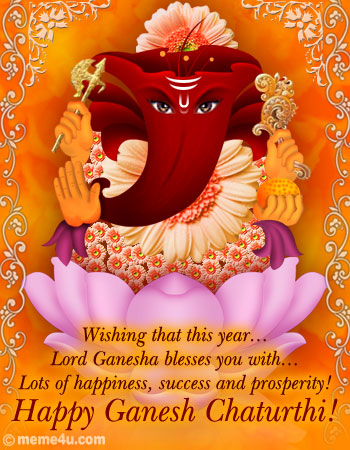
Om Shri Ganeshaay Namah...
Soon after, Shiva (Lord of destruction and husband of Parvati) came to see Parvati but the young boy blocked his way and would not let him in. Shiva, unaware that this lad was his son, became furious and in great anger fought with this boy whose head got severed from his body in the ensuing battle. Parvati, returning from her bath, saw her headless son and threatened in her rage to destroy the heavens and the earth, so great was her sorrow.
Shiva pacified her and instructed his followers (known as Ganas) to bring the head of the first living being they encounter. The first creature they encountered was an elephant. They thus cut off its head and placed it on the body of Parvati's son and breathed life into him. Thus overjoyed, Parvati embraced her son.
The son of Parvati was given the name Ganesh or Ganapati by Lord Shiva. The word Ganesh is made up of gana (followers of Shiva) and isha (lord), thus Shiva appointed him the lord of his ganas. Shiva also bestowed a boon that people would worship him and invoke his name before undertaking any venture.
- Elephant head, wide mouth, and large ears: the large head of an elephant symbolizes wisdom, understanding, and a discriminating intellect that one must possess to attain perfection in life. The wide mouth represents the natural human desire to enjoy life in the world. The large ears signify that a perfect person is the one who possesses a great capacity to listen to others and assimilate ideas.
- The trunk and two tusks with the left tusk broken: there is no known human instrument that has an operating range as wide as that of an elephant's trunk. It can uproot a tree and yet lift a needle off the ground. Likewise, the human mind must be strong enough to face the ups and downs of the external world and yet delicate enough to explore the subtle realms of the inner world. The two tusks denote the two aspects of the human personality, wisdom and emotion. The right tusk represents wisdom and the left tusk represents emotion. The broken left tusk conveys the idea that one must conquer emotions with wisdom to attain perfection.
- Elephant eyes: the elephant eyes are said to possess natural deceptiveness that allows them to perceive objects to be bigger than what they really are. Thus the elephant eyes symbolize the idea that even if an individual gets "bigger and bigger" in wealth and wisdom, he should perceive others to be bigger than himself; that is, surrender one's pride and attain humility.
- The four arms and various objects in the four hands: the four arms indicate that the Lord is omnipresent and omnipotent. The left side of the body symbolizes emotion and the right side symbolizes reason. An axe in the upper left hand and a lotus in the upper right hand signify that in order to attain spiritual perfection, one should cut worldly attachments and conquer emotions. This enables one to live in the world without being affected by earthly temptations, just as a lotus remains in water but is not affected by it. A tray of Laddus (a popular snack) near the Lord denotes that He bestows wealth and prosperity upon His devotees. The lower right hand is shown in a blessing pose, which signifies that Ganesha always blesses His devotees.
- A human body with a big belly: the human body possesses a human heart, which is a symbol of kindness and compassion toward all. Ganesha's body is usually portrayed wearing red and yellow clothes. Yellow symbolizes purity, peace and truthfulness. Red symbolizes the activity in the world. These are the qualities of a perfect person who perforrns all duties in the world, with purity, peace, and truthfulness. The big belly signifies that a perfect individual must have a large capacity to face all pleasant and unpleasant experiences of the world.
- A mouse sitting near the feet of Ganesha and gazing at the tray of Laddoos: a mouse symbalizes the ego that can nibble all that is good and noble in a person. A mouse sitting near the feet of Ganesha indicates that a perfect person is one who has conquered his (or her) ego. A mouse gazing at the Laddus, but not consuming them, denotes that a purified or controlled ego can live in the world without being affected by the worldly temptations. The mouse is also the vehicle of Ganesha, signifying that one must control ego in order for wisdom to shine forth.
- Right foot dangling over the left foot: as stated above, the left side of the body symbolizes emotion and the right side symbolizes reason and knowledge. The right foot dangling over the left foot illustrates that in order to live a successful life one should utilize knowledge and reason to overcome emotions.
Shri Ganesh is the symbol of auspiciousness He is the Lord of success and destroyer of evils and remover of obstacles.Ganesh is also the destroyer of vanity, selfishness and pride.He is the personification of material universe in all its various magnificent manifestations.











 Shiva wanted to test them by setting the task where each would go around the universe and come back first. Kumaraswamy immediately started off on voyage on his peacock, but Gajanana knowing that he can not go round so fast on his rat, prayed to Shiva and went around (Pradakshinas) his parents. "Going around you, who represent the entire manifested universe, is equivalent of going around the universe!"
  Thus the dispute was settled in favour of Ganesh. Ganesh, who is now the elected leader of the Deva Ganas is thus also known as Ganapati ' 'chief of the celestial army.' The day on which he was crowned as Ganapati happened to be the Chaviti (fourth) day of the month of Bhadrapada.
  Ganesh is very fond of sweet pudding or balls of rice flour with a sweet core. On one of his birthdays, he was going around accepting the offerings of sweet puddings. Having eaten a good number of these, he set out moving on his mouse late in the night. The mouse saw a snake in the dark and got startled - dropping Ganesh in the process. Ganesh's stomach burst open, leading to his death. The moon, observing all this, burst out laughing.
  The story goes like this: Once lord Krishna saw the reflection of the Moon in a milk pot on Vinayaka Chaviti day. He was subjected to false accusations that he killed a King for the sake of a precious stone. To prove himself Krishna had to wage a fierce fight with Jambavantha. However, as Krishna was a king and powerful, he could come clear of the false accusations. People wondered that they would not be able to clear themselves of false accusations like Krishna did. They prayed to the sages for a remedy to save them from the curse of goddess Parvati.







 Health and Fitness
 Tum Se Tum Tak

