

Azad Bharath Review A Stirring Tribute To Courage Beyond Textbooks
Set during the rise of Subhas Chandra Bose’s Indian National Army, the film traces the journey of Neera Arya, one of the lesser-known figures from the Rani of Jhansi Regiment.
Published: Friday,Jan 02, 2026 07:45 AM GMT+05:30

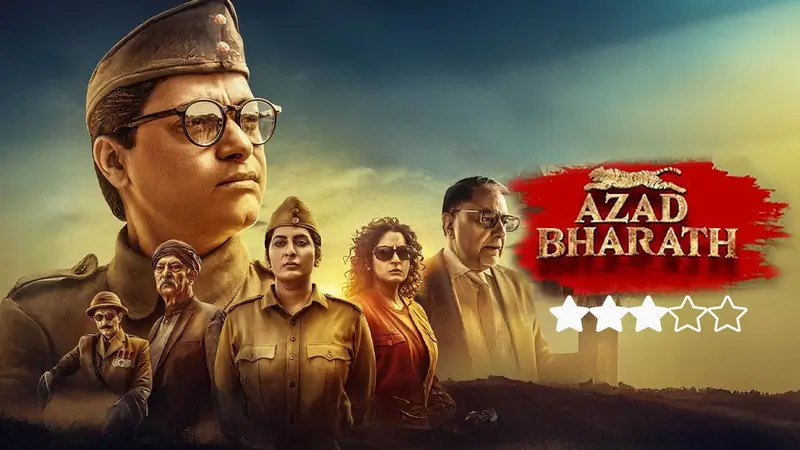
Azad Bharath
In theaters now
Cast : Shreyas Talpade, Suresh Oberoi, Roopa Iyer, Indira Tiwari, Dr. Subhash Chandra, Priyanshu Chatterjee, Suchendra Prasad
Director: Roopa Iyer
Producer: Roopa Iyer, Jaya Gopal AB, Rajendra Rajan
Runtime: 2 hours
Rating - *** (3/5)
Most Hindi films on India’s independence movement return to familiar names and familiar beats. Azad Bharath takes a different route by shifting attention toward the women who operated away from applause, carrying responsibility rather than recognition. The film frames freedom as lived experience instead of legend, and that choice shapes its emotional spine.
Set during the rise of Subhas Chandra Bose’s Indian National Army, the film traces the journey of Neera Arya, one of the lesser-known figures from the Rani of Jhansi Regiment. It is not mounted as a grand historical spectacle but as a personal reckoning, where loyalty, ideology, and sacrifice constantly clash. That focus keeps the film grounded, even when it occasionally reaches beyond its grasp.
Netaji And The Supporting Pillars

Shreyas Talpade steps into the role of Subhas Chandra Bose with surprising composure. Rather than attempting imitation, he focuses on quiet authority. His Netaji listens more than he speaks, observes more than he commands. This interpretation works because it aligns with the film’s intent to humanise history rather than mythologise it.
Talpade’s scenes function best when he is placed on the margins of action, reinforcing belief without dominating the frame. It is a measured performance that avoids exaggeration, even if the screenplay sometimes limits his scope.
The supporting cast lends stability to the film’s emotional structure. Suresh Oberoi brings warmth and gravity, while Indira Tiwari adds nuance to the regiment’s internal dynamics. Their presence helps ground the narrative, especially during sections that risk becoming too message-driven.
Roopa Iyer Leads From The Front

Roopa Iyer wears multiple hats here as director, writer, and lead actor, yet Azad Bharath rarely slips into self-indulgence. Her portrayal of Neera Arya is firm and layered, shaped by conviction but also inner conflict. Neera is not written as a symbol meant only to inspire. She is allowed doubt, anger, and emotional contradiction, which gives the character weight beyond patriotic imagery.
The film’s most striking stretch arrives when Neera’s political commitment collides with her personal life. Her confrontation with her husband Shrikant, played by Priyanshu Chatterjee, is staged as a battle of belief systems rather than melodrama. The tension here feels earned because it reflects the real cost of choosing a cause over comfort. These scenes add texture to the narrative and prevent the film from becoming a simple tale of heroism.
Iyer’s performance benefits from restraint. Instead of heightened theatrics, she relies on controlled expressions and physical presence. At times, the writing pushes her into overtly declarative moments, but she mostly keeps Neera rooted in emotional truth. This balance becomes one of the film’s strengths.
Direction That Chooses Immersion Over Scale

Azad Bharath does not chase visual grandeur. Roopa Iyer’s direction leans toward immersion, using training sequences, covert missions, and wartime preparation to build atmosphere. The camerawork feels intimate, often placing viewers close to the characters rather than the conflict itself. This approach suits the film’s intent, even if the limited scale occasionally shows.
The screenplay draws from real incidents but structures them with dramatic tension rather than historical listing. Moments of secrecy, coded communication, and ethical compromise are used to keep the audience engaged. The film suggests that the freedom struggle was not always fought in open fields but often in isolation and silence.
Music supports this vision without overpowering it. Patriotic tracks like Jai Ho are placed carefully, enhancing emotional beats instead of interrupting the flow. The dialogues aim to inspire but mostly avoid sermonising, though a few lines lean heavily into rhetoric.
The Final Verdict
As a whole, Azad Bharath earns its three stars through intent, sincerity, and focus. It does not always achieve narrative sharpness, and some stretches could have benefited from tighter pacing. Yet its commitment to spotlighting forgotten women of the independence movement gives it relevance and emotional pull. The film may not redefine the genre, but it adds a necessary chapter to it, reminding viewers that freedom was built by many voices, not just the loudest ones.
Poll
Are you planning to watch Azad Bharath in theaters this weekend?
Join Our WhatsApp Channel
Stay updated with the latest news, gossip, and hot discussions. Be a part of our WhatsApp family now!
Join NowYour reaction
 Nice
Nice Great
Great Loved
Loved LOL
LOL OMG
OMG Cry
Cry Fail
Fail












Post a comment