FAMILY vs BHAI 8.12
SACCHA PYAAR 9.12 DT pg 18

GK kya karega ? GK tropy le gaya - 🏆

Jitesh Pillai openly disses the ‘sore loser’ Ranveer on Instagram
Still not recovered from MC Stan Trauma now another undeserving winner

🏏South Africa tour of India 2025: India vs SA - 1st T20I🏏

🎉Happy 22nd Birthday India Forums🎊🎈Born of Stardust, Grown by Us🌟
Paresh Rawal blasts Anupama Chopra over Dharundar Review.
Honest Opinion on the Finalist Rankings
Jatinder from PV calls out Harminder from BoI for bias against Ranveer
Deepika in Mahavatar
negative reviews being pulled down 😭

Kavach Mahashivratri FF ~ Chapter 3 on pg 2
Every country has its own language and its own history. But there is much more than this: Every country even has its own clothing. For example there is the German traditional clothing: German people are well-known for their clothes and many foreigners only think of German people in "Tracht". But German traditional clothing depends on the geographic area. There is not only one way of German clothing, there are many styles. For example German traditional clothes in Bavaria are lederhosen and dirndl, but in the Black Forest theres also kind of "Tracht" which deviates from the Bavarian style. But dirndls and dirndl-style dresses are popular in many parts of Germany and can be considered as an important part of German traditional clothing.
http://www.oktoberfest-dirndl-shop.co.uk/german-traditional-clothing
Full List of cloths-check the down link..
Traditional German Clothing for Men
There is a difference between clothes worn daily and what is worn as part of one's heritage and tradition. National costumes or dresses vary from country to country and even regionally, with different styles being adopted in different areas of the same country. Scroll below to learn which clothes make up traditional menswear in the European nation of Germany.
Read more at Buzzle: http://www.buzzle.com/articles/traditional-german-clothing-for-men.html
http://www.buzzle.com/articles/traditional-german-clothing-for-men.html
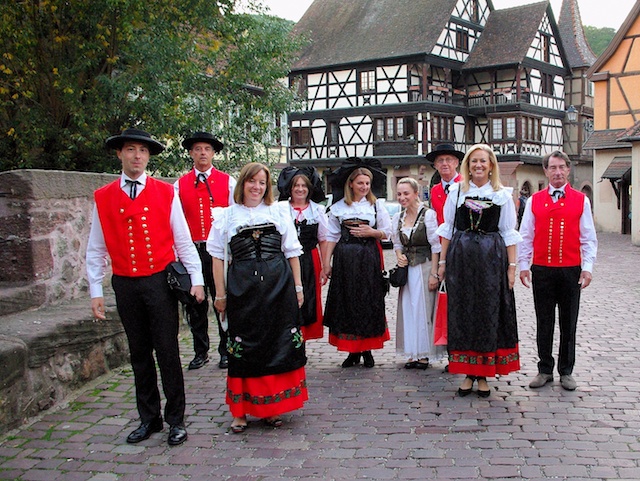
| Historic events, since 1870, have coined a picture of the Alsatian girl wearing a big bow, which became a national symbol. |
| Shirts : are being worn since the 17th century, first linen, then cotton, trimmed with a narrow ruff and a slight low neckline. In the 18th century the sleeves are long and puffed out, tied at the end by ribbons. Ruff : The ruff worn by the women can be squared or rounded according to the places, edged by the same lace as the shirt. Skirts : The skirt's length color and decoration depend on religious beliefs. First bicolor, then, since 1830, only one shade. For the Protestants : the skirt is half long, hemmed by a velvet ribbon. Color : green, purple, brown, blue, even red. For the Catholics : the skirt is long, hemmed by black velvet, no ribbon. Color : madder red for girls. The wives and the aged wore deep colored skirts, but never green. Corselet : often in precious material, is laced in front, fastened by a hook or tied by a silk ribbon. False shirt front : worn behind the laces of the corselet. It is lavishly adorned with ribbons, colored glasses or sequins. The seamstresses made often real masterpieces. The false shirt front was and is always a spot to hide treasures : love letters, poetries, lace handkerchiefs... and rosemary sprigs to avoid sleeping during the offices. |
Shirt : comes from the long linen or cotton shirt worn by peasants. First stiff collar, then soft collar. The sleeves are long and pleated. Pants : First "culottes" and gaiters coming from the Revolution era, then long and tight, black, blue, green woolen trousers opened on each leg and buttoned in some villages. Today the pants are larger. Shoes : First leather boots. Then shoes with buckle worn with hand knitted white socks. Finally laced shoes with large heels. Vest (Waistcoat) : The principal part of the man costume, coming from the bloody peasant war of the 16th century. In that time it was only a piece of red material worn on the breast by countrymen. Since 1780, this piece has become a vest with many buttons. Young people wore a red vest, older one liked better dark colored vest. Hat : Different types. 19th century : black felt with large brims, hand knitted bonnet. Fur hat (polecat or marten fur), black felt hat with a not so large brim and a flat crown. This last hat is still worn. |
The term highland dress describes the traditional dress of Scotland. It is often characterised by tartan (plaid in North America) patterns in some form.
Male highland dress includes kilt (or trews), sporran, sgian dubh and ghillies. Ghillies, or ghillie brogues, are traditional thick soled shoes with no tongues and long laces. The laces are wrapped around and tied above the wearer's ankles so that the shoes do not get pulled off in mud. The shoes lack tongues so the wearer's feet can dry more quickly in typically damp Scottish weather. The ghillie brogue is named after the ghillie, the traditional Scottish gamekeeper and outdoorsman.
Female highland dress includes women's shoes, also called ghillies, that are tied in the same way but have thin soles for indoor wear and dancing. Traditionally, women and girls do not wear kilts but may wear ankle-length tartan skirts. A tartan sash or shawl may also be worn. Women may also wear dress tartans which are modified versions which include white in place of a more prominent colour.
History
In 1618, a poet from London, John Taylor described the costume of Scottish aristocrats, lairds, and their followers and servants, dressed for hunting at Braemar. In August and September, all classes dressed in the same fashion by custom, as if equals. This included tartan stockings and jerkins, with garters of twisted straw, and a finer plaid mantle round their shoulders. They had knotted handkerchiefs at their necks and wore blue caps. Taylor said the tartan was "warm stuff of diverse colours."[1]

Near the end of the seventeenth century, Martin Martin gave a description of traditional women's clothing in the Western Islands, thearisaid with its brooches and buckles.
The morning suit version of Highland dress consists of:

Traditionally, black tie Scots Highland dress comprises:
The traditional[dubious " discuss] white-tie version of Highland dress consists of:































 Kyunki Saas Bhi Kabhi Bahu Thi 2
 Sports
 Hindi TV Shows

